Relationship between Thoughts, Emotions, & Events
Goal
To be able to more readily identify thoughts and emotions
Interpretation of Events (Turk & Winter, p. 130)
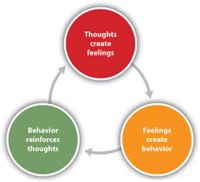 Events can be interpreted in different ways. The interpretation changes the way we view reality and influences our emotional reaction. In other words, the way you think about your chronic pain impacts how you feel about it as well as how you behave. If you struggle to see the connection between specific thoughts and feelings, it is likely because the thoughts have become automatic-resulting in only noticing the subsequent feeling.
ABC Exercise (Barlow, p. 94; Turk & Winter, p. 141)
Instructions: Use the following boxes and questions to begin recognizing what you are telling yourself and your resulting emotions. Write down an event in column A (can be physical, emotional, social, or environmental), thoughts/beliefs about the event in column B, and how you felt and behaved in response to the event in column C. Then, answer the questions below the boxes. Keep in mind that feelings are almost always one word. Use the diagram on the next page to help identify feelings.
Example: A muscle spasm in your back kept you from fulfilling a commitment (A). “Now I can’t do what I said I would. My friends will think I’m weak and always unreliable (B).” You feel down and depressed as well as in pain as you tense your back muscles (C).
“Something happens”
“I tell myself something”
“I feel something”
|
|
|
Are your thoughts in column B realistic?
_____________________________________________________________________________________
_____________________________________________________________________________________
What can you tell yourself on such occasions in the future?
_____________________________________________________________________________________
_____________________________________________________________________________________
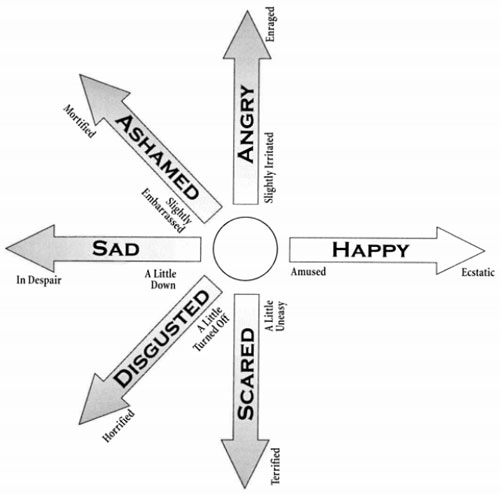
(Resick, Monson, & Chard, 2008, p. 55)
Next Step
By completing this activity often, it will likely become easier to identify your thoughts and emotions. In time, you should be able to recognize which thoughts are automatic and be able to decide whether they and the associated emotions make sense or need to be challenged or changed.
Learn more about the ABC approach by watching the following video: