Interpretation of Problems
Goal
To be able to identify how thoughts ,emotions, behaviors, physical reactions, and environment influence our understanding of problems
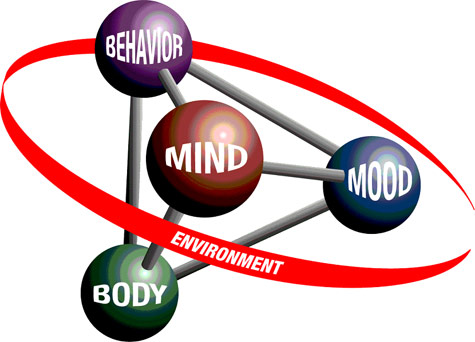
Interpretation of Problems (Greenberger & Padesky, p. 4)
How we understand our problems has an effect on how we cope. Our interpretation of the problems is influenced by thoughts (beliefs, images, memories), moods, behaviors, physical reactions, and environment (past and present). Notice that the five areas are interconnected as shown in the image below. The connecting lines convey that each different aspect of a person’s life influences all the others. For example, changes in our behavior influence how we think and also how we feel (both physically and emotionally). Behavior changes can also change our environment. Likewise, changes in our thinking affect our behavior, mood, physical reactions, and can lead to changes in our social environment. Some thoughts are automatic-making it difficult to understand the influence it is having on the other areas. With practice, however, even automatic thoughts can be improved.
ABC Exercise (Barlow, p. 94)
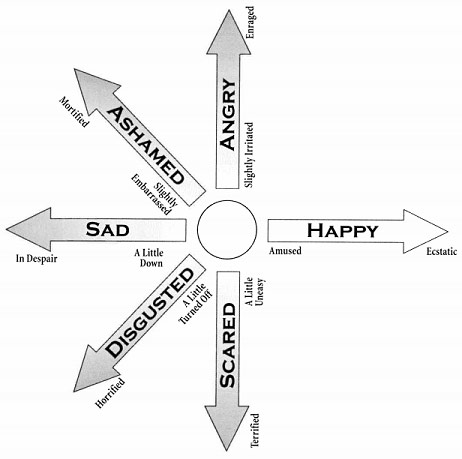
Instructions: Use the following boxes and questions to begin recognizing what you are telling yourself and your resulting emotions. Write down an event in column A, thoughts/beliefs about the event in column B, and how you felt and behaved in response to the event in column C. Then, answer the questions below the boxes. Keep in mind that feelings are almost always one word. Use the diagram on the next page to help identify feelings.
| Activating Event (A) “Something happens” |
Belief (B) “I tell myself something” |
Consequence (C) “I feel something” |
|---|---|---|
|
|
|
Are your thoughts in column B realistic?
__________________________________________________________________________
__________________________________________________________________________
__________________________________________________________________________
__________________________________________________________________________
What can you tell yourself on such occasions in the future?
__________________________________________________________________________
__________________________________________________________________________
__________________________________________________________________________
__________________________________________________________________________
(Resick, Monson, & Chard, 2008, p. 55)
Next Step
By completing this activity often, it will likely become easier to identify your thoughts and emotions. In time, you should be able to recognize which thoughts are automatic and be able to decide whether they and the associated emotions make sense or need to be challenged or changed.
Learn more about the ABC approach by watching the following video: