Pretending to Be Marie Curie Helps Girls Persist at Science

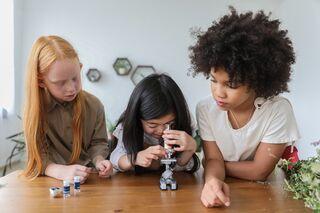
"Pretend play offers children a way to learn about the world and their place in it. When children play dress up or put on costumes, they’re exploring what it might feel like to have different sets of characteristics or how they might like occupying a specific role. In a recently published paper, researchers examined whether pretending to be a talented female scientist could encourage young girls to persist at a science-based task. Results suggested this type of pretend play could have a powerful effect on how girls approach science.
Although girls tend to do well in math and science classes, often earning higher grades than boys do in these subjects, girls become less interested in science as they progress through childhood. A 2011 study found that girls and boys had similar interests in science in early childhood, but by high school their science interests diverged substantially. At age 5, children don’t hold strong stereotypes about either sex being smarter than the other, but by age 6, girls begin to believe that boys are more likely to be “really, really smart.” Perhaps not surprisingly, researchers found that this belief extended to children’s behavior. Boys and girls were equally likely to be interested in playing a game described by researchers as being for “children who try really, really hard,” but girls were less interested than boys in playing a game described by researchers as being for “children who are really, really smart.” If girls don’t believe in their potential to be “really, really smart,” it’s no wonder that they might turn away from fields that seem to require that trait.
For this new study, researchers from Yale, Duke, and the University of Chicago recruited 240 children between 4 and 7 years old, who completed the study via Zoom. The children were randomly assigned to one of three different conditions before playing a science-based game with the researcher.
In the “baseline condition,” the researchers told children they were going to “be scientists and play a science game.” Researchers also explained the role of scientists: “Scientists explore the world and discover new things. An important part of being a scientist is making predictions.”
The “exposure condition” was the same as the baseline condition, except that the kids were also given information about a specific scientist before beginning the game. Girls were told about Marie Curie and boys were told about Isaac Newton. For example, researchers told girls in this condition, “Dr. Marie Curie is a scientist that discovered really important stuff about the world! What is special about Dr. Marie is that she always worked really hard, even when things got tricky. And when she made mistakes, or her predictions were wrong, she just kept on trying!” To make sure the children listened and understood, they were asked whether Dr. Marie worked hard and whether, when she makes mistakes, she gives up or keeps on trying. (For boys, the name was changed to Dr. Isaac.)
Finally, in the “role-play condition,” children learned about either Marie Curie or Isaac Newton, but were additionally asked to pretend to be that scientist during the game. Researchers referred to these children by the relevant scientist’s name while they played. For example, they would ask, “What’s your prediction, Dr. Isaac?”
The science-based game played by the children was designed to measure their persistence. Would a child keep going at the science game or choose to stop and move on to another task?
The researchers who conducted this study suggest that pretend play, something young children often already enjoy, could be a powerful way to help children cope with stereotypes. Just learning about role models who match your identity is a start, but may not be enough to change behavior. Using pretend play to help children actually put themselves in the shoes of role models may be a key step.
Role-playing may offer a relatively simple and inexpensive method of challenging young girls’ belief that they’re less likely to be “really, really smart” than boys. Parents, consider giving the princess dress and tiara a break and see how your daughter might like playing a scientist. Whether she becomes a scientist or not, persisting in the face of uncertainty or failure is a trait that will serve her well in life."
*I never understood why either gender of children was associated with certain types of toys. For example, girls would play with dolls and boys would play with trucks and cars. Growing up with this mindset can potentially become problematic, but for both boys and girls. There are certain careers that are usually occupied with majority of one gender and this is because there are gender roles so deeply rooted in our society that society doesn't let us think that the other gender can work in the position. Who says women can't be truck drivers and men can't be stay at home dads? We have to teach our children that they can pretend to be whatever they want to be so that they grow up with the confidence to pursue whatever field their heart desires. What other ways could we encourage children to think freely of gender roles?*
#GenderRoles #Society #PretendPlay
Please find the full article at Psychology Today.

I think that's really interesting, and in this day and age whatever it's tough, but more open in some ways too. Subtly changing language to make things more equal, and adults paying closer attention to how the kiddos feel (if they feel smart or not, or whatever, not necesarily how well they do their work) and help encourage change/growth where it might benefit could help them. I think when I was a bit younger there were a couple classes a councilor would come in and teach about midsets and the class was honestly boring but still good stuff for anyone to learn really
@LonleyCheese I agree! ❤️ Thank you for sharing your thoughts!

@fruityPond7887
As someone in a STEM field and female, I can relate to what this article is saying. I was also gender stereotyped as being in a field such as teaching or secretarial. But I had a keen interest in science, biology, mathematics, and technology. Parents have a lot of influence in how their children will decide what they intend to do as adults. I originally became a medical technologist and worked in a hospital laboratory. After a time, I decided to return to college and obtain an advanced degree in a related field. I work in this field to this day. And I will retire from this field as well. ❤️
@xandia I agree! I have a degree in biology and I totally understand how some people are stereotyped into certain careers, but I'm so proud of you for doing what you love! Keep doing you! ❤️