Psychology Today: Give Students a Chance To Be Important in Some Way

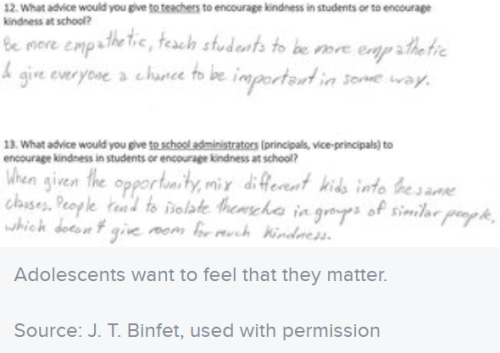
"This summer finds my students at the University of British Columbia and I analyzing data from a recent study of kindness in high school (yes, it does exist) and as part of this study, we asked high schoolers in grades nine through 12 to share their insights and views on kindness by responding to a variety of open-ended prompts.
When asked about the advice students might give to teachers and school administrators about encouraging kindness, students were quick to offer their input. The response above, in which a 12th-grade student shares her views on what teachers and school administrators should do to encourage kindness, is particularly insightful.
The aim of this post is to unpack the responses offered here and encourage educators to invite students to be kind as one way to “give everyone a chance to be important in some way.”
“Being important in some way” really means that students feel valued and are seen within the school context. It means that meaningful connections between students and fellow students and between students and faculty are nurtured. Further, “being important” reflects providing students with opportunities to contribute and to be acknowledged for their contribution.
In an article I published in 2015 titled “Not so random acts of kindness: A guide to intentional kindness in the classroom,” I wrote of the importance of guiding students in developing their prosocial habits and the importance of scaffolding for students how they might be kind as a way of helping them practice and build their kindness confidence. The assertion here is that students need both structure and support as they begin practicing being intentionally kind.
We know from prior kindness research that adolescents have a propensity to be kind to “known others”—to individuals with whom they are already familiar (i.e., upwards of 80% of the time). Educators can craft kindness challenges for students to encourage them to be kind to “unknown others” and thereby help address the challenge the student above presents to school administrators.
Though in the midst of the summer break from school, educators will soon turn their minds to thinking about the kind of classroom climates they want to engender and how they will connect with new students.
Allocating resources, time, and energy to inviting students to be intentionally kind holds the potential to offer a whole host of benefits for both educators themselves and moreover for students—students who are seeking to be seen, valued, and important within their school communities."
Read the full article here!
Reflection:
What else do you think can be done to encourage kindness?
*I think being kind itself will encourage children to be kind. If children see or experience kindness, they are more likely to replicate it.*
#Kindness #Children #School #MentalHealth

@comfortableNight4463 Thanks for writing this.
It was very educational.
Loved reading this.
@Happy900 You're welcome. Thanks for reading!

@comfortableNight4463
Great article, thank you for sharing!
I think that to encourage kindness, the teachers can promote “rule” to treat others like you want to be treated and to set kindness challenges.