Psychology Today: How to Escape From the Prison of Fear
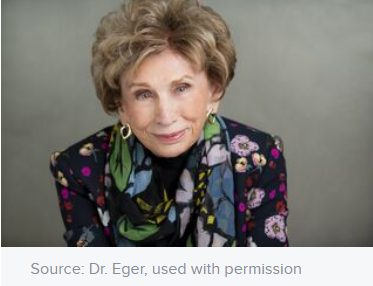
"In the spring of 1944, Edith Eger was a teenage gymnast in Hungary. Then she and her family were imprisoned in Auschwitz. Yet she says, “I'm here to tell you that the worst prison is not the one that Nazis put me in. The worst prison is the one I built for myself”
Her approach parallels that of Viktor Frankl, who said that everything can be taken from us “but one thing: the last of the human freedoms—to choose one’s attitude in any given set of circumstances”
In The Choice (2017), Eger describes how when her family arrived at the concentration camp, her parents were immediately sent to the gas chamber. She felt alone and abandoned in Auschwitz, continually asking herself, “Does anyone know that I’m here?” Yet she persevered, despite her ever-present fear and uncertainty.
Today, as a practicing psychologist in San Diego, Eger helps her clients recognize “that we have the inner strength, not to react, but to respond.” She says, “In my experience, victims ask ‘Why me?’ and survivors ask ‘What now?’”
To free ourselves from the inner prison of victimhood and self-neglect, Eger recommends what psychologists call savoring. he says, “Anything we practice, we become better at.” Some examples Eger cites are to “spend at least five minutes every day savoring pleasant sensations: the first sip of coffee in the morning, the feel of warm sun on your skin or a hug from someone you love, the sound of laughter or rain on the roof, the smell of baking bread. Take time to notice and experience joy”
Sometimes, Eger says, it takes only one question to get us out of victimhood: “Is it good for me? Is it good for me to sleep with a married man? Is it good for me to eat a piece of chocolate cake? ... Is it good for me to go dancing? To help a friend? Does it deplete me or empower me?”
Eger points out how we often limit ourselves to the scripts our parents and culture have given us, accepting limitations of sexism, ageism, and more. But “you can rewrite your script,” she says.
"It's OK to feel frightened, it's OK to be worried. But what's not good for them is to let those fears and worries occupy too much of their time.” She recommends taking five minutes to write down our fears, to express what’s troubling us, and then put that list away. Next, she says, to “make your list of the things you want to do with your day to make it a good day."
As Eger says, “fear and love do not coexist,” she recommends kindness on all levels to overcome fear.
- Kindness to ourselves: This “is very important,” she says. “When you get up in the morning and look in the mirror, say something like, 'I love me,' because self-love is self-care, it’s not narcissistic.”
- Kindness to others: Eger says, “I think this would be good for us to point out what's good and what is right.”
- Appreciating kindness from others: They were told if they left the premises they’d be shot, but when Magda told her she was so hungry that if she didn’t get food she would die, Edie, the gymnast, jumped the fence to pick carrots from the garden next door. A German guard asked who broke the rules and she told him. He gave her a little loaf of bread and said, “You must have been really hungry to do what you did.” Remembering his kindness, Eger says, gratefully, “I wish I could meet that man today.”
- Kind speech. In what sounds like the Buddhist concept of “right speech,” Eger tells people, “If you want to say something, ask yourself, Is it important? Is it necessary? And most of all, is it kind? If it's not kind, don't say it.”
For many of us, during over two years of COVID challenges, the worst experience is feeling confused and isolated, which can be really frightening. The opposite of this painful isolation is connection, kindness, and love, which make us realize we're not alone, that we're all connected.
That connection, that human connection, is what we all need in order to be healthy and whole."
Read the full article here!
Reflection:
Is fear holding you back from doing something you've always wanted to do?
*I have a fear of public speaking which could affect my career if I don't face it. I'm working to overcome it and I've come a long way from where I started.*
#Fear #Motivation #Kindness #Freedom

@comfortableNight4463
Thank you so much for your discussion and article. I have read multiple articles and discussions you have wrote and it takes alot to do these and i appreciate you very much so. I needed this and to learn this<3
Is fear holding you back from doing something you've always wanted to do?
Yes, fear is holding me back from moving forward from the last chapter i need to close. I need to get over my fear of being alone, and move to the next chapter in my life, as it is everything to me to succeed and do what i need to do before the end of my life, i want to live a fulfilled life and remember all the mistakes i made to get to where i am today and to be a better loving kind individual. i just want that humility so many in AA talk about<3

@comfortableNight4463
I definitely feel as fear is something everyone will go through, but how we respond to it is what is different and unique for everyone of us.