Psychology Today: The 4 Steps to Becoming Indistractable

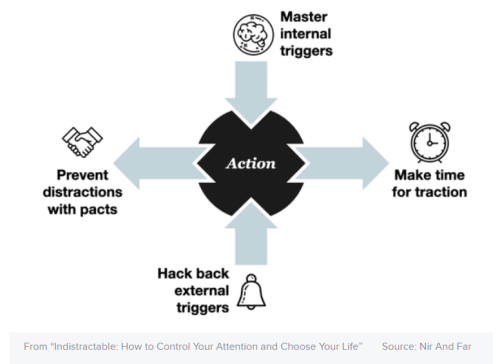
"Overcoming distraction is the struggle of our time.
Distraction erodes your day-to-day life and diverts your resources toward things that don’t really matter. If you’re not equipped to manage distraction—if you’re not indistractable—your brain will be manipulated by time-wasting diversions.
There are four pillars to becoming indistractable:
- Mastering internal triggers
- Making time for traction
- Hacking back external triggers
- Blocking out distraction
All behaviors, both traction and distraction, are prompted by triggers, both internal and external.
Internal triggers cue us from within. External triggers, on the other hand, are cues in our environment such as the pings, dings, and rings that prompt us to check our email, answer a phone call, or open a news alert.
Whether it’s an internal or an external trigger that prompts us, the resulting action is either aligned with our broader intention (traction), or misaligned (distraction). Traction moves us toward our goals; distraction moves us away from them.
1. Mastering Internal Triggers
The first step to managing distraction is to recognize that it starts from within. Unless we deal with the root causes of distraction, we will continue to find ways to distract ourselves.
While we can’t control the feelings and thoughts that pop into our heads, we can control what we do with them. We can manage distractions that originate from within by changing how we think about them. We can reimagine the trigger, the task, and our temperament. Rather than trying to fight the urge, we need new methods to handle intrusive thoughts.
The following four steps help us do just that:
Step 1: Look for the discomfort that precedes the distraction, focusing in on the internal trigger.
Step 2: Write down the trigger.
Step 3: Explore your negative sensations with curiosity instead of contempt.
Step 4: Be extra cautious during liminal moments when you transition from one activity to another.
2. Making Time for Traction
Being indistractable is largely about making sure you make time for traction each day and eliminating the distraction that keeps you from living the life you want—one that involves taking care of yourself, your relationships, and your work.
Planning your time with intention is critical. By defining how we spend our time and syncing with the stakeholders in our lives, we ensure that we do the things that matter and ignore the things that don’t.
3. Hacking Back External Triggers
Unwanted external triggers hamper our productivity and diminish our well-being. While technology companies use cues like the pings and dings on our phones to hack our behavior, external triggers are not confined to our digital devices.
Answer the question: Is this trigger serving me, or am I serving it? That way, you can hack back the external triggers that aren’t serving you.
4. Blocking Out Distraction

Hello @comfortableNight4463, I'm always extremely appreciative of your posts and articles you share!
Reflection:
Are you often distracted? How are you coping?
- Over the years, day by day, I've mastered all the points highlighted here. It doesn't mean I don't have slip ups or triggering circumstances, I just take better (and quicker) control of my mind through mastering my triggers.
@SirenOfSerenity Thank you! You're so kind😊. That's amazing! You must have great discipline. Occasional slip-ups are okay, we are all human. Thanks for reading!

@comfortableNight4463

@comfortableNight4463
Given that during my off times I'm always on my phone on social media or playing quick games I'd say I get fairly distracted really easily. I think what helps is getting myself into a rhythm of productivity in which once I'm in I feel like I have more willpower to stay focused.