Changing the Habit of Self-Criticism

comfortableNight4463
November 7th, 2022
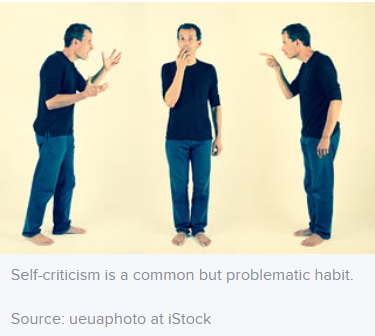
"Self-criticism is positively linked with a range of mental health conditions, including depression, anxiety, eating disorders, posttraumatic stress disorder, addictions, and self-harm. Self-criticism is influenced by family and cultural contexts, including emotional abuse, racial discrimination, and homophobia. The evidence shows that many of us internalize negative messages so that our own minds habitually perpetuate self-criticism. The research also indicates that self-criticism can be changed.
How the Habitual Nature of Self-Criticism Impacts Mental Health
Bas et al. created a self-report measure called the Habit Index of Negative Thinking (HINT). Analyzing responses to the following questions, the research team assessed the degree to which participants engaged in self-critical thinking by having them respond to the following:
Thinking negatively about myself is something...
"I do frequently.
I do automatically.
I do unintentionally.
That feels sort of natural to me.
I do without further thinking.
That would require mental effort to leave.
I do every day.
I start doing before I realize I’m doing it.
I would find hard not to do.
I don’t do on purpose.
That’s typically "me."
I have been doing for a long time. (Verplanken et al., p. 541)"
The researchers found that levels of habitual self-criticism as measured by the HINT contributed to symptoms of depression and anxiety over a 9-month period in a sample of 1,102 respondents (641 women and 461 men). These results don’t tell us that the habit of self-criticism causes more mental health problems than the self-criticism itself, but rather that both aspects of self-criticism impact depression and anxiety.
How to Change the Habit of Self-Criticism
Awareness of default behaviors can be a valuable step toward changing habits, but awareness or intentions alone (“I should really be nicer to myself”), are unlikely to produce real change. Instead, the research indicates that people make significant changes in self-criticism from specific mental techniques that reduce self-judgment and promote self-compassion.
The term “self-compassion” means treating yourself in a friendly and caring manner, even during moments of difficulty or failure. Mindfulness meditation and lovingkindness meditation are two specific approaches that decrease self-criticism. You can start mindful meditation by tuning into the sensations of your breath, and then redirecting your attention back to the breath, for about 10 minutes or longer. The goal is not to repress the thoughts that arise, but instead to return your attention back to the breath with as little self-criticism as possible (“My mind wandered, that’s OK, now back to the breath”). When you notice self-criticism about becoming distracted, simply handle it as you would any other thought (“There’s the self-criticism, that’s OK, back to the breath).”
Another approach that meaningfully reduces self-criticism is lovingkindness meditation (LKM). The practice involves several minutes of silently repeating phrases to yourself, such as, “May I be safe. May I be happy. May I be healthy. May I live with ease.”
Read the complete article available at Psychology Today!
Reflection:
Do you tend to self-criticize frequently?
#Self-Criticism #Self-Compassion #Mindfulness #meditation

magneticShoulder3193
November 9th, 2022
@comfortableNight4463
Thank you for sharing, this was very helpful!
1 reply
@magneticShoulder3193 You're most welcome! Thank you for reading!
load more