Healthline - How to Release ‘Emotional Baggage’ and the Tension That Goes with It

“You’ve probably heard the term “emotional baggage.”
It’s sometimes used to describe the phenomenon of carrying past trauma or so-called negative experiences through life, relationships, or a career.
You may see this reflected in someone’s posture, as if they’re carrying around an unbearable weight. It may even prevent them from moving forward in life.
Everyone carries unprocessed emotions from experiences to some degree. However, emotions that aren’t dealt with don’t just go away.
They can affect:
- the way you think about yourself
- how you react to stress
- your physical well-being
- your relationships with others
After all, emotional baggage gets its name from somewhere, right?
Let’s unpack the layers of how and where emotions get stuck, so you can release what’s weighing you down.
What does it mean to have ‘trapped’ emotions?
Perhaps you’ve heard of people crying during yoga, massage, or acupuncture treatment because of a tender spot that, when activated, appears to lead to an emotional release.
Though some may refer to trauma being “stored” or “trapped” in the body, that isn’t necessarily a scientific way to put it.
However, the symptoms of traumatic stress can manifest physically.
This may be because the brain associates this area with a particular memory — often on a subconscious level.
Activating certain areas of the body may trigger these memories, according to Mark Olson, PhD, LMT, the owner and director of the Pacific Center for Awareness & Bodywork.
“Emotions are constantly being generated — subconsciously or consciously — in response to the reactivation of memories or unsatisfied goals,” Olson says. “The touch to X area is simply a reliable stimulus to reconstruct the pattern associated with that traumatic event.”
Touch may bring up emotions or a memory may create sensations in a particular area of the body. While this is usually associated with a bodily location, Olson believes that everything is happening in the brain.
Alternatively, some believe that trauma and difficult emotions can, in fact, become literally stuck energy in the body, though this isn’t supported by scientific evidence.
According to Bradley Nelson, DC, trapped emotional vibrations cause surrounding tissues to vibrate at the same frequency, known as resonance.
In his book “The Emotion Code,” Nelson writes, “Each trapped emotion resides in a specific location in the body, vibrating at its own particular frequency.”
This may cause you to attract more of that emotion, he says, creating a build-up or blockage.
Still, Nelson’s stance remains theoretical until further research can be done.
That said, research as early as 1992Trusted Source along with more current research supports the mind-body connection, or the belief that a person’s mental and emotional health impacts the state of their physical health.
A classic example of this is fear.
If you’re in a situation where you’re afraid, your body generates a physical response to this emotion by activating the fight-flight-freeze response.
According to Nelson, three things happen when an emotion is experienced.
- We develop an emotional vibration.
- We feel the emotion and any thoughts or physical sensations associated with it. This is where the mind and body’s interconnectedness comes into play.
- We move on from the emotion by processing it.
According to Olson and other researchTrusted Source, emotional processing occurs in the limbic structures of the brain.
We’re constantly taking in information, which generates pre-conscious autonomic nervous system responses. This sends a signal to the body activating the corresponding emotion.
In other words, your “feeling” comes from what your nervous system is telling you.
According to Nelson, when the second or third step mentioned above gets interrupted, the energy of the emotion becomes trapped in the body. As a result, you might experience muscle tension, pain, or other ailments.
The higher the emotional intensity, the more likely it is to become trapped.
“The phrase ‘trapped emotions’ usually means that the true self wants to express something that the false self doesn’t want us to express,” Olson says. “In psychology, we think of the true self as the part of us that we are born with that is naturally open, curious, and trusting, while the false self emerges as a set of adaptive strategies to deal with pain and loss.”
This repressed negative emotional energy can express as:
- resentment
- poor decision-making
- self-sabotage
- overreaction
- increased stress and anxiety
- depression
- fatigue
Mind-body therapist Kelly Vincent, PsyD, compares trapped emotions to carrying around a large backpack. It weighs us down, impacts our mood, and drains our energy.
Additionally, she notes that it can also destroy body tissues and prevent normal functions of organs and glands.
“It’s just like a giant roadblock on the freeway,” Vincent says. “It is hard for energy to flow naturally through.”
Trapped emotions and trauma
It’s impossible to have a conversation about trapped emotions without exploring trauma, especially how the brain experiences it.
Nearly everyone experiences trauma at some point in their lives.
According to a 2015 surveyTrusted Source of almost 69,000 adults across six continents, over 70 percent of respondents reported exposure to a traumatic event, while 30.5 percent were exposed to four or more.
Trauma can come about through life experiences like:
- a breakup
- a major life change
- the death of a loved one
- infidelity in a relationship
- loss of a job
- an experience of violence, discrimination, or racism
Trauma can impact cognitive processes.
It especially affects memory processing and the ability to recall factual information, or explicit memory. As a result, the traumatic experience or memory is not “logged” properly in the brain.
“When it comes to an extremely overwhelming experience, like a trauma, the brain encodes the traumatic memories as pictures or body sensations,” Vincent says.
When triggered, the brain may disconnect from reality or replay the traumatic event in the form of a flashback.
This is known as dissociation, or psychological disconnect.
These sensory fragments remain in the mind and interrupt the brain’s natural recovery process.
Vincent compares traumatic memories to a virus in our encoding system, where unprocessed events can cause our mental and physical processes to malfunction.
When trauma isn’t processed or resolved on its own, it may linger far past the actual event.
This is often seen in people with post-traumatic stress disorder (PTSD), a condition that develops after a person undergoes terrifying or life-threatening events.
ResearchTrusted Source shows that those with current PTSD have a smaller hippocampus, a center for emotions and memory in the brain.
Stress leads to the release of the hormone cortisol, which is a part of the fight-flight-freeze response.
Research from 2011Trusted Source showed that prolonged stress damages the hippocampus, which may show up as abnormal blood flow or reduced size. As a result, your body may remain in this hypervigilant state even if you’re not consciously thinking of the traumatic event.
Ever feel a tightness in your chest during an anxiety-inducing situation? Or do you notice that it feels good to stretch your hips after an emotionally draining day?
Where one person feels tension or sensitivity in their bodies might not be the same for another.
Some studies, however, provide a baseline for where emotions are generally experienced. But there’s still more research needed on this subject for conclusive takeaways.
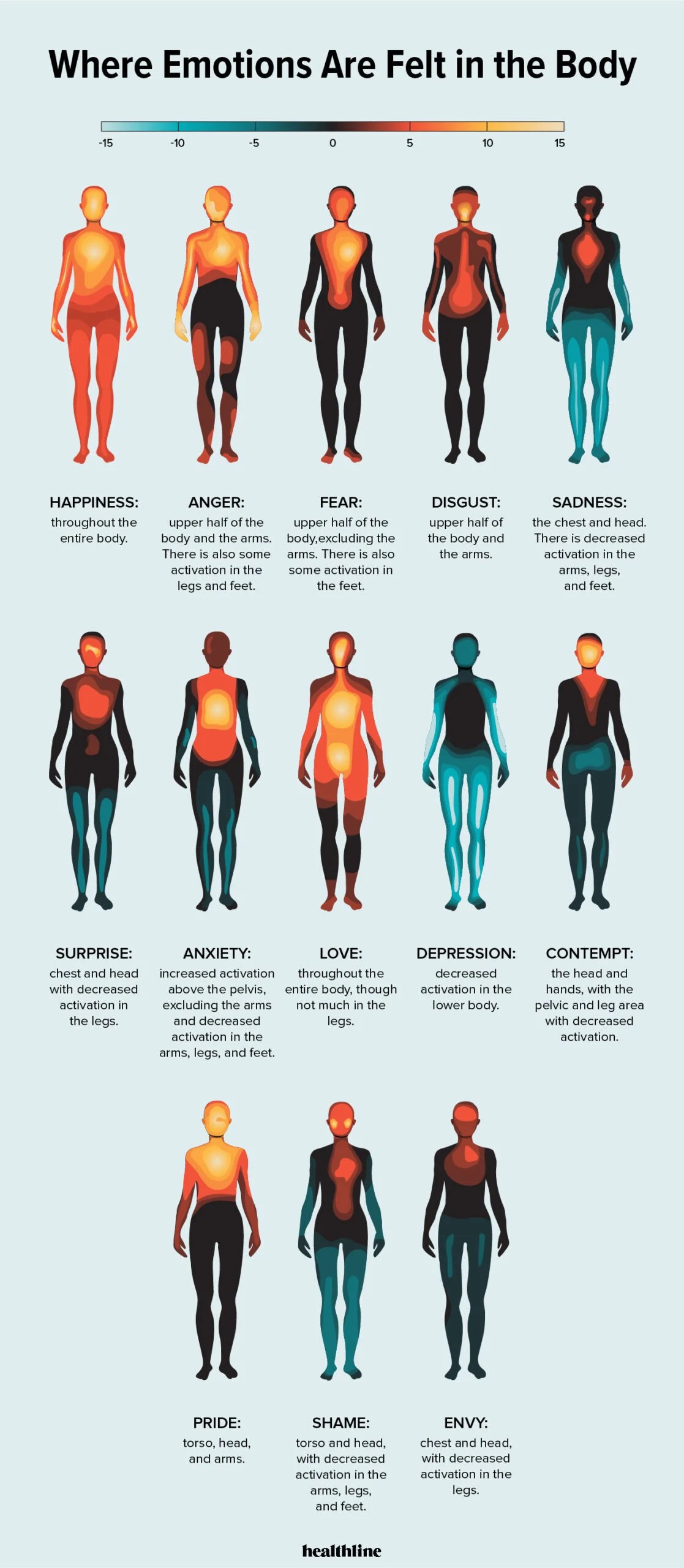
One such study from 2013 led by a team of biomedical engineers in Finland sought to explain where emotions are felt in the body.
They mapped bodily reactions to emotions in about 700 individuals by asking them to color in regions where they felt reactions increasing or decreasing due to various stimuli.
They found that different emotions were associated with different bodily sensations that were generally the same for participants across the board.
For example, anger, fear, and anxiety showed increased activity in the chest and upper body.
This may explain the origins of expressions like “hot-headed” or “carrying the weight of the world on your shoulders.”
These emotions can also kickstart the sympathetic nervous system to create a quick response in the body. That’s why you may feel your heart pulsing or your muscles tightening when you become nervous or stressed.
A chart in the study references where these feelings were found to be experienced in the body. See a summary below:
 Share on PinterestIllustration by Maya Chastain
Additionally, the same researchers conducted a follow-up study that found the intensity of a feeling directly correlated with the intensity of physical and mental sensations.
They categorized feelings into five groups:
- negative, such as stress, anger, and shame
- positive, such as happiness, love, and pride
- cognition, such as attention and perception
- homeostatic states, or a balanced, regulated internal state
- illnesses and somatic states
Feelings are ever-changing, and this research may be helpful for those who have trouble understanding their emotions.
Emotions that aren’t dealt with may become stored in your unconscious, and may even affect your body posture.
“Your head is in a different position when you’re confident and when you’re confused,” Olson says. “Your spine takes on a different shape when you’re defeated or victorious.”
Olson says that people may subconsciously default to specific postures that block their awareness of painful feelings.
“Muscle tension emerges to create and maintain postures that keep oneself safe or unaware of unpleasant feelings,” he says.
Certain postures and gestures also relate to specific feelings and social meanings. Think of a warm embrace versus crossed arms.
This may help us understand why some believe tension in the body is associated with specific areas. However, Olson advises against using this to create general narratives.
“This puts a very shallow limit on how far one can explore as they defer to a [list] rather than what they can find within themselves,” he says.
Ever feel like you need to cry, scream, laugh, punch a pillow, or dance it out?
We’re often taught to bury our pain and soldier on. Over time, this can lead to repressed emotions, also known as unconscious avoidance.
Research from 2019 linked emotional repression with decreased immune system function.
Here are a few ways to release repressed emotions:
- acknowledging your feelings
- working through trauma
- trying shadow work
- making intentional movement
- practicing stillness
Acknowledge your feelings
The more you understand your emotional world, the more you can digest your feelings in healthy ways.
The first step is to connect with and understand your emotions. People with repressed emotions may have trouble identifying their feelings, which is why it can be valuable to talk with a mental health professional.
A 2007 studyTrusted Source showed that labeling your emotions can decrease their intensity.
You can do this by using psychological tools, like the cognitive distortion categories, or by exploring ways to categorize your emotions to help you make sense of them.
Work through past trauma
Often, there are things we carry around for years that stem back to childhood. Some examples of past trauma include:
- abuse, including mental, emotional, physical, or sexual
- neglect
- loss of a loved one
- separation from a parent or caregiver
- bullying
- dysfunction at home
Unresolved childhood trauma can show up in many ways, including:
- self-blaming
- casting blame on others
- feeling depressed
- withdrawing from social activities
In order to work through trauma, Olson says it’s crucial to feel the grief about the fact that you may never get what you wanted or deserved years ago.
Once you’ve allowed yourself that grief, you can acknowledge the adaptive strategy you developed as a result.
For example, you may have developed a coping strategy to be independent that eventually results in feelings of isolation. Without recognizing your strategy, you might think you’re being alienated by others.
On the other hand, if you realize your isolation comes from your adaptive strategy, you can identify the root of the issue and modify your strategy to better meet your true needs.
Shadow work
Similar to exploring childhood trauma, shadow work offers another lens of exploring different parts of ourselves that we keep hidden, typically due to shame or inadequacy.
People tend to hide the parts of themselves that they believe are unacceptable.
For example, were you told to “calm down” or “stop crying” when you were upset as a kid? This emotional invalidation may cause you to feel ashamed of your emotions or to downplay them.
Shadow work can be done in several ways, though it’s generally recommended to work with a therapist.
You can find a few shadow work exercises here.
Intentional movement
Somatic experiencing (SE) is a way to address any unprocessed tension or emotion that may be lingering in your body.
SE uses a body-first approach to address symptoms, with the idea that freeing unprocessed trauma can promote emotional healing.
One way to do this is through intentional movement, according to Vincent.
“When we intentionally move, we can create a sense of safety in our bodies that we may not have experienced before, especially individuals who have stored trauma,” Vincent says.
Examples of intentional movement include:
- dance
- stretching
- yoga
- shaking
- martial arts
- qi gong
- tai chi
- meditative walking
- belly breathing exercises
Vincent notes that intentional movement releases any stored energy while helping the brain recognize the difference between tension and relaxation.
Practicing stillness
Being still allows us to be with our thoughts and feelings in a present state.
It taps into the brain’s default mode networkTrusted Source, which is when your brain briefly enters an idle state. This triggers what scientists call “self-generated cognition,” which includes things like daydreaming or letting your mind wander.
By momentarily disengaging from external stimuli, researchTrusted Source says people can better connect with their inner thoughts, emotions, and desires.
“We live in a world where stillness isn’t practiced enough, nor is it valued, but can be so nourishing to our minds and bodies,” Vincent says. “It also allows space for emotions to come into… consciousness.”
Some ways to practice stillness are:
- meditation
- breathing exercises
- sitting in nature
- listening to calming music
- repeating affirmations
- progressive muscle relaxation
When an emotion is not fully processed, it may become “stuck” in the body.
However, it’s the limbic structures of the brain where emotional processing occurs. While some areas of your body undoubtedly hold tension or may be associated with an emotional experience, ultimately it’s the brain that’s reconstructing the emotion.
By using techniques to work through your emotions, like therapy, intentional movement, and shadow work, you can learn to move on from past traumas and release the associated bodily tension. ”
By - Julianne Ishler
Read Source here
#EmotionalHealth #Growth #Healing

@zealousGrace5023
Thank you for this very comprehensive and thorough read about exactly what I've been struggling of as of lately. I think I've gotten so used to holding my emotions and processing them later that I get 'stuck' with that emotion inside of me and improperly expressed. I think the descriptions of emotions and how they feel like definitely help guide you what to feel and how to go about 'feeling' the emotion.
@sunnyWriting4806 I hope you are able to resolve all those pent up emotions

@zealousGrace5023 I love this article and the picture that goes with it! It's astounding what emotions can do to our physical body and it's important we properly process these emotions because it be really be harmful to our health. Thanks for sharing this!
@fruityPond7887 I'm glad you enjoyed it! And absolutely, our emotions have such intense effects on our bodies

@zealousGrace5023 Thank you so much for this article. I've been stressed for the past few days with exams and reading this has made me stop and take a break.
@comfortableNight4463 Good luck!! I'm sure you'll do great
@zealousGrace5023 Thank you!
@comfortableNight4463 You're welcome!!

@zealousGrace5023
Thank you so much for posting this article.
I know that I can personally vouch for somatic experiencing when it comes to my own trauma recovery. Growing up, I think I nearly always had a good sense of what I was feeling, but I also never really had the luxury of being or even feeling safe enough to express whatever the emotion was.
In any case, you can imagine that this led to quite the journey of self-discovery as an adult. Because when I discovered mindfulness, meditation, and somatic experiencing through therapy, it really opened up so much for me in life.
@sereneSunset26 i'm glad you were able to tackle all that!
@zealousGrace5023
Same here!!
It was a lot, and to be honest, it still is. But I feel like I have no choice but to face everything and move through the trauma everyday. :)
@sereneSunset26 i can imagine
but. least it gets better
slowly yes but it does
@zealousGrace5023
Yeah, it's the 'slowly' part that I have had to have the most patience with--along with myself as well. 😅
@sereneSunset26 haha yeah thats the hardest part

@zealousGrace5023
Thank you for sharing this article! It is very useful and I enjoyed reading it.
@globalBraid3744 Thank you! Glad you enjoyed it :)
@zealousGrace5023 Thanks you for sharing this intriguing article. The mind-body connection is truly staggering!
@comfortableNight4463 it is! it's fascinating
glad you like the article
@zealousGrace5023 I do! Thanks.
@comfortableNight4463 of course :)