Overcoming A Hurdle to Saying "No."

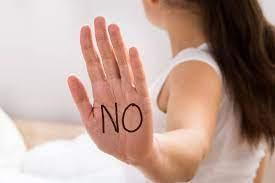
"In my work as a therapist, it’s common for me to ask the brave individuals I work with to try something that may feel unfamiliar, challenging, vulnerable, or awkward. It’s also really important to me to support people’s autonomy and boundaries. In the spirit of this, I like to underline the fact that I embrace their refusal to try something as much as I appreciate their agreement to have a go at it. For instance, I’ve mentioned that I welcome "no" just as much as I welcome "yes.”
That's something worth repeating, because, let’s be honest here, it can be hard to set a boundary—really hard. I’ll bet it wouldn’t take much rummaging through your memory bank to know exactly what I mean. Perhaps it was that favor a friend asked of you, the one you didn’t want to do but you just couldn’t quite bring yourself to say “no” to. Or maybe it was that time a boss or coworker asked to schedule a work meeting the next day and you said “sure thing” even though you were already stretched to the limit and privately wished they hadn’t asked. In all likelihood, you could come up with several mental snapshots.
Be that as it may, the fact that it’s tough to say “no” doesn’t tell us why it’s difficult to do so. That’s where a new study comes in, one in which a team of researchers explored an element behind why we find it arduous to say that healthy, vital, two-letter word. Across a series of experiments, they found support for the idea that one reason why we humans tend to struggle with setting boundaries and saying “no” is because we inadvertently exaggerate the adverse effects that will arise if we do. For example, we might fear that the person who is asking us for something would feel upset, would judge us, would disparage us to others, or would not support us when we need it. Or, we might be afraid that the relationship would suffer (the investigators included all of these in their study). Yet, despite our belief that our boundaries will give rise to these unpleasant results, the research team found that people on the receiving end handle “no” better than we think they will, at least in the short run (they didn't research the long run).
The research team also rightly pointed out that there are downsides to inflating the odds of other people’s problematic reactions to our boundaries, like saying “yes” more than we need to or want to, which could also work against the very bonds we’re trying to protect. Of course, the investigators were right to state that additional studies will be needed to more fully illuminate our understanding of this matter. In the meantime, how might we use this information fruitfully? As the research team indicated, if we can remind ourselves that the consequences of setting a boundary likely won’t be as bad as we imagine, we might feel more able to try saying "no" at times, which could feel unfamiliar, challenging, vulnerable, or awkward, but ultimately better."
*Setting boundaries can be tricky, especially when it comes to your loved ones. We want to let our loved ones know that we are there for them and we don't want to disappoint them. Trying to remind ourselves that what we think will happen actually won't is important because people accept no more easily than we think. We have to be able to set boundaries to protect ourselves and our mental health too. I know we look out for others as humans, but it's okay to take care of ourselves first sometimes! Do you have trouble saying no? If so, why do you think this is and what can you do to work on it?*
#Boundaries #SayingNo #PutYourselfFirst
Please find the full article at Psychology Today.

@fruityPond7887
This was a very interesting piece I can relate to this with family members or close friends. However for the most part I don't have a problem saying no or setting boundaries.
@Josh3889 I'm so glad to hear that you are good at setting those boundaries! Having that skill is so important for our own mental health, but it can be hard to learn or set, especially with our very close family and friends. Thank you for sharing!
@fruityPond7887
Thank you so much!