Scientific American - Brain-Reading Devices Help Paralyzed People Move, Talk and Touch

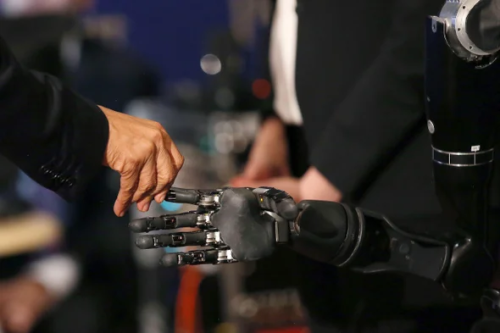
U.S. President Barack Obama touches a robotic arm operated by a quadriplegic brain implant patient who can experience the sensation of touch and control a remote robotic arm with his brain during a tour of the innovation projects at the White House Frontiers conference in Pittsburgh in October 2016. Credit: REUTERS/Carlos Barria/Alamy Stock Photo
Implants are becoming more sophisticated—and are attracting commercial interest
“In March 2017, Johnson broke his neck in a go-carting accident, leaving him almost completely paralysed below the shoulders. He understood his new reality better than most. For decades, he had been a carer for people with paralysis. “There was a deep depression,” he says. “I thought that when this happened to me there was nothing—nothing that I could do or give.”
But then Johnson’s rehabilitation team introduced him to researchers from the nearby California Institute of Technology (Caltech) in Pasadena, who invited him to join a clinical trial of a brain–computer interface (BCI). This would first entail neurosurgery to implant two grids of electrodes into his cortex. These electrodes would record neurons in his brain as they fire, and the researchers would use algorithms to decode his thoughts and intentions. The system would then use Johnson’s brain activity to operate computer applications or to move a prosthetic device. All told, it would take years and require hundreds of intensive training sessions. “I really didn’t hesitate,” says Johnson.
The first time he used his BCI, implanted in November 2018, Johnson moved a cursor around a computer screen. “It felt like The Matrix,” he says. “We hooked up to the computer, and lo and behold I was able to move the cursor just by thinking.”
Johnson has since used the BCI to control a robotic arm, use Photoshop software, play ‘shoot-’em-up’ video games, and now to drive a simulated car through a virtual environment, changing speed, steering and reacting to hazards. “I am always stunned at what we are able to do,” he says, “and it’s frigging awesome.”
Johnson is one of an estimated 35 people who have had a BCI implanted long-term in their brain. Only around a dozen laboratories conduct such research, but that number is growing. And in the past five years, the range of skills these devices can restore has expanded enormously. Last year alone, scientists described a study participant using a robotic arm that could send sensory feedback directly to his brain; a prosthetic speech device for someone left unable to speak by a stroke; and a person able to communicate at record speeds by imagining himself handwriting.
So far, the vast majority of implants for recording long-term from individual neurons have been made by a single company: Blackrock Neurotech, a medical-device developer based in Salt Lake City, Utah. But in the past seven years, commercial interest in BCIs has surged. Most notably, in 2016, entrepreneur Elon Musk launched Neuralink in San Francisco, California, with the goal of connecting humans and computers. The company has raised US$363 million. Last year, Blackrock Neurotech and several other newer BCI companies also attracted major financial backing.
Bringing a BCI to market will, however, entail transforming a bespoke technology, road-tested in only a small number of people, into a product that can be manufactured, implanted and used at scale. Large trials will need to show that BCIs can work in non-research settings and demonstrably improve the everyday lives of users—at prices that the market can support. The timeline for achieving all this is uncertain, but the field is bullish. “For thousands of years, we have been looking for some way to heal people who have paralysis,” says Matt Angle, founding chief executive of Paradromics, a neurotechnology company in Austin, Texas. “Now we’re actually on the cusp of having technologies that we can leverage for those things.””
Read the full article here
#New #ScientificAdvancement #Research #Neuroscience

@zealousGrace5023 Love this article! I'm so amazed at the extent of technological development in these times. This innovation would be instrumental to many people!
@comfortableNight4463 I know!! Reading this whole thing was mind blowing
@zealousGrace5023 Exactly! It's truly amazing!
@comfortableNight4463 It iss!!

@zealousGrace5023
It is a pity that not many laboratories conduct research like this. Technology such as BCI could significantly transform the lives of people like Johnson! It is very inspiring to see the influential work of researchers in this area.
@globalBraid3744 Exactly. I wish there was more funding for research and innovation
@globalBraid3744 definitely, i agree. More funding and support.
but also research like this is so tricky because you inarguably require human trials and very hard to source materials. Not to mention neuroscience is one of the hardest sects of science