VeryWellMind: What Is Exposure Therapy?

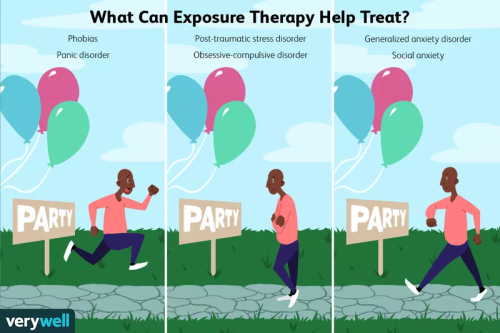
“Exposure therapy is an evidence-based treatment, which quite simply means that the research has shown us that it works, designed to help you face your fears. When you’re scared of a specific object or activity, you may avoid it. For instance, if you’re afraid of enclosed spaces, you may avoid taking the elevator, especially if it’s crowded. While avoiding it can help keep your fear at bay in the short term, it can cause your fear and anxiety to worsen in the long term. Exposure therapy can help break this cycle of fear and avoidance. It involves exposing you to the source of your fear in a safe environment. Exposure therapy aims to help you overcome your fear so that the object, activity, or situation doesn’t cause anxiety, and you can engage with it meaningfully. Exposure therapy can help treat several conditions, including phobias, generalized anxiety disorder, social anxiety disorder, and obsessive-compulsive disorder (OCD).
Therapists who practice exposure therapy may draw upon a variety of techniques and progress at different paces.- Graded exposure: This involves exposing you to the source of your fear gradually by going up the ladder one step at a time. So, for instance, if you are afraid of needles, the steps could include looking at a picture of a needle, having a covered needle near you, holding a needle, etc., until you’re able to do what you fear most, which is getting an injection.
- Systematic desensitization: Your therapist may employ systematic desensitization methods to help you relax and get comfortable with each step of this process. These methods can include relaxation exercises like meditation, deep breathing, guided imagery, and progressive muscle relaxation.
- Flooding: This method involves exposing you to the highest level of the ladder all at once. Therapists may use flooding if your fear interferes with your ability to go about your daily life. While this approach can help you overcome your fear faster, flooding can be traumatic to experience. A therapist may consider this method only after your anxiety has decreased significantly.
- Habituation: As you gradually and repeatedly expose yourself to the source of your fear, your reaction to it may decrease over time.
- Extinction: Exposure therapy can offer a safe environment for you to learn that the situation you fear does not pose a threat to you. It can help weaken your association between the situation and the negative outcome you expect.
- Emotional processing: This form of therapy can help you explore and understand the source of your fear. It can also help you replace your instinctive response with more realistic thoughts and beliefs about the feared situation and make you more comfortable with fear and anxiety.
- Self-efficacy: Over time, exposure therapy can help you realize that you can confront the situation you fear and manage the anxiety it causes.
“Exposure therapy can significantly reduce an individual's anxiety symptoms, increase a person's ability or willingness to approach uncomfortable situations, and strengthen learning that individuals can handle hard things. “
Read the full article here!
#Exposure #Therapy #OCD #PTSD #Anxiety

@globalBraid3744 Exposure therapy is something I am very familiar with as I struggle with OCD. It's probably one of the hardest things to work through because you are directly going into the face of your fear. It's a very effective way of getting over fears, but you do have to be ready to do it. I have to do it soon because I have a dreadful fear of driving long distances/highways. I know it will work, but it's scary.
@fruityPond7887
I agree with you! It is extremely difficult to directly face fears. I am not sure whether a person can ever be ready for it, but at least willing to give it a try. A therapist is usually skilled at comforting you and regulating the intensity so it is not too easy but neither too much. I wish you all the best for your upcoming exposure session. Believe in yourself! Often a person does not even know how much they are capable of handling until a confrontation with the fear.
@globalBraid3744 Thank you so much! I wish my therapist was more comforting 😂 I have this irrational fear of hitting a person while driving and she was like "well, it could happen." UH, please lady don't tell me that. I know she was just trying to get me desensitized, but still 😅 LOL
@fruityPond7887
This does not really sound comforting. I think that usually, it is more helpful to try to convert it into probabilities. In essence, anything can happen but probabilities make me feel more realistic about the fear. I have once watched a training for a spider phobia and the therapist asked whether there are no spiders in their wardrobe as well. The person freaked out because he did not see there spiders before and it made him more suspicious. I think that therapists should definitely be more careful with what they say. But there are also many therapists that are very skilled at conducting a therapy they specialize in.
@globalBraid3744 Oooh, I like the probabilities idea! I think breaking down irrational fears into more rational thoughts can be really really helpful in combating those fears. It may be difficult at first, but anything is possible!