Verywellmind - How Mandalas and Brain Scans Could Enhance Mindfulness
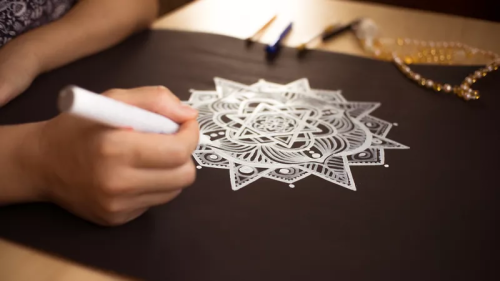
“Sanskrit for "circle," mandalas are geometric diagrams that serve as symbolic maps for sacred rituals and meditation in such religions as Hinduism and Buddhism. Thought to represent the cosmos and other deities, they're often used as tools for a spiritual journey.
Psychological research has also linked mandala-making, even just the act of coloring in, to stress-relief.1 In fact, renowned psychologist Carl Jung studied mandalas as a window to the subconscious and believed the creation of these images encouraged focus and personal growth in patients.2
Today, coloring as a mindful practice has become increasingly popular, with some adult coloring books devoted entirely to mandalas. But what is it about these shapes that gear them toward a more present, mindful state? A new study exploring the connection between mandala coloring and mindfulness suggests that brain-sensing technology can help us understand the connection.3
The Research
Unlike a blank canvas awaiting paint, a mandala presents a more structured approach to coloring through an array of simple, often symmetrical shapes. The designs are accessible, the materials are inexpensive and finishing a full mandala offers a sense of accomplishment. These may be reasons why mandala coloring has become so popular in times of stress.
Curious as to whether this mindfulness practice could be deepened, a group of human-computer interaction researchers, who study computing technologies and their potential to help people, designed a study involving mandala-coloring and brain-sensing technology.3
I found fascinating how using metaphorical representations of internal processes, such as colors to represent emotional states, was really helpful to externalize them, become more aware and work with them in a fairly effortless way.
Researchers began by interviewing "experienced mandala practitioners" to better understand the subject. They then designed a prototype including a tablet and stylus for coloring, an EEG headset and a separate display shaped like an artist's palette.3
While the participant colored, the headset monitored their brain signals to gauge the level of mindfulness. Those readings then produced real-time feedback on the palette display to indicate the level of mindfulness achieved. The display presented brightness of color as an indicator of mindfulness levels and was placed within the participant's peripheral vision in order to guide the individual without totally distracting them.3
"Participants described how having color-based metaphorical representations of their mindfulness states in the periphery, enhanced self-awareness and reflection without being too cognitively demanding or overwhelming," says lead study author Claudia Dauden Roquet, PhD.
The findings suggest that coloring mandalas induces self-reflection, focused attention and acceptance of imperfections while promoting emotional well-being and self-expression.3 Roquet adopted mindfulness practices like meditation and mandala coloring years ago after taking an interest in understanding how we get in touch with our thoughts and emotions.
"I found fascinating how using metaphorical representations of internal processes, such as colors to represent emotional states, was really helpful to externalize them, become more aware and work with them in a fairly effortless way," Roquet says.
Creating Art As Therapy
Art as a therapeutic intervention is an effective treatment style for people of all ages, says Eric Patterson, LPC, who specializes in art therapy, depression and personality disorders.
"Expressive arts can play an invaluable role for someone’s mental health and well-being because they can help the person communicate without words and express the unmentionable," Patterson says. "The arts can make someone feel strong and capable of creating beauty after ugly experiences."
So much more goes into an art practice than just the physical or mental act of coloring, as exemplified in the study. When it comes to mandala coloring, participants lauded the accessibility, affordability and sense of accomplishment provided by this practice.
The arts can make someone feel strong and capable of creating beauty after ugly experiences.
"It was a moment of self-care in which they didn’t have to think about anything else," Roquet says. "They would brew their favorite tea, sit looking out their favorite window and avoid looking at their phones for a little while. Approaching mandala coloring in such a ritualistic way, seemed to create the perfect safe space for them to check on their emotions and thoughts non-judgementally through coloring."
Roquet notes that the most common challenge cited by patients was finding the time to practice mandala coloring regularly amid busy schedules and responsibilities. But just as with any healthy habit, real results and benefits come from commitment and an open mind.
"I hope that our work can inspire individuals who are looking to be more mindful to explore ways in which familiar and accessible practices, such as mandala coloring, can help them be more in touch with their feelings and emotions," she says.”
By Lo Styx
Read source here
#Art #MentalHealth #ArtTherapy #News
:max_bytes(150000):strip_icc():format(webp)/headshot-8b15cb26081f4f1c86f3393a97f09878.jpg)
@zealousGrace5023
This was a fascinating article - thanks for contributing!
@MidwesternCalmSeeker thank you! glad you enjoyed :)
@zealousGrace5023
This was an interesting article! I had no idea that Carl Jung studied mandalas. As I am not a very creative person, I sometimes prefer coloring mandalas to paint. I love the conducted study, it would be amazing to take part in it. I would have not thought that coloring mandalas induce self-reflection, focused attention, acceptance of imperfections, and encourages personal growth. I would definitely benefit from doing this on a regular basis.
@globalBraid3744 yeah its awesome!
glad you liked it
@zealousGrace5023 Art always calms me down. I usually use it to de-stress. Thanks for sharing this article!

@zealousGrace5023 I think mandalas are absolutely beautiful, but I could never design one myself. I don't have an ounce of creativity in me and I think my perfectionism would cause me more stress than calmness if I tried to do this! I do think that it could be calming for the right person though! Thanks for sharing!
@fruityPond7887 haha i get that but the purpose of art activities like that is just doing it not the result although i cant say much im the same 😂