Tolerate Anxiety
Goal
To learn about anxiety and how to tolerate it.
What is Anxiety? (Derisley et al., pp. 69-71)
As you learned in lesson 2, certain emotions contribute to the OCD trap. Anxiety in particular is one of the main feelings that fuels OCD. Anxiety is an uncomfortable feeling that includes worry, fear, and apprehension. It is accompanied by a variety of thoughts and physical sensations (i.e., rapid heartbeat, quick breathing, tense muscles, shaking, upset stomach, sweating, headaches, dry mouth) and occurs when we sense danger.
Anxiety & OCD (Derisley et al., pp. 72-73)
Anxiety is helpful when it acts to protect us from harm. For this to happen, it must occur when there is a real danger. Anxiety is unhelpful when there is no real danger. Think of it as an alarm bell being triggered at the wrong time. OCD triggers anxiety when it is not needed, which contributes to overestimating the likelihood and extent of danger and underestimating one’s ability to cope.
When you experience anxiety, it may feel as if it will go on forever unless you react with a compulsion. However, anxiety does pass on its own and usually lasts no longer than an hour. It can become easier to tolerate anxiety by facing your fears and resisting the urge to perform a compulsion. The more you practice facing your anxiety, the less anxious you will feel and the quicker your anxiety will disappear. The more you do this, the more you’ll realize that resisting compulsions is not as scary as you first thought.
Monitoring Anxiety Exercise (Derisley et al., pp. 74; 76; 89; 96; 100; 110)
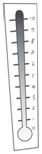 Instructions: Choose a compulsion toward the bottom of the list you created in lesson 2 that you want to change. Use an “anxiety thermometer” to rate how anxious you would feel if you didn’t perform the compulsion. The anxiety thermometer is a 0-10 point scale, with 10 being the most anxious you have ever felt and 0 being the least anxious that you have ever felt. The next time you have the urge to perform the compulsion, don’t do it. Do the opposite of what OCD would normally have you do. Tolerate the anxiety that surfaces-rating your level of anxiety every few minutes.
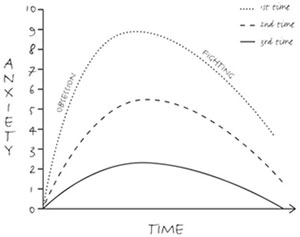 When you resist a compulsion, the anxiety lasts longer than it would if you had followed through on the urge. However, it does not last forever, and it does reduce the more you do this exercise. Your anxiety will lessen until eventually you no longer feel the need to do the compulsion, as shown in the graph to the right.
Perform this exercise daily. Only when you feel that your anxiety has significantly reduced (i.e., a rating of 2 or less)-and that you are able to resist the compulsion-should you move on to another compulsion that you want to change.