Anxious Thinking
Goal
To be able to more readily identify anxious thoughts
Anxious Thinking (Greenberger & Padesky, p. 177, 180)
Anxiety is accompanied by the perception that we are in danger or that we are threatened or vulnerable in some way. A threat or danger can be physical, mental, or social. A physical threat occurs when you believe you will be physically hurt (e.g., a snake bite, a heart attack, being hit). A social threat occurs when you believe you will be rejected, humiliated, embarrassed, or put down. A mental threat occurs when something makes you worry that you are going crazy or losing your mind.
The perception of these threats varies from person to person. Some people, because of their life experiences, may feel threatened very easily and will often feel anxious. Other people may feel a greater sense of safety and security. Growing up in chaotic and volatile surroundings may lead a person to conclude that the world and other people are continually and constantly dangerous.
Anxious thoughts are future oriented and often predict catastrophe. Anxious thoughts often begin with “What if...” and end with a disastrous outcome. Anxious thoughts also frequently include images of danger. Here are some examples of anxious thoughts:
- What if I stumble over my words?
- What if I have a traffic accident on the freeway?
- What if I get hurt?
- What if I am rejected?
Interpretation of Problems (Greenberger & Padesky, p. 4)
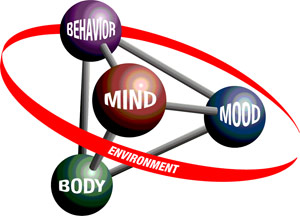 How we understand our problems has an effect on how we cope. Our interpretation of the problems is influenced by thoughts (beliefs, images, memories), moods, behaviors, physical reactions, and environment (past and present). Notice that the five areas are interconnected as shown in the image below. The connecting lines convey that each different aspect of a person’s life influences all the others. For example, changes in our behavior influence how we think and also how we feel (both physically and emotionally). Behavior changes can also change our environment. Likewise, changes in our thinking affect our behavior, mood, physical reactions, and can lead to changes in our social environment. Some thoughts are automatic—making it difficult to understand the influence it is having on the other areas. With practice, however, even automatic thoughts can be improved.
Understanding Automatic Thoughts
Watch this video to better understand automatic thoughts:
http://www.youtube.com/watch?v=m2zRA5zCA6M
Identifying Anxious Thoughts Exercise (Greenberger & Padesky, pp. 180-181)
Instructions: To identify the thoughts that are associated with anxiety or fear in your own life, complete the table below. Think about a recent time when you were anxious, fearful, or nervous. Recall the thoughts you had (in words, in images). If you had a visual image, describe it. If your thoughts were in words, notice if the thoughts began with “What if...”.
| Situation | Moods | Automatic Thoughts/Images |
|---|---|---|
|
Who? What? When? Where? |
|
|
Next Step
By completing this activity often, it will likely become easier to identify your anxious thoughts. In time, you should be able to recognize which thoughts are automatic and be able to decide whether they and the associated emotions make sense or need to be challenged or changed.