Regular Eating
Goal
To be able to establish regular eating patterns
Importance of Regular Eating
Establishing regular eating patterns is crucial for all types of eating disorders. It will rapidly decrease the frequency of binge eating for people who engage in that behavior, address the tendency of people with a high level of dietary restraint to put off eating during the day, and introduce regular meals and snacks that can be subsequently increased in size for people who are underweight. Regular eating consists of eating three planned meals each day, plus two (if underweight, three) planned snacks. You can choose what you eat; however, the meals and snacks must not be followed by vomiting, laxative misuse, or any other compensatory behavior. Plan ahead so you know when you are going to have your next meal or snack. Do not let more than approximately 4 hours go by between the meals and snacks.
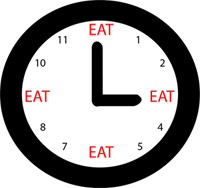 You should consume no more than average-size portions of food. You can determine the size of an average portion by observing eating habits of friends or relatives, from recipes, and from the instructions on food packages. In time, you will be able to rely on your sensations of appetite, hunger, and fullness to assist you in knowing how much to consume. These sensations are likely disturbed right now depending on the nature of your eating disorder and therefore cannot be relied upon.
If you struggle to resist eating in the time periods between the planned meals and snacks, you may find it helpful to plan how you will distract yourself in those instances. Try to predict when difficulties are likely to arise and intervene early by arranging activities that will help you adhere to the regular eating pattern. Additionally, you can focus on your urge to eat and recognize that it is a temporary phenomenon. Observe the urge rather than trying to eliminate it.
Eating Plan Exercise
Instructions: Every morning, write out your eating plan for the day using the table below. In column two, indicate if the food is a snack (S) or a meal (M). List all the foods that you plan to eat for that particular snack or meal on the same line. Remember that you are shooting for three meals each day and two snacks (three if you are underweight) and no more than approximately four hours going by in between when you eat. If the day is going to be unpredictable, plan ahead as far as possible and identify a time when you can take stock and re-plan the rest of the day if need be. If you find it difficult to implement an eating plan for an entire day, begin by focusing on the part of your day when your eating is least problematic (usually the mornings). Gradually (it may take several weeks) extend your plan to include snacks and meals for the entire day.
| Time | S or M | Food | Comments |
|---|---|---|---|
Distraction Exercise (adapted from Beck, 2007, pp. 76-77)
Instructions: Use one of the distractions listed in the table below when you feel the urge to deviate from your eating plan. Feel free to come up with your own distractions and add them to the table. After you use a distraction, rate how effective it was for you. This will help you to know which distractions are most helpful to you.
| Activity | Effectiveness (not at all, mild, moderate, very) |
|---|---|
| Distance myself from food | |
| Throw away food or move it | |
| Play a computer game or a game on my smartphone | |
| Get out of the house | |
| Listen to a relaxation exercise such as: http://www.youtube.com/watch?v=HFwCKKa--18 or http://www.youtube.com/watch?v=7wFX9Wn70eM |
|
| Do a jigsaw puzzle | |
| Make a scrapbook | |
| Organize my closet | |
| Clean out my drawers | |
| Polish my nails | |
| Call a friend or family member to chat | |
| Take a walk | |
| Surf the web | |
| “Window-shop” via the Internet | |
| Write emails or cards | |
| Take a bath or shower | |
| Do a home-improvement project | |
| Do a crafts project | |
| Work in the garden | |
| Download and listen to music | |
| Read a magazine or book | |
| Brush my pet | |
| Plan a trip (real or fantasy) |
Next Step
For now, prioritize when you eat, not what you eat. Avoid counting calories and being too focused on what you are eating. Regular eating is an important skillset to establish first before being concerned about feeding your body in a healthy way.