Family Communication
Goal
To be able to communicate clearly and effectively with family members
Family Communication (Barlow, pp. 443, 452)
 Good communication can go a long way towards reducing family stress. Learning effective communication skills can be a way of decreasing tension and improving family relationships. There are four specific communication skills that you will learn in this lesson: expressing positive feelings, expressing anger, active listening, and making requests.
Expressing Positive Feelings Exercise (Barlow, p. 452)
Instructions: The purpose of positive communication is to increase the likelihood that members of a family will collaborate when dealing with more difficult issues. Praise a family member for some specific behavior they have performed. Tell the family member how this behavior makes you feel.
Example: I appreciate you picking me up on time from work last night. I feel self-conscious when I have to wait around up front until you arrive. It makes me feel loved by you when you pick me up at the time I ask you to.
Expressing Anger (Whitson)
Anger is among the most universal of human emotions, yet all too often, young people struggle to accept their feelings of anger and to know how to express this emotion in honest, direct, relationship-enhancing ways. You have four basic choices when it comes to expressing anger:
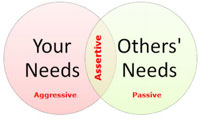 Aggression is one way the feeling of anger is expressed in behavior. Aggression is usually impulsive and unplanned. Aggressive behavior is destructive to relationships because it aims to hurt or damage a person or an object. Aggression can be physical (e.g. punching, kicking) or verbal (e.g. threatening, calling names).
A passive person expresses needs, wants, and feelings in an indirect way. They feel that their needs are not as important as the needs of others, so they behave in ways that allow their needs to be ignored or overlooked. Passive behaviors may take the form of poor eye contact or soft speech.
Passive aggressive behavior is a hidden way of expressing feelings of anger. It involves behaviors designed to get back at another person without the person recognizing the hidden anger. Passive aggressive behaviors include procrastinating, carrying out chores or tasks the wrong way, sulking, or getting hidden revenge.
Assertiveness is a style that is used to express anger in words, in a direct and respectful way. Assertive behavior sets limits on what a person is willing or not willing to do in a situation. It is an honest form of communication in which a person expresses their wants and needs without hurting or violating the rights of others. Assertiveness includes behaviors like good eye contact, even tone of voice, and the use of ‘I’ messages.
Watch the following video to learn more about being assertive and using ‘I’ messages:
Active Listening
Active listening is a great way to care and support another person. At first, you will likely find it to be a bit challenging, but it will be worth the effort. By listening carefully, your family member will feel heard, valued, and understood. Keep in mind that active listening is not counseling or advice giving.
Reflecting content and emotion are two components of active listening. Here are some helpful tips:
| Reflecting Content | Reflecting Emotion |
|---|---|
| Repeat back to the person the facts that they have just shared | Listen for key words |
| Summarize long stories | Repeat back expressed emotions |
| Don’t assume you understand the story-missing the main point can lead to confusion for both of you | Listen for underlying emotion and tentatively suggest a word to label it |
| Don’t add questions, commentary, or suggestions | It’s okay if you label emotions incorrectly |
Tip: You know you’ve done a good job reflecting when your family member provides you with additional information and examines their emotions.
Asking questions is an additional aspect of active listening and can result in helping you understand the person’s experience on another level, help the person explore their motives, guide the person to greater understanding, and focus the conversation. Here are some tips for asking good questions:
 Good questions go beyond asking for more details of a story
- Ask open-ended questions
- Don’t ask too many questions
- When someone is vague or nonspecific, ask for clarification rather than make assumptions
- Allow the deeper issues guide your questions rather than the content
- Here are some examples of good questions:
- How would you like her to respond?
- What is the most important thing you want him to understand?
- What do you like about this situation?
- What is the worst-case scenario?
Making Requests (Barlow, pp. 453-454)
Making requests consists of telling your family member what you would like to see done differently and how it would make you feel. Phrase your requests in a way that they can help you. It is important to choose your words carefully because a person who feels one-down often reacts by refusing to go along with the plan, even though going along with it might be of help to them personally.
Example: When we talk, I would really appreciate it if you’d hang in there and finish talking to me. That would make me feel like we’re partners.
Next Step
Watch the following video to learn more about active listening: