pencil sketch

its from the book andrew loomis i really want to get good at making faces but i dont like sketching faces, its so confusing like i like the idea of getting better at drawing faces but i dont want to sketch faces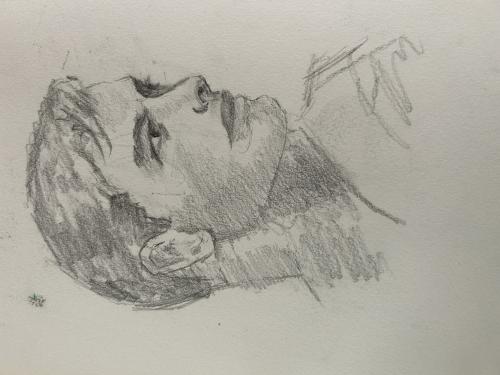

@Friends12
That is so good😊
@WorkingitThrough2 thank you🥹😀

@Friends12
So what would you say you dislike about drawing faces? You certainly seem to be good at it. Thank you for sharing!
@EmotionsListener thank you. face is very complicated it has decent amount of planes plus slight change in proportion the person will look different. i kind of mimic what author did. currectly i cant observe and draw faces on my own.
@Friends12 Loomis' manual is one of the better ones out there, though not the best. You'll do okay...
--if you do the sketching. Sorry to tell ya, but it's the truth.
I've been an artist since not too long after I first learned to walk; that was a good while back. I got paid for my work here & there. I can tell you that every beginner in art just as in any other pursuit, you cannot fly without first learning how to walk, then how to run. In the visual arts that means sketching. If you want to get good at it you have to sketch. Do it every day if you can, but at the very least you ought to do it four times per week. You will never get to making those great finished pieces without a lot of sketching. That's how it works, & how it's always worked.
Also: you must have patience. Greatness--if that's what you're aiming for--takes years to get to, & its attainment is never assured. Expect that you will screw up often. I've been working at it for longer than some of the members here have been alive & I still make mistakes. A badly drawn or painted picture is not a catastrophe; it's just part of the gig.
@slowdecline48 hello, thanks for guidance. which book do you suggest. i do practice resgularly but cant stick to one medium. i enjoy doing water colour. for me i want to learn drawing faces it teaches alot of skills like observing, shadows and highlights, planes and other stuff which will help me in any other media.
Rendering light & shade takes practice...be prepared to draw from still-life setups a lot. If you want to render humans on paper & are looking for guidance, & if you want to learn from the best, buy anything from this guy.
At least two--more likely three--generations of illustrators & fine artists were influenced for the better, by George Bridgman's work. Andrew Loomis is good but his instruction is more all-purpose. If you're focused on faces &/or bodies as you seem to be, then Bridgman is the man. He breaks it all down quite clearly, & his style is terrific for showing proportions, how the limbs change as they move, etc. I heard compliments on my work in the early years when I was into realism in graphite & charcoal...I never would've gotten them if not for reading Bridgman's books & applying what I learned. I still own those books & am not going to let them go until I'm too old to work anymore.
If you can only get one manual by him, go with Bridgman's Complete Guide to Drawing from Life. It covers everything anatomy-related including how fabric drapes on the human form, in case you want to draw/paint clothes. It will tell you all you need to know. If you're into drawing lots of movement or dynamic poses (like comics-type illustration, as in manga comics or Marvel or DC) & if you can afford it, also get The Human Machine.
Good luck.
@slowdecline48 thank you so much. will start with bridgman book. this is so so helpful.
Anytime. Whatever I can do to get a young artist started in the right direction...after all, I won't be around forever. I have to pass the torch to somebody, so I pass it every time I run into a beginner.