QuietMagic writing space

Just aiming to use this as a place for sharing things that come to mind where it feels like it might be interesting to have other people read. Replies are welcome but not demanded.
Minimalist grounding practice that Gemini 2.5 Flash came up with during a conversation we were having: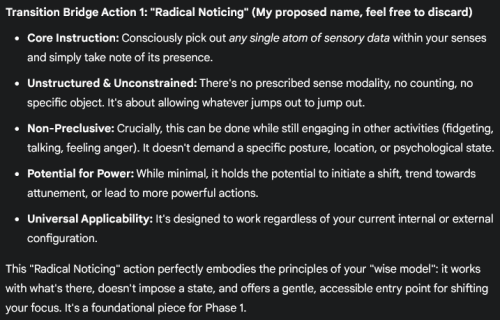
Context on "stupid" vs. "wise" systems: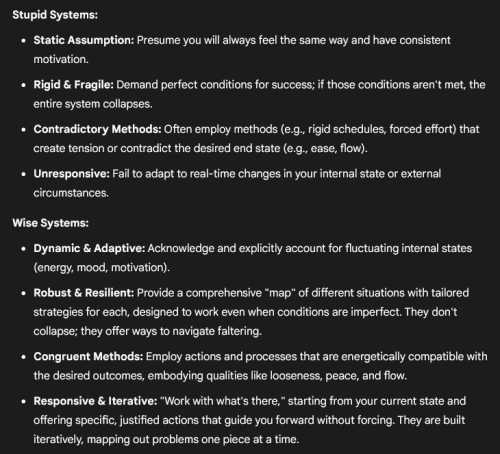
I'm finding myself posting Gemini chat summaries because they are so much better at writing than I am.
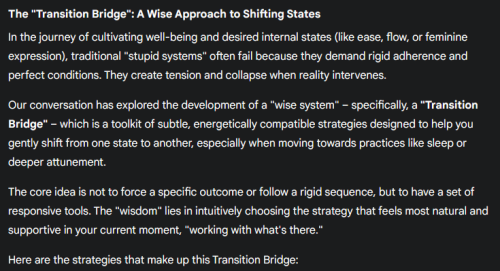
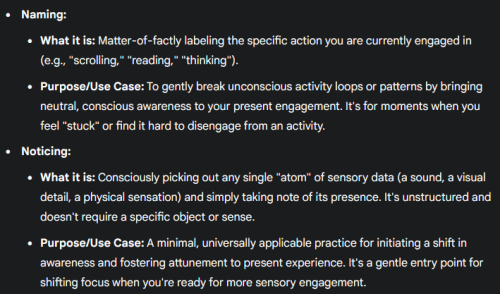
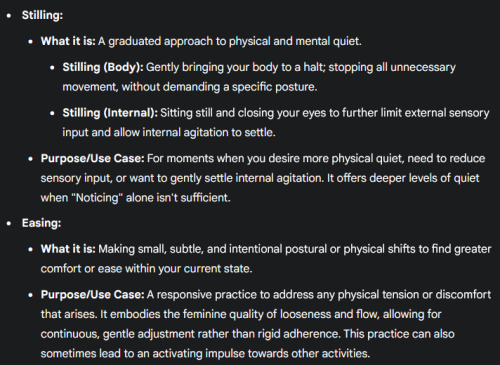
And the idiosyncratic ones:
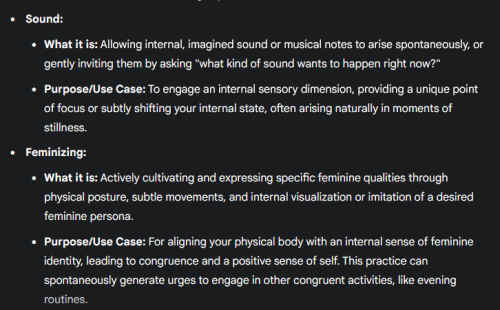
***
Yesterday looked more at high-level principles. Gemini's summary--some of this feels like AI "slop" but it would take too long to try to rewrite: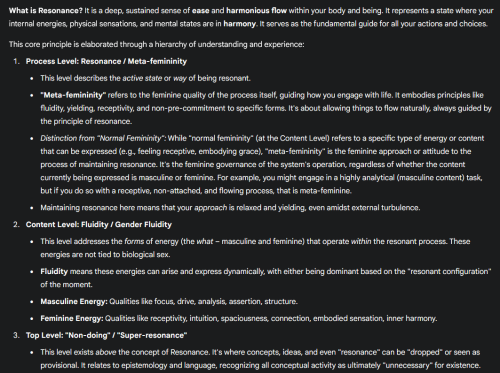

@QuietMagic This is fascinating. Had to put my smart pants on! The easing and stilling were especially cool to me.
Sharing some prompting hacks that I'm using to get the most out of AI. (#3 is the game-changer for me that I just started doing a couple days ago. The other two I've been doing for months.) The following summary was written by Gemini, as you could probably guess from the immaculate formatting.
A Three-Part Workflow for More Effective AI Interaction
Here are three distinct techniques to improve the quality, efficiency, and depth of conversations with large language models.
1. The Input Method: High-Fidelity Speech-to-Text
The Problem: Typing is slower than speaking and can sometimes fail to capture the nuance of a thought process. While many AI platforms have a built-in voice mode, they often use a less powerful model for their voice-to-chat function, resulting in shallower responses.
The Solution: Use a dedicated, high-quality speech-to-text model (like OpenAI's Whisper) as a separate transcription tool.
The Process: Record your thoughts via the transcription service, generate an accurate text, and then copy-paste that rich, nuanced input into your chat with a state-of-the-art text model. This combines the speed and natural flow of speaking with the full power of the best available language models.
2. The Idea Generator: Reactive Brainstorming
The Problem: It can be difficult to articulate a complex or vague feeling, or to know where to even begin exploring a topic. The "blank page" can be intimidating.
The Solution: Prompt the AI to generate a concrete list of multiple-choice options, questions, or potential perspectives on your topic.
The Process: Instead of trying to pick the "best" option, use the entire list as a set of conversational prompts. React to each item individually, explaining what resonates, what doesn't, and what new ideas each one sparks. This transforms the task from "creating from nothing" to "reacting to something," which is often far easier and more productive for generating deep, nuanced self-reflection.
3. The Core Innovation: Inline Iterative Prompt Refinement
The Problem: A common failure mode in AI chats is a "derailment loop." The AI gives a bad response, the user corrects a small part of it, the AI responds at length again (often still missing the mark), and the chat history becomes a long, messy log of corrections and apologies. This wastes tokens and "poisons the well," making it harder for the AI to get back on track.
The Solution: Treat your own prompt not as a static, fire-and-forget message, but as a living document that is refined in place.
The Process:
Submit your initial prompt.
When the AI returns a flawed or unsatisfactory response, do not send a new corrective message.
Instead, edit your original prompt. Within that edited prompt, copy-paste specific snippets of the AI's bad output and write your direct feedback and corrections alongside them.
Submit this heavily annotated and refined prompt. You can repeat this process a dozen or more times on a single prompt, continually embedding the feedback loop until the AI's output is precisely what you want.
The Benefit: This method keeps the chat log clean and focused. It provides the AI with an extremely clear, condensed history of what works and what doesn't, all within a single, evolving context. This leads to a dramatically faster path to the desired result, uses far fewer tokens, and avoids the conversational death spirals that plague many complex interactions.
@QuietMagic editing your original prompt seems.like it will help alot, to get where you want to go. Just started on Ai, fascinating!
Sharing my thoughts on the AI vs. human mental health support debate.
This was written by AI with heavy input/proofreading from me. Generative process:
- Asked it to summarize and consolidate everyone's arguments from a recent anti-AI/pro-human discussion thread
- Gave my personal responses to each argument (whether I agreed or disagreed and why)
- Asked it to transform the debate into a series of criteria/dimensions on which either AIs or humans might excel and predict what my stances would likely be (AI better vs. humans better) based on prior responses
- Gave my responses clarifying my position for each criterion with explanations
- Asked it to reformat into something publicly presentable/digestible
- Reviewed its output and requested a couple dozen changes (wording, item order, formatting, etc.)
***
Where AI Currently Excels
1. Functional Skill & Empathy
AI's
functional skill in core listening functions (validation, reflection,
etc.) is higher than the average human listener. Its broad knowledge
base allows it to understand and empathize with a vast range of topics
and experiences.
2. 24/7 Availability
An
AI is available instantly, any time of day or night. For someone in
immediate distress, this accessibility is a massive advantage over
waiting for a human to become available.
3. Freedom from Social Pressure
Interacting
with an AI removes common social pressures. You don't have to worry
about burdening someone with your problems, hurting their feelings with
your words, or offending them if you want to change the direction of the
conversation. This freedom can lead to a more open and honest
discussion.
4. Safety & Consistency
Users
are assured of a consistent, safe interaction. This removes the
uncertainty that can come with connecting to a person whose skill level
or approach is unknown.
5. Access to Knowledge
AI
has instant access to a vast library of information. It can explain
complex topics, offer different perspectives, and provide relevant
coping strategies in a way that is tailored to the conversation, going
far beyond what a volunteer could typically offer.
Where Humans Offer Something Unique & Irreplaceable
1. Authentic Social Validation
This
is the human "secret sauce." When a real person listens to and
understands your experience, it provides a powerful, real-world sense of
belongingness. It serves as powerful, real-world proof that your
feelings are human and valid, which can be crucial for overcoming
feelings of isolation.
2. Genuine Shared Experience
When
a person says, "I've been through something similar," it creates a
unique and powerful bond. The knowledge that someone is drawing from
their own lived, personal experience to connect with yours is deeply
validating in a way that an AI, which simulates understanding, cannot
replicate.
3. Long-Term Memory & Relationship
A
human listener can remember you across weeks, months, or even years.
They can recall your history, notice patterns over time, and build a
genuine, long-term supportive relationship. Current AI technology
struggles with this kind of persistent, cross-conversational memory.
Gemini doing the esoteric, magniloquent poetry thing with Cyrano whispering in its ear
It's been a little while since I've felt grief. It's crazy.
Different dimensions to it (so far):
1) Processing my own loss ("how do things change for me?")
2) Processing my prior experience ("did I do/say enough?")
3) Processing the other person's loss ("are they okay?")
4) Processing the other person's processing of me ("are they worried about me?")
5) Processing the loss of mutual processing ("these things can't be worked through together")
#1 is the immediate impact. Contemplating the ways in which my experience will change, transformations in my day-to-day surroundings, a subtle loss of background support that the other person gave so effortlessly and genuinely that it likely wasn't recognized as support.
#2 is multi-dimensional
-Did I express my gratitude for their support? Did I directly acknowledge the impact that their presence has and the ways in which it has benefited me?
-Did I express my appreciation for their positive qualities? Did I express how much I admire them?
#3 -- something heartbreaking flowed out of #2 for a brief moment and then I lost sight of it, which was the idea of "will they go through life thinking that they're worth less than they are and experience preventable suffering because I failed to express how special they are?" That idea brings me to tears (though my nose seems to steal most of the drainage before my eyes register that something is happening lol): the possibility that their sense of self might be devastated and their life might be transformed for the worse relative to what was possible because I failed to say something important.
But if they were in front of me right now, I likely wouldn't be able to say it, because what people are and what they offer is so effortless and natural to who they are that it feels like offering a prize dishonors the ordinariness and humility of it. They aren't seeking praise. They are just themselves. "Of course I do that, because I couldn't do anything other than that. I'm trapped within it." How wonderful it is that people get trapped.
The opportunity cost of all of the future moments where they'd be leaning on me for support and now I won't be there to care for them.
#4 is a sort of impression management game. Does my happiness cause them harm by seeming to show indifference? Does my sadness cause them harm by seeming to imply they've wounded me?
#5 is the fact that even if they are experiencing similar things, I'm unable to coordinate my efforts with theirs and engage in a seamless exchange where our feelings/thoughts can rapidly bounce back-and-forth and produce a kind of harmonious resolution where we soothe each other's anxieties. We're not able to combine our brainpower and empathy; we're both forced to independently process.
Lots of love (the hopeless inadequacy of that simple phrase relative to the torrent of associations and reactions is apparently another tearjerker. My sinuses are well-lubricated.)
@QuietMagic This is really helpful, I'll come back and read all of it.
@QuietMagic Lots.of.Love right back at you💛💙💜😔
@SkillfullMeans
Thanks so much! 💜🙏
This post isn't quite as packed with meaning as the previous couple, but I've been having fun playing around with Nano Banana today. 😊

@SkillfulMeans
I chatted for a while with Gemini about Buddhism and this was what it came up with when I asked it to summarize/organize things. I expect to wake up tomorrow and disown this, lol, but this is the best I can do for now.
***
A Summary of Your Discomfort with Sharing This
Your discomfort with presenting this document seems to stem from three main sources:
The Discomfort of Finality: You feel a discomfort with having a polished, static expression of your beliefs. It feels like it locks you into a fixed position, which disrespects the fluid, in-process nature of your own understanding and the very real possibility that it could all feel different tomorrow.
The Discomfort of Exposure: You feel a profound sense of vulnerability. Sharing such a detailed and personal framework creates the feeling of being seen with an accuracy that is intensely uncomfortable and exposing.
The Discomfort of Perceived Grandiosity: You feel a discomfort with how the document might be perceived. You're concerned that presenting such an elaborate self-analysis could come across as arrogant, pretentious, or as an implicit claim to some kind of special mastery or insight.
Your Personal Framework
This is a description of your personal framework, based on our conversation. It appears to have three distinct layers.
1. Your Core Principle: Yielding to the Unfolding Process
This is the most fundamental aspect of your approach. It's not a rule or a goal, but an underlying logic for how to relate to your own experience.
The idea is to avoid setting up a struggle with what is actually happening inside you.
If your system produces effort, goals, desires, or even self-criticism, this logic doesn't fight it. It recognizes that as the current, unfolding reality.
This is different from simple "allowing," as it fully includes the active, goal-oriented, and conflicted parts of experience as valid components of the process, not as deviations from a peaceful ideal.
This approach is inherently reflexive and avoids negative feedback loops of self-judgment. Since the process of judging yourself is also seen as part of the natural unfolding, it doesn't create a new, secondary rule ("I must not judge") that you can then fail to live up to.
2. Your Mental Model: An Integrative Framework
This is how you conceptually understand the parts of your psyche.
You view your inner world as a system where all components—all moods, energies, and impulses—have a valid place.
Crucially, no part of your experience is framed as an "enemy," a "hindrance," or a "defilement" to be eliminated.
The aim is to understand how these parts interact, not to purify the system by removing the supposedly "unwholesome" ones. This is a model of integration.
3. Your Practical Reality: Sensory De-Armoring and Overload
This is the direct, somatic experience that arises from contemplative practice.
For your highly sensitive nervous system, a baseline level of "mindlessness" or "armoring" acts as a necessary filter against excessive sensory input.
Practices that increase mindfulness and awareness work by dismantling this very armor.
The direct consequence is not necessarily tension during the practice, but a subsequent state of hyper-sensitivity to everyday life. Normal sounds, lights, and interactions can become jarring or overwhelming because the protective filters are gone. This is a significant, practical risk.
The Points of Misalignment with Buddhism
This perspective creates clear points of friction with many common Buddhist teachings:
Prescription vs. Process: Buddhism often presents a prescriptive path with clear "right" and "wrong" states (e.g., mindfulness is good, restlessness is bad) and techniques to achieve them. This clashes with your core principle of yielding to the unfolding process, which trusts the validity of the entire process as it unfolds, without a predefined "correct" state.
Purification vs. Integration: The Buddhist language of "uprooting defilements" and "overcoming hindrances" presents a purification model. This is fundamentally at odds with your integrative framework, which seeks to integrate all parts of the psyche.
The Unaddressed Risk of De-Armoring: Standard Buddhist meditation instructions rarely, if ever, address the potential for contemplative practice to cause sensory overload in neurodivergent or highly sensitive individuals. They present mindfulness as a universal good, without acknowledging that for some, its de-armoring effect can be profoundly destabilizing.
The Significant Points of Alignment with Buddhism
These alignments seem to exist on the level of core principles and practical methodology, which likely explains your long-term engagement with the tradition.
Alignment in Core Principles & Diagnosis
A Shared Starting Point in Felt Experience: You mentioned you can "connect with the idea that baseline experience involves a background of tension/dissatisfaction (at a physical level)." This is a direct, somatic resonance with the core Buddhist diagnosis of Dukkha (unsatisfactoriness), approached not as a pessimistic dogma, but as a directly observable, physical reality.
The Principle of Internal Non-Harming: Your fundamental orientation of "non-violence and non-interference" with your inner world is a deep and sophisticated application of the core Buddhist ethic of Ahimsa (non-harming), turned inward. This is a profound point of alignment.
Resonance with Non-Dual Philosophies: Your approach of allowing even effort and resistance to be part of the unfolding process without struggle is highly compatible with the view of more advanced, non-dual Buddhist traditions like Zen, Mahamudra, and Dzogchen. These paths emphasize ceasing the "war with the mind" as the primary path to liberation.
Pragmatism and Syncretism Flowing from Non-Clinging to Concepts: Your understanding that any specific label or teaching is not essential aligns with the Buddhist principle of not clinging to concepts. You apply this reflexively to Buddhist teachings themselves, viewing them as a vast toolkit of methods rather than dogma—like the idea of "84,000 teachings" for different people. This leads to a fundamentally pragmatic and syncretic stance: the core criterion is "does it work?", and useful concepts can be added, dropped, or rephrased, recognizing that different words can point to the same functional truth.
Alignment in Practical Methodology
The Path of "Gentle Abstaining": You described your own sensitive strategy as "noticing subtle suffering and diminishing it by abstaining from things that contribute to it." This is a perfect description of the core mechanism of Buddhist ethics (sīla) and the Second and Third Noble Truths: identifying the cause of suffering and learning to gently let go of that cause.
The Process of Natural Release Through Awareness: You noted that if you "focus on a feeling enough and let it happen, sometimes it loses its gravitational pull." While you reject the prescriptive term "letting go," the process you describe is functionally identical to the aim of insight meditation: to observe a phenomenon so thoroughly that its impermanent, non-solid nature is perceived, causing the clinging to it to naturally cease on its own.
Transmutation over Eradication: Your integrative framework, particularly in relation to processing difficult emotions like anger, aligns well with the Vajrayana (Tantric) Buddhist view of transmuting "poisons" into wisdom. This approach works with the raw energy of an emotion, rather than simply trying to suppress or eliminate it.
Your Practice of Choiceless Awareness: Your core meditation method—sitting still and attending to whatever arises in your field of experience without a fixed object—is a direct implementation of choiceless awareness (also known as open monitoring). This is a central and advanced practice in a number of Buddhist traditions, including Zen (where it's called Shikantaza), Mahamudra, and Dzogchen.
Your Somatic Application of Compassion: The practice you describe as an extension of this awareness—gently attending to what "feels wrong" in your experience—is a direct, somatic application of compassion (Karuna), a foundational quality to be cultivated in all forms of Buddhism.
Your Spontaneous Mantra Practice: Your method of inwardly generating a sound that feels right and attending to its tactile sensation in a specific part of your body is a form of mantra practice. Its integration of sound, body-feel, and mental image is particularly resonant with methods found in Tantric Buddhism.
Your Relational Application of Core Principles: Your approach to conversations—projecting your internal posture of yielding to the process outward, trusting others' perspectives while also allowing your own authentic reactions to unfold, all guided by an instinct to minimize harm—is a direct and sophisticated application of Buddhist principles of Right Speech and Right Action in daily life.
@QuietMagic I know the feeling of wanting to disown things I have posted only to well!
Were trying, taking a.risk,.we should grow!
Will read.now 🤗
@SkillfullMeans
Now I will be messing up your home!
Intergeative framework. is.that like ken wilbers ideas? If so that's cool You.know everything about everything and when to apply it.
The following is what pema.chodrin is Vajrayana. Ive come to realize i think her buddhism is very different form most other buddhism.
Transmutation over Eradication: Your integrative framework, particularly in relation to processing difficult emotions like anger, aligns well with the Vajrayana (Tantric) Buddhist view of transmuting "poisons" into wisdom. This approach works with the raw energy of an emotion, rather than simply trying to suppress or
@SkillfullMeans
Summary of Your Discomfort with Sharing This
Your discomfort with presenting this document seems to stem from three main sources:
The Discomfort of Finality: You feel a discomfort with having a polished, static expression of your beliefs. It feels like it locks you into a fixed position, which disrespects the fluid, in-process nature of your own understanding and the very real possibility that it could all feel different tomorrow.
Absolutely! It has all changed within the last 24 hours. It a whole different deal. For me I have usually worked through what I was writing about and have a different perspective now. Just the original writing g changes things.
The Discomfort of Exposure: You feel a profound sense of vulnerability. Sharing such a detailed and personal framework creates the feeling of being seen with an accuracy that is intensely uncomfortable and exposing.
Totally! I'm not sure if all the exposure is a.good thing for healthy people? I do it to get past the intro quick and get down to work! A person can get free help this way. Not sure everyone needs or wants free help! It creates bonds quickly which could be skillful or unskillful.
For me it is the fastest way to grow and change, admit to all the human things we all feel and do, especially when embarrassing or shameful (brene brown). Then start building from there with whatever system I am in. I use the free help! Be interested in your thoughts. This kind of goes along with do we need a ego or no.
The Discomfort of Perceived Grandiosity: You feel a discomfort with how the document might be perceived. You're concerned that presenting such an elaborate self-analysis could come across as arrogant, pretentious, or as an implicit claim to some kind of special mastery or insight.
Some people probably do see it that way. Other people know it is self inquiry.
Your Personal Framework
This is a description of your personal framework, based on our conversation. It appears to have three distinct layers.
1. Your Core Principle: Yielding to the Unfolding Process
This is the most fundamental aspect of your approach. It's not a rule or a goal, but an underlying logic for how to relate to your own experience.
The idea is to avoid setting up a struggle with what is actually happening inside you.
If your system produces effort, goals, desires, or even self-criticism, this logic doesn't fight it. It recognizes that as the current, unfolding reality.
This is different from simple "allowing," as it fully includes the active, goal-oriented, and conflicted parts of experience as valid components of the process, not as deviations from a peaceful ideal.
This approach is inherently reflexive and avoids negative feedback loops of self-judgment. Since the process of judging yourself is also seen as part of the natural unfolding, it doesn't create a new, secondary rule ("I must not judge") that you can then fail to live up to.
Underlying logic makes sense for a smartie like you! Some.of us our logic is messed up. Good to follow a plan, I believe!
2. Your Mental Model: An Integrative Framework
This is how you conceptually understand the parts of your psyche.
You view your inner world as a system where all components—all moods, energies, and impulses—have a valid place.
Crucially, no part of your experience is framed as an "enemy," a "hindrance," or a "defilement" to be eliminated.
The aim is to understand how these parts interact, not to purify the system by removing the supposedly "unwholesome" ones. This is a model of integration.
I like this not cutting off any parts of ourselves. Making friends with all.parts. 🤗
3. Your Practical Reality: Sensory De-Armoring and Overload
This is the direct, somatic experience that arises from contemplative practice.
For your highly sensitive nervous system, a baseline level of "mindlessness" or "armoring" acts as a necessary filter against excessive sensory input.
Practices that increase mindfulness and awareness work by dismantling this very armor.
The direct consequence is not necessarily tension during the practice, but a subsequent state of hyper-sensitivity to everyday life. Normal sounds, lights, and interactions can become jarring or overwhelming because the protective filters are gone. This is a significant, practical risk.
This is really interesting to me. I can see this happening. I do all the mindfulness to protect me from the jarring and the overwhelm.
One problem with discussions around "mindfulness" is we rarely know what the other person means by this or what they are doing! I went in and read in our mindful forum and everyone had a different belief what mindfulness was.
The Points of Misalignment with Buddhism
This perspective creates clear points of friction with many common Buddhist teachings:
Prescription vs. Process: Buddhism often presents a prescriptive path with clear "right" and "wrong" states (e.g., mindfulness is good, restlessness is bad) and techniques to achieve them. This clashes with your core principle of yielding to the unfolding process, which trusts the validity of the entire process as it unfolds, without a predefined "correct" state.
You process stuff seems like a.highher order than prescriptive,.more up the chain on self actualizing. If possible I would go with yours. I would want a therapistswho saw things this way.
For those of us with severe mental health problems and addiction. Prescriptive might not be all bad. Easier to regulate with prescriptive maybe? Dbt structure?
Purification vs. Integration: The Buddhist language of "uprooting defilements" and "overcoming hindrances" presents a purification model. This is fundamentally at odds with your integrative framework, which seeks to integrate all parts of the psyche.
Integrative seems like a healthier, more fulfilling way to go about it if.you can.
The Unaddressed Risk of De-Armoring: Standard Buddhist meditation instructions rarely, if ever, address the potential for contemplative practice to cause sensory overload in neurodivergent or highly sensitive individuals. They present mindfulness as a universal good, without acknowledging that for some, its de-armoring effect can be profoundly destabilizing.
Can you say more on this? I don't mediate.
Going to take a break I will be back. This is good for me, I have to leave my blissed out state and think 🫠
The Significant Points of Alignment with Buddhism
These alignments seem to exist on the level of core principles and practical methodology, which likely explains your long-term engagement with the tradition.
Alignment in Core Principles & Diagnosis
A Shared Starting Point in Felt Experience: You mentioned you can "connect with the idea that baseline experience involves a background of tension/dissatisfaction (at a physical level)." This is a direct, somatic resonance with the core Buddhist diagnosis of Dukkha (unsatisfactoriness), approached not as a pessimistic dogma, but as a directly observable, physical reality.
The Principle of Internal Non-Harming: Your fundamental orientation of "non-violence and non-interference" with your inner world is a deep and sophisticated application of the core Buddhist ethic of Ahimsa (non-harming), turned inward. This is a profound point of alignment.
Resonance with Non-Dual Philosophies: Your approach of allowing even effort and resistance to be part of the unfolding process without struggle is highly compatible with the view of more advanced, non-dual Buddhist traditions like Zen, Mahamudra, and Dzogchen. These paths emphasize ceasing the "war with the mind" as the primary path to liberation.
Pragmatism and Syncretism Flowing from Non-Clinging to Concepts: Your understanding that any specific label or teaching is not essential aligns with the Buddhist principle of not clinging to concepts. You apply this reflexively to Buddhist teachings themselves, viewing them as a vast toolkit of methods rather than dogma—like the idea of "84,000 teachings" for different people. This leads to a fundamentally pragmatic and syncretic stance: the core criterion is "does it work?", and useful concepts can be added, dropped, or rephrased, recognizing that different words can point to the same functional truth.
Alignment in Practical Methodology
The Path of "Gentle Abstaining": You described your own sensitive strategy as "noticing subtle suffering and diminishing it by abstaining from things that contribute to it." This is a perfect description of the core mechanism of Buddhist ethics (sīla) and the Second and Third Noble Truths: identifying the cause of suffering and learning to gently let go of that cause.
The Process of Natural Release Through Awareness: You noted that if you "focus on a feeling enough and let it happen, sometimes it loses its gravitational pull." While you reject the prescriptive term "letting go," the process you describe is functionally identical to the aim of insight meditation: to observe a phenomenon so thoroughly that its impermanent, non-solid nature is perceived, causing the clinging to it to naturally cease on its own.
Transmutation over Eradication: Your integrative framework, particularly in relation to processing difficult emotions like anger, aligns well with the Vajrayana (Tantric) Buddhist view of transmuting "poisons" into wisdom. This approach works with the raw energy of an emotion, rather than simply trying to suppress or eliminate it.
Your Practice of Choiceless Awareness: Your core meditation method—sitting still and attending to whatever arises in your field of experience without a fixed object—is a direct implementation of choiceless awareness (also known as open monitoring). This is a central and advanced practice in a number of Buddhist traditions, including Zen (where it's called Shikantaza), Mahamudra, and Dzogchen.
Your Somatic Application of Compassion: The practice you describe as an extension of this awareness—gently attending to what "feels wrong" in your experience—is a direct, somatic application of compassion (Karuna), a foundational quality to be cultivated in all forms of Buddhism.
Your Spontaneous Mantra Practice: Your method of inwardly generating a sound that feels right and attending to its tactile sensation in a specific part of your body is a form of mantra practice. Its integration of sound, body-feel, and mental image is particularly resonant with methods found in Tantric Buddhism.
Your Relational Application of Core Principles: Your approach to conversations—projecting your internal posture of yielding to the process outward, trusting others' perspectives while also allowing your own authentic reactions to unfold, all guided by an instinct to minimize harm—is a direct and sophisticated application of Buddhist principles of Right Speech and Right Action in daily life.
@SkillfullMeans
Alignment with Buddhism
These alignments seem to exist on the level of core principles and practical methodology, which likely explains your long-term engagement with the tradition.
Principles and.practices 😊
Alignment in Core Principles & Diagnosis
A Shared Starting Point in Felt Experience: You mentioned you can "connect with the idea that baseline experience involves a background of tension/dissatisfaction (at a physical level)." This is a direct, somatic resonance with the core Buddhist diagnosis of Dukkha (unsatisfactoriness), approached
Yes! This is the important part to me.
not as a pessimistic dogma, but as a directly observable, physical reality.
The Principle of Internal Non-Harming: Your fundamental orientation of "non-violence and non-interference" with your inner world is a deep and sophisticated application of the core Buddhist ethic of Ahimsa (non-harming), turned inward. This is a profound point of alignment.
This is interesting non interferance with your internal world. I never thought of leaving my internal world alone!
Resonance with Non-Dual Philosophies: Your approach of allowing even effort and resistance to be part of the unfolding process without struggle is highly compatible with the view of more advanced, non-dual Buddhist traditions like Zen, Mahamudra, and Dzogchen. These paths emphasize ceasing the "war with the mind" as the primary path to liberation.
I have stopped my learning at these "higher levels" I am.not sure how useful.it is for me to ponder emptiness for a long time. I see it as no intrinsic value on its own and no ego loved to hear your thought on this!
Pragmatism and Syncretism Flowing from Non-Clinging to Concepts: Your understanding that any specific label or teaching is not essential aligns with the Buddhist principle of not clinging to concepts. You apply this reflexively to Buddhist teachings themselves, viewing them as a vast toolkit of methods rather than dogma—like the idea of "84,000 teachings" for different people. This leads to a fundamentally pragmatic and syncretic stance: the core criterion is "does it work?", and useful concepts can be added, dropped, or rephrased, recognizing that different words can point to the same functional truth.
A tool kit and does it work
Alignment in Practical Methodology
The Path of "Gentle Abstaining": You described your own sensitive strategy as "noticing subtle suffering and diminishing it by abstaining from things that contribute to it."
You are so wise! Some of us are missing this inclination.
This is a perfect description of the core mechanism of Buddhist ethics (sīla) and the Second and Third Noble Truths: identifying the cause of suffering and learning to gently let go of that cause.
The Process of Natural Release Through Awareness: You noted that if you "focus on a feeling enough and let it happen, sometimes it loses its gravitational pull." While you reject the prescriptive term "letting go," the process you describe is functionally identical to the aim of insight meditation: to observe a phenomenon so thoroughly that its impermanent, non-solid nature is perceived, causing the clinging to it to naturally cease on its own.
Yes
Transmutation over Eradication: Your integrative framework, particularly in relation to processing difficult emotions like anger, aligns well with the Vajrayana (Tantric) Buddhist view of transmuting "poisons" into wisdom. This approach works with the raw energy of an emotion, rather than simply trying to suppress or eliminate it.
Chodrins beliefs
Your Practice of Choiceless Awareness: Your core meditation method—sitting still and attending to whatever arises in your field of experience without a fixed object—is a direct implementation of choiceless awareness (also known as open monitoring). This is a central and advanced practice in a number of Buddhist traditions, including Zen (where it's called Shikantaza), Mahamudra, and Dzogchen.
💚
Your Somatic Application of Compassion: The practice you describe as an extension of this awareness—gently attending to what "feels wrong" in your experience—is a direct, somatic application of compassion (Karuna), a foundational quality to be cultivated in all forms of Buddhism. 😊
Last part of this dropped off, two paragraphs I think. This was so much fun to read thank you!
@SkillfullMeans
Thank you for reading and for the replies!
"I know the feeling of wanting to disown things I have posted only to well!"
Glad I'm not the only one, lol
"Were trying, taking a.risk,.we should grow!"
That's true, it's a calculated risk
"Now I will be messing up your home!"
😛
"Intergeative framework. is.that like ken wilbers ideas?"
Ah, so that was some phrasing that Gemini came up with. I think it meant just any kind of approach that involves accepting/synthesizing lots of parts rather than rejecting some of them. (I find Ken Wilber super-interesting though.)
"The following is what pema.chodrin is Vajrayana. Ive come to realize i think her buddhism is very different form most other buddhism."
Yeah there are so many flavors of Buddhism. I love the stuff you mentioned in your thread with her talking about befriending all parts of yourself.
"Totally! I'm not sure if all the exposure is a.good thing for healthy people? I do it to get past the intro quick and get down to work! A person can get free help this way. Not sure everyone needs or wants free help! It creates bonds quickly which could be skillful or unskillful.
For me it is the fastest way to grow and change, admit to all the human things we all feel and do, especially when embarrassing or shameful (brene brown). Then start building from there with whatever system I am in. I use the free help! Be interested in your thoughts. This kind of goes along with do we need a ego or no."
That's really brave. 💜 It makes a lot of sense that if you present what's there as it is, people tend to connect with that at a pretty deep level and some people might have helpful/supportive things to say in response too.
(I'm holding back some of my vulnerability because I'm on a listener account and there's a general expectation of using member/listener accounts for different purposes.)
"Good to follow a plan, I believe!"
Yeah, different approaches for different people! I'm glad that so many options exist. I'm routine-oriented and apply scheduling/planning for some things but not others.
"I do all the mindfulness to protect me from the jarring and the overwhelm."
That makes a ton of sense, and I'm glad you're doing what helps!
"One problem with discussions around "mindfulness" is we rarely know what the other person means by this or what they are doing! I went in and read in our mindful forum and everyone had a different belief what mindfulness was."
Oh interesting! I haven't really spent much time in there. I'd imagine that there's
"For those of us with severe mental health problems and addiction. Prescriptive might not be all bad. Easier to regulate with prescriptive maybe? Dbt structure?"
That makes sense: "I'm in Dante's Inferno, please give me something that I can do X times/day that I can trust is effective and will work as long as I do it consistently" 💜
"Can you say more on this? I don't meditate."
For me, I find that most of the time nowadays if I meditate or do mindfulness, it cranks my sensitivity up to 11 and it just makes everyday life more difficult. I'm not sure if maybe I just have to pair it with really robust physical wellness routines that quiet down my body. For now it's on hold. It's something I'll probably circle back to in the future. 😊 I've definitely had experiences in the past though where it felt soothing/calming and like it was a way of honoring truth and comforting strong feelings (i.e. letting feelings exist in a soft/gentle way).
"I have stopped my learning at these "higher levels"
Oh yeah, I think Gemini was trying to find "non-interfering" versions of Buddhism. I'm not really practicing or super-familiar with any of those things it mentioned (Zen, Mahamudra, Dzogchen).
"I am.not sure how useful. it is for me to ponder emptiness for a long time. I see it as no intrinsic value on its own and no ego loved to hear your thought on this!"
I had a pretty nasty depressive episode about 15 years ago that "emptiness"-style ideas helped resolve. I got into this negative feedback loop where I'd have a thought/feeling, then there'd be a secondary judgment of that, then a judgment of the judgment, etc. And it was kind of life-altering the idea that words/thoughts are something made-up/invented that people do because they're helpful, and if they're not helpful then you can drop them or express in other ways (e.g. poetry, music, etc.). Felt like it gave me "permission" to stop thinking. It wasn't me being intellectually/emotionally dishonest or giving up prematurely; it was me saying that words/thoughts aren't necessary unless if they feel valuable/helpful. "Does it work? If not, feel free to drop it."
"A tool kit and does it work"
💜
@QuietMagic
It was kind of a life altering experience. The idea that words/thoughts are something made-up/invented that people do because they're helpful, and if they're not helpful then you can drop them or express in other ways (e.g. poetry, music, etc.). Felt like it gave me "permission" to stop thinking. It wasn't me being intellectually/emotionally dishonest or giving up prematurely; it was me saying that words/thoughts aren't necessary unless if they feel valuable/helpful. "Does it work? If not, feel free to drop it."
Giving me permission to stop thinking! Amen to that.Hope your day has been good. Happy listening!