
@ChopWoodAndCarryWater
Fair play 💚🤗
@ChopWoodAndCarryWater
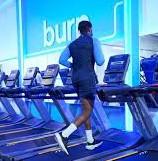
Did you enjoy it ? I enjoy mixing in speed intervals ocassionally usually after gentle jog warm up or just as a set of progression ones 😉

@RunningMachine I did enjoy it.
@ChopWoodAndCarryWater
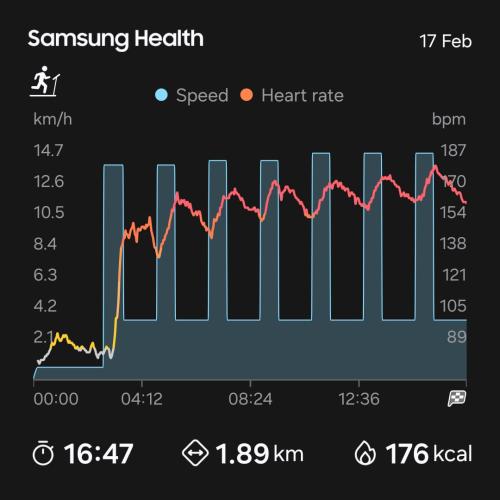
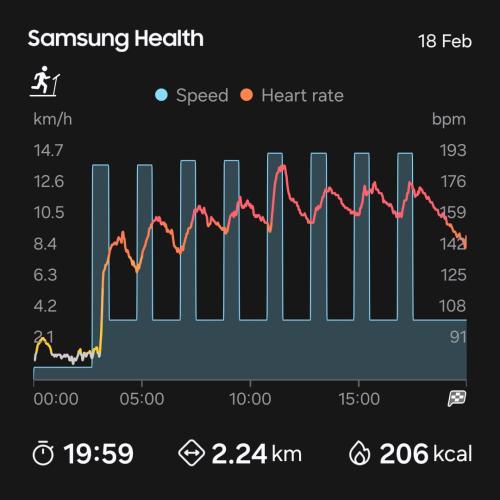
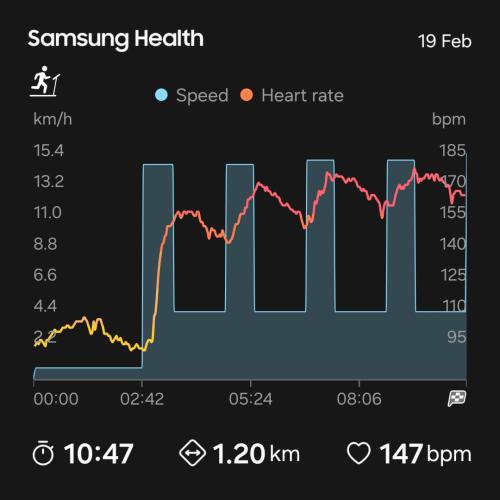
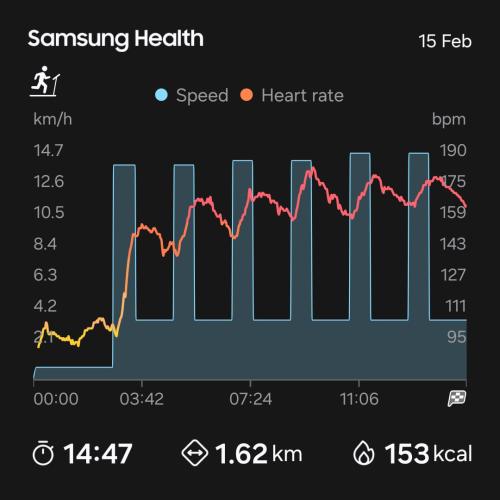
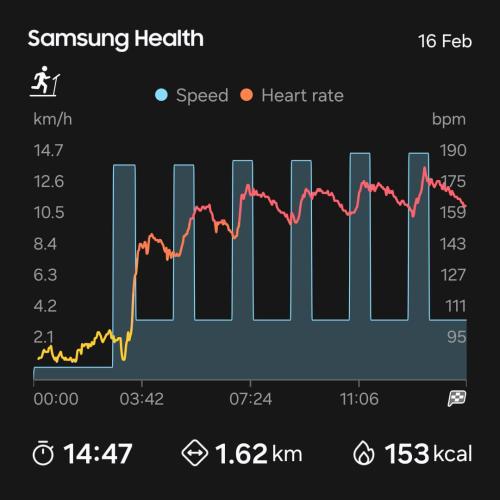
Do you know what your max hear rate is ? your heart rate seems pretty high. It appears like your doing a 3 minutes or so warm up. most runners say 'the first mile always lies', you might find it more comfortable with 6-7 min warm up and a couple of slower intervals at the start to lift heart rate a little slower before taking it so high.
@RunningMachine 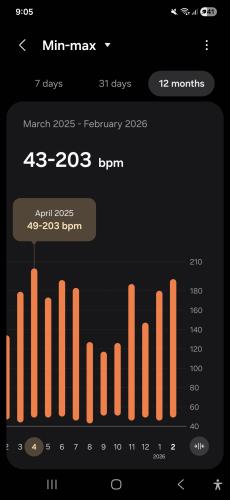
@ChopWoodAndCarryWater
Based on the 220-age formula, which isn't particularly accurate that would suggest you are late teen early twenties so that hitting 175 isn't so bad.
What are you trying to achieve with speed intervals ? 1.6 km in 15 mins seems relatively slow pace for the heart rates your reaching, most days, being much older and just maintaining fitness, weight control I'm running 10-12 km in an hour at an average of 124 bpm.
I'm skinny fat. 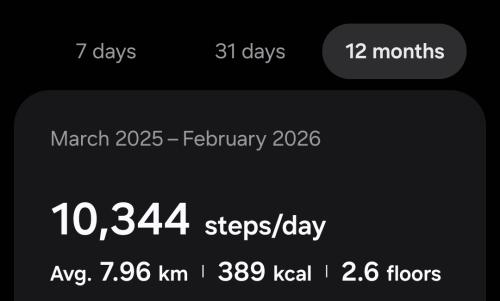
@RunningMachine An uninterrupted treadmill session of longer than 20 minutes is not allowed at the gym I go to.
@ChopWoodAndCarryWater
Easily solved, 20 min treadmill, the same on rower and cross trainer, or equivalents 😄
Being a former racing cyclist I love the spin classes and tend to hit my intensity sessions on it 😄😄
@RunningMachine Not much of those step counts have been runs. I've not been a regular runner.
@ChopWoodAndCarryWater
That was way triggered me to respond,, I was struggking to see what the purpose of 1km Hit a day was for.
Short high intensity Hit sessions work if you have a good endurance based or are mixing them in with longer low intensity base work as one works the aerobic system and the Hit targets anaerobic tolerance. Both will lify tour VO2 max over time.
High intensity work works better with resistance training, as recovery and building muscle works better with it. Too much low resistance CV impairs muscle growth as it isn't stimulated enough to grow.
My initial questions was about your objectives, you stated raising your VO2 max, I'm interested why ? VO2 max is literally the maximum volune of oxygen your blood can absorbed at maximum intensity, wrist bases activity trackers etc can only estimate bases on age standards, pace, duration and heart rate which is merely an estimation and even popular brands like Garmin, Polar etc aren't accurate. With my past I can't trust them at all as they would be miles off
If you have got limited time to train and nut training to compete on races, then for the benefit of your heart, i.e lower stress, I would recommend splitting your training a little at least
My current focus is ultimatey to lift keep my blood circulation as optimal as I can, slow steady warm up so it contracts fully before lifting pace a little upto the top end on my aerobic zone. I then do walk/run intervals keeping heart rate within Zone2. It works as a staple run I can repeat daily, keeps heart in shape while maximise fat burning, both designed to minimise my risk of Thrombosis.
I'm happy to help tailor a plan with you if you would like ? I remain a little concerned that without a solid aerobic pace, daily 1k Hit sessions on their own is just unnecessary strain with minimal gain.
@ChopWoodAndCarryWater
As an aside, it's also worth focusing on breathing, in through the nose ( nasal passages filter nitrogen monoxide) ans out through the mouth. If you focus on forcing the out breath you are clearing more CO2 which is what essentially triggera your heart rate rise, the less NO and CO2 in your blood the easier it can absorb oxygen. Also by forcing the whale you are effectively creating a vacuum effect which makes the inhalation more effective.
One of the factors that surprises me most 40 years ago, is that on average even professional level athletes with really high VO2 Max's only absorbed no more the 70% of the oxygen inhaled each breath.
@RunningMachine I keep it a point to keep my mouth shut during HIT. I, inhale and exhale from my nostrils only. Never from my mouth. When I can breathe no more, I pull the lever.