Can Walking Reverse Brain Aging?

A recent study finds that exercise can strengthen the brain and improve memory.
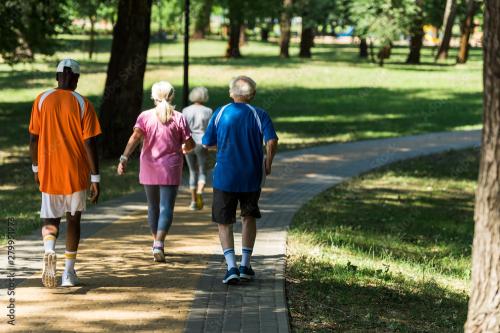
The brain is mainly made up of two types of substances: gray and white matter. White matter is made up of myelinated axons that connect different parts of the brain. They generate electrical signals and release chemicals to transmit information. As we age, white matter deteriorates; as a result, the signal becomes slower, misdirected, or lost. White matter degeneration is even more severe in people with cognitive impairment and/or dementia.
Because the global incidence of dementia is projected to double every 20 years, developing effective strategies to slow down cognitive decline—in both healthy and unhealthy brains—is critical. Fortunately, there is room for reclaiming white matter integrity even in our 60s and beyond. What's more, improvement or decline in brain health can occur in a relatively short time. One study showed that a decline in white matter integrity can occur over a short period of only six months in healthy older adults.
There are some encouraging findings on the reversibility and the slowing down of age-related white matter shrinkage. In one study, of Colorado State University in Fort Collins, researchers collected brain images and cognitive measurements from a group of healthy sedentary men and women (60-79 years old; the average age was 65 years). They randomly assigned participants to one of three conditions: walking, dancing, or active control. Active control involved exercises designed to improve flexibility, strength, and balance with the aid of yoga mats and blocks, chairs, and resistance bands specifically designed for people 60 years of age or older.
Both the walking and dance interventions resulted in an increase in white matter and/or reduction in decline rate. However, the walking group showed more widespread positive effects as compared to either the dance group or the control group. What's more, the post-program improvements in white matter integrity correlated with improved memory only for the walking condition.
These results offer lots of hope. It is remarkable that age-related declines in white matter can be rescued after a brief period of moderate aerobic exercise training. It is equally important that these physiological changes led to noticeable improvements in memory function after only six months of exercising. One can imagine that unhealthy behaviors such as smoking, poor diet, and sleep deprivation, would lead to earlier and more severe white matter impairments. Future research will have to confirm these conjectures.
Conclusions- The antiqued idea that the neural tissue can’t regenerate is a myth!
- Although more research is needed, overall healthy living seems to improve both physical and mental health.
- Moderate aerobic walking three times a week can reverse age-related white matter impairments, as well as improve memory.
What is your favorite type of exercise? Do you consider incorporating walking into your everyday life?
#Exercising #HealthyLiving #Brain #Aging #Cognition

@calmDew1576
I must admit, I am not the biggest exercise fan :P
However, if I had to choose cardio is definitely the kind I enjoy the most!
I've seen so many benefits of walking lately, including this post, I think walking might be the way to go!
Thanks for the great post Dew<3 🌿🌺
@innateJoy9602 It so important that you see this as motivation! I agree that cardio is the best! Much less injuries and much more benefits. Plus it increases endurance. Thank you so much!

@calmDew1576
Thank you for sharing this great article! I do not like exercise that much, but I like doing yoga and I would also like to implement taking regular walks during the weekend.
@globalBraid3744 This is amazing! A walk outside can be much more fun that walking at the gym, I highly recommend it. Thank you so much for your reply <3

Walking helps in addition to physical contributions, it helps additionally in the way of being with oneself deeply, recalling memories, being nostalgic, seeing the nature, trees, different places, different people, all these kind of side positive effects also facilitate a healtier life too
@bilenn I believe so too. I have been thinking if there's any difference between walking at the gym or walking in nature from a research perspective. Thank you for sharing you thoughts!