Healthline: Tips for Finding a Culturally Competent Therapist

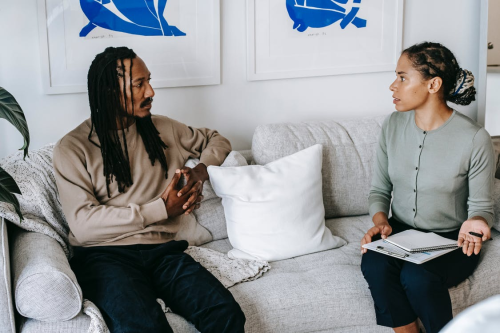
“I think folks believe I’m joking when I say it took seeing six or seven mental health professionals before I found one who was a good fit. I wouldn’t say the others were bad counselors — at least not all of them. What I can say is that they were a bad fit for me as a Black woman.
The early stages of locating mental health assistance can be overwhelming. I’ve found that many individuals are unsure of what to look for in mental health professional.
Here are a few things to consider:
Friend material - I suggest looking for the same qualities in a mental health professional that you’d look for in a friend. Are they good listeners? Do they show empathy? Do they get the language you use?
Make a list -The best way to develop your list of non-negotiables is to consider what you’re seeking support for. Are you struggling to process your race or gender? Are your experiences as an individual with a disability making you feel like no one understands what you’re going through?
Use these struggles as a guiding light to locate providers who understand, or at least affirm, your experiences.
Ask questions - After you make your list of needs, ask prospective providers how much experience they have with clients whose needs are similar to yours. More experience means it’ll be less work for you to educate them about your worldview. That’s the last thing anyone needs when seeking support.
Once you know your must-haves, you can start researching the professionals who are available to you, both in-person and online. Here are some tips to keep in mind:
Use your network - An individual without access to resources has the burden of finding the right care for themselves. That research process varies greatly depending on your insurance and life context. Sometimes the best place to start is with word of mouth. Members of your community may be able to refer you to competent, empathetic therapists who can serve your specific needs.
What worked for others - I spoke to two fellow BIPOC about their journey finding the right therapist. They shared their process and what worked for them.
As an African American man, Keenan White knew that he needed a professional who would understand the stressors of growing up Black. “My nonnegotiables were Black, professional, and experienced, as well as LGBT-friendly: an ally or part of the community,” he says. He began his search on Google. He used keywords about race and orientation, and even surnames, to locate a counselor who fit.
Shayna Lonoaea-Alexander, a Pacific Islander who’s also a community activist, knew she needed someone who was queer-friendly and affirming, understood oppressive systems, and could accommodate her busy schedule. “I put together a spreadsheet using an online directory provided by my insurance company. I researched therapists’ backgrounds and clinics they worked in, and, honestly, it was important to me to receive services from a queer-friendly and welcoming clinic,” she says.
Trial and error - Just as I had to try out several counselors before finding the right person for me, other people of color often see multiple counselors before settling on a quality fit.”
Read the whole article here
#Therapy #MentalHealth #Culture
💬 Do you think it is important to have a therapist from the same/similar cultural background?

@globalBraid3744
A really good and interesting article! I really love these types of articles since it makes readers stop and wonder about important subjects like this. Personally, I do think having a therapist from a similar cultural background can certainly help in certain aspects like having the same values and maybe even religion? But the downside is that there is a bigger risk for the therapist to feel "biased" and maybe become blindsided by the client's need than a therapist that has an entirely different cultural background would be able to see and provide. So it can certainly be a big benefit to have a therapist sharing the same cultural background but it can also become an obstacle.

I feel like a lot of this applies for disability too.
I have had an experience with a therapist who mostly dealt with psychosomatic types of symptoms and he wanted to use the same approach on me.
I can't comment too much on the practice of trying to do a bit more each day for something like depression, even if feeling very fatigued from it. I definitely know that for my health conditions that is not a solution as a way to reduce frustrated with spending a lot of time in bed or on the couch.
@AffyAvo
I agree with you! I think this guide can be applied to any special needs that a person might have. I think it might be good to tell the therapists our expectations as it might help them to adapt their approach.
@globalBraid3744 In my specific example, we had the conversation and he informed me he would be unable to help me if I wasn't going to follow his suggestions.
Which isn't a bad thing either, sometimes that upfrontness is nice to have although it didn't happen until the 2nd (maybe 3rd) session. I think he was thinking things over after our 1st session. I wish more of that could just occur through the matching system that was used (an EFAP).
@AffyAvo
Thank you for providing the example! I agree with you that lots of incidents like this could be avoided by improving the matching system. It would be better for both parties, the client and the therapist and there would be less disappointment and frustration on the client's side.

@globalBraid3744 i think it's more about aligned cultural beliefs
a lot of time that means having the same cultural background but sometimes not so much
@zealousGrace5023
This is a good point! Sometimes even people coming from different backgrounds can be a good fit if they share a belief system. Thank you for sharing.
@globalBraid3744 happy to share ^_^