How Your Muscles Affect Your Mental Health

Why the gym may be your most powerful antidepressant.
KEY POINTS
- Muscle tissue communicates directly with the brain and other organs through chemicals called myokines.
- Through these chemical interactions between muscles and the mind, exercise improves cognitive function and mental health.
- The brain is designed for movement. This is why inactivity breeds depression and cognitive decline while exercise fuels well-being.

Image source: Pexels.com
"You're probably underestimating your muscles. In fact, almost everyone does. While everyone knows, for instance, that muscles are important for function—activities such as walking, climbing, and lifting—few appreciate just how important muscles are for feeling.
If you haven't noticed this mood-muscle connection yourself, take heart; it is only a recent discovery. Surprisingly, the entire scientific community remained in the dark until approximately 2003 (1) when a team of Copenhagen-based researchers reported a remarkable discovery: Muscles at work secrete tiny chemical messengers called myokines that exert powerful effects on organ function, including brain function (2).
Through the actions of myokines, muscle tissue communicates directly with the brain about its activity, triggering a cascade of biological responses that improve memory, learning, and mood (see Figure 1 below). This newly discovered mechanism implies that a person engaging in physical activities that build and maintain healthy muscle tissue can expect to enjoy a range of cognitive and mental health benefits. Recent clinical trials show precisely this effect (3).
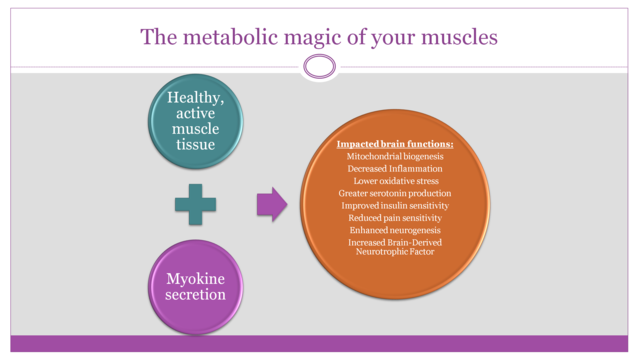
This brings us back to resistance training. Given the vital roles your muscles play in energy production and brain function, perhaps it is time to begin appreciating resistance training and muscle building as being useful for more than athletes and magazine models. Using your muscles against resistance, for example, is far more effective for strengthening your bones than any calcium supplement (4). Regular muscle activity also improves insulin resistance (the cause of diabetes and many other metabolic conditions) better than any prescription medicine.
And now we know that stimulating muscle tissue with resistance training has emotional effects rivaling those of conventional antidepressants and psychotherapies (3). Recent neuroscience suggests that we evolved brains for one primary reason: to move (5).
Counterintuitive to our traditional preoccupation with thinking, the primary function of the human brain is to coordinate complex movement (this is probably why we have brains while giant but stationary redwood trees do not). Recognizing this intimate connection between the brain and movement, the biological basis of the mind-muscle relationship becomes clear, and the importance of resistance training for optimal physical and emotional health becomes indisputable."
Read the full available article at Psychology Today
Reflection: Have you noticed a connection between increasing ones muscle growth and improved mental health?
#Muscles #MentalHealth #Connection

@professionalVision2624
I have noticed!
It’s interesting to learn about the process!
Whenever, I exercise in the morning I feel so upbeat and positive.
Whereas if I miss a few days, I begin to feel a bit gloomy!
Thanks for the article! 💛💫
@innateJoy9602
Yes! I have also noticed a difference in excersising in the morning in contrast to when I don't. I can relate to the feeling of "feeling energized and upbeat" Thank you so much for your awesome response!