Recognizing Negative Automatic Thoughts
Goal
To recognize negative automatic thoughts about weight management.
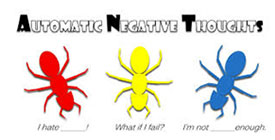 Back in the second lesson, we discussed how our thoughts impact our behaviors and feelings, how our behaviors also impact our feelings and thoughts, and how are feelings can also do that. This time, we are going to center on negative thoughts that you may have about weight management. Automatic thoughts are the way we talk to ourselves, the conversation we have internally without even realizing it.
Sadly, we often don’t talk to ourselves in a healthy way. In fact, a lot of us talk to ourselves in a way we would never let someone else speak to our friends or us! These thoughts can often be grouped into one of 10 categories. We are going to look at each one and see what it might sound like if Jordan had a similar thought.
- Overgeneralization: making a general conclusion based on one piece of evidence.
- Jordan checks in on her healthy eating goal and realizes she did very poorly this week “I am once again failingat this, I’m never going to meet this goal.”
- Filtering: Focusing on negative events, and ignoring positive events, or information that contradicts the negative outlook.
- Despite having stuck to her exercise plan for a solid month, Jordan misses a couple days due to being sick. When she starts to feel better, she beats herself up about missing, thinking “Here I go again, not sticking to my plans. Why do I even try?”
- All or nothing thinking: Thinking that there are only two extremes, with no middle ground.
- Jordan misses her first day of a new workout class and thinks “Well, I guess I won’t do this now. No point.”
 Personalizing: Taking responsibility for something that is not your fault.
- Jordan has an appointment with a weight trainer at her gym, but the trainer never shows to teach her how to use the weights appropriately. When she leaves the gym, she thinks, “This is pretty sad, Jordan, you can’t even work out right.”
- Catastrophizing: Expecting that the worst will happen.
- Jordan realizes the holiday season is approaching and gives up on her diet because “There’s no way to stay healthy during the holidays, there will never be healthy options available.”
- Emotional reasoning: Mistaking how you feel about a situation with how the situation really is.
- Jordan checks on weight loss goal after a couple months of working out and eating better, only to see that her weight has actually gone up slightly. Rather than considering that this might happen due to gaining muscle, which weighs more than fat, she feels very discouraged and thinks “I’ve put in all this work for nothing. Might as well give it up.”
 Mind reading: Thinking you know how another person thinks or feels about you without checking evidence from their actions.
- When Jordan has her next follow up with her doctor, she thinks her doctor is rushing through her appointment because the doctor doesn’t think she has made enough progress. Jordan does not consider the fact that the doctor seems to be running behind for the day.
- Fortune Telling Error: Anticipating negative outcomes and then thinking your anticipation is fact.
- When Jordan’s doctor originally told her she should start better managing her weight, she thinks that it will end poorly “Why would this time be any different than the rest?”
- Should statements: Using the words “should” or “must” can set up unrealistic expectations and difficult rules to stick to.
- After Jordan decides to make changes, she thinks “I should only eat low fat foods and I must eat only healthy foods all the time.”
- Magnification/Minimization: Emphasizing the impact of negative events, while downplaying the importance of positive events
- Jordan overemphasizes the impact that missing one day of a workout, and downplays her success in sticking with her diet.
Your Turn:
For the next week, keep a record of your thoughts before you go on to the next lesson. You can keep this record on a piece of paper. Keep track of the negative thoughts you think, what you were doing when you had the thought, and note how much you believe the thought. Also keep track of how you feel after the thought. It can look like the following table. Our next lesson will look at changing those thoughts, and reframing them into more positive ones.
| Automatic Thought | How I feel | What I was doing | How much I believe the thought |
|---|---|---|---|