Suicide Postvention is Prevention

What is Postvention?
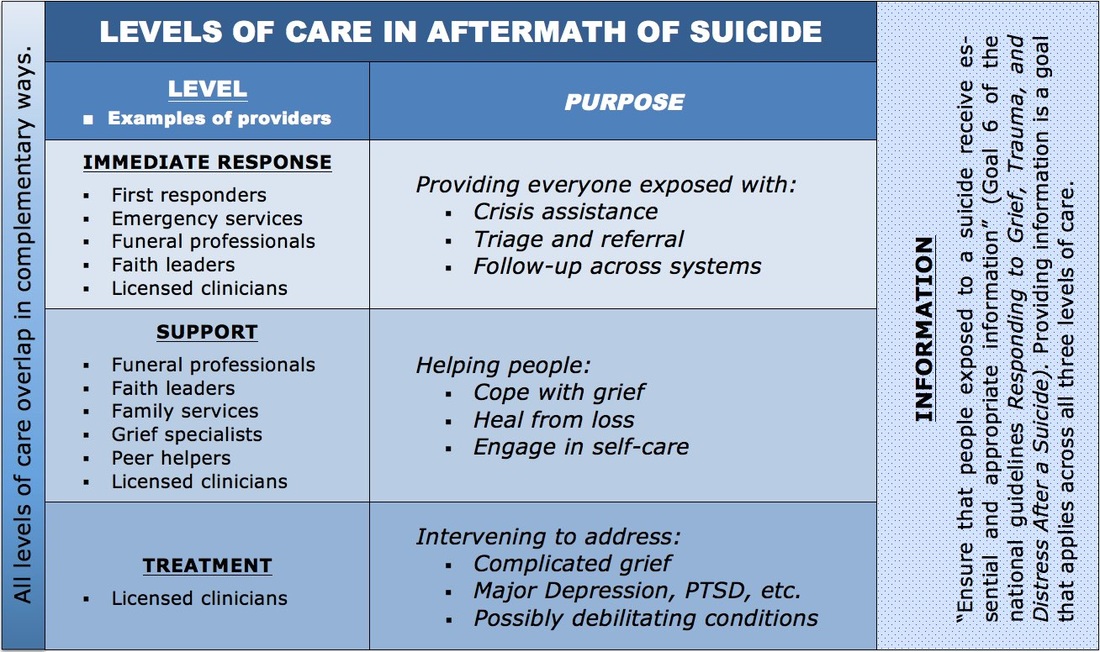
Postvention refers to activities which reduce risk and promote healing after a suicide death. It is an organized response in the aftermath of a suicide to accomplish any one or more of the following:
►To facilitate the healing of individuals from the grief and distress of suicide loss
►To mitigate other negative effects of exposure to suicide
►To prevent suicide among people who are at high risk after exposure to suicide
When a person dies by suicide, many others are deeply affected:
►One study estimated that 115 people are exposed to each suicide, with 1 in 5 reporting that this experience had a devastating impact or caused a major life disruption.
►Everyone grieves differently. Some people may experience short-term reactions, while others may have long-term responses.
►Exposure to suicide can lead to an array of negative outcomes, including mental health issues, social isolation, and an increased risk of suicide.
It has been said that the person who dies by suicide dies a single death, while those left behind die a thousand deaths. Loss survivors are faced with unanswered and often unanswerable questions, especially "Why?". Intense emotional reactions such as guilt, blame, rejection, anger, shame, and relief may be experienced by them, too. It is important to integrate cultural considerations about religion, death, suicide, grief and lost into all postvention efforts as cultural factors can also play a major role in the grieving process. Losing someone to suicide can lead to isolation, unbearable pain and life-altering experiences. The impact it has brought upon loss survivors indicates the importance of having peer supports – connecting loss survivors with each other, as well as training first responders, faith leaders, funeral directors, and mental health providers to respond sensitively and effectively to loss survivors.
Schools and postvention
School systems are an integral part of a community. As the majority of young people who die by suicide are part of a school community, the school becomes a natural place for a postvention response. Identifying youth who may be at risk for suicide, and responding to the emotional and psychological needs of all students, is crucial. Suggested postvention procedures for schools are discussed.
Cultural considerations in postvention
We must always be mindful of cultural considerations. In the aftermath of suicide, close attention should be paid to the unique cultural meaning of suicide, as well as to local healing practices for the family, community, and cultural group who have experienced the loss. Culturally respectful guidelines are outlined.
Take Action
All settings should incorporate postvention as a component of a comprehensive approach to suicide prevention. All communities and organizations should be prepared to respond to a suicide death, including tribes, towns, senior living facilities, workplaces, and health care providers.
Plan ahead:
Develop a plan and protocols in advance to enable your institution or community to respond quickly and compassionately in the crisis period after a suicide death.
Be prepared to respond to the immediate emotional needs of people affected by the crisis as well as to the long-term effects and risks that may be associated with exposure.
Educate and build relationships among those who will interact with bereaved people to enable a coordinated community response rather than fragmented services. Involve law enforcement, emergency medical services, community mental health, social service agencies, and other institutions.
Consider adopting the Active Postvention Model, in which trained volunteer teams reach out to provide support and resources to survivors as soon after a suicide death as possible. It differs from the traditional (passive) model of postvention where survivors only get help if they seek it themselves. The Survivor Outreach Team Training Manual will help you set up and train a survivor outreach team.
Respond effectively:
Immediately following a suicide, work with the news media to encourage safe reporting.
Work with those affected by the suicide death to aid mourning in ways that avoid increasing the risk of contagion.
Build capacity for ongoing support and treatment, including professional and peer-support options, for those who need it.
Provide support and guidance for friends and family members of the bereaved to help them provide effective ongoing support.
Resources:
After a Suicide: A Toolkit for Schools, Suicide Prevention Resource Center (SPRC) & American Foundation for Suicide Prevention (AFSP) After a Suicide Toolkit for Schools
After a Suicide: Recommendations for Religious Services & Other Public Memorial Observances, Suicide Prevention Resource Center (SPRC) & American Foundation for Suicide Prevention (AFSP) After a Suicide Services and Observances
Children, Teens and Suicide Loss, AFSP & The Dougy Center Children, Teens and Suicide Loss
Helping Survivors of Suicide: What Can You Do? American Association of Suicidology (AAS) Helping Survivors of Suicide
Managers Guide to Suicide Postvention in the Workplace, American Association of Suicidology (AAS) & Action Alliance for Suicide Prevention (AASP) Managers Guidebook to Suicide Postvention
Postvention: A Guide for Response to Suicide on College Campuses, Higher Education Mental Health Alliance (HEMHA) Project Postvention Guide for Colleges
Recommendations for Reporting on Suicide, ReportingOnSuicide.org
Resources for Suicide Postvention Planning (SPRC) Resources for Suicide Postvention
Responding to Grief, Trauma and Distress After a Suicide: U.S. National Guidelines, AASP Responding to Grief After a Suicide
Suicide Prevention Resources for Survivors of Suicide Loss (SPRC) Resources for Survivors
Supporting Survivors of Suicide Loss: A Guide for Funeral Directors (SAMHSA) Supporting Survivors: Guide for Funeral Directors
References:
After A Suicide – Postvention. (2018, February 6). Retrieved from Prevention Lane: https://preventionlane.org/after-a-suicide-postvention
Ken Norton, L. (2015, May 7). Postvention as Prevention. Retrieved from Suicide Prevention Resource Center: https://www.sprc.org/news/postvention-prevention
Provide for Immediate and Long-Term Postvention. (n.d.). Retrieved from Suicide Prevention Resource Center: https://www.sprc.org/comprehensive-approach/postvention
Dafoe, B. (n.d.). A Proactive Planning Workbook for Communities Affected by Youth Suicide. Retrieved from https://www.heretohelp.bc.ca/visions-suicide-vol2/suicide-postvention-prevention
Questions:
1) What's the importance of promoting Postvention?
2) Have you received postvention in real life? How did it affect you? (if applicable)
>Have you applied postvention in real life? How were you able to carry it out? (if applicable)
3) How can society help the loss survivors?

1) What's the importance of promoting Postvention?
There's little or no independent evidence that postvention does reduce risk or promote healing. Obviously, everyone involved in the postvention business thinks it's a great idea, but not everyone else agrees. For example, one review I found explains:
Despite the controversy related to the basic assumption that suicide survivors require specific interventions, programs have gained momentum. However, unsettling reservations have been raised about the efficacy of bereavement counseling for survivors of suicide, as well as for those bereaved by other causes of death. Upon examining general bereavement intervention literature, Jordan and Neimeyer (2003) concluded that the scientific basis for accepting the efficacy of grief counseling is weak. The extensive review conducted by Schut and his colleagues (Schut, Stroebe, van den Bout, & Terheggen, 2002) determined that positive outcomes are more likely for grief processes that are more complicated. Additionally, they found that studies using an outreach approach as opposed to examining the process of those who seek help, almost always showed less favorable results.
Read that last sentence again: "an outreach approach...almost always showed less favorable results."
2) Have you received postvention in real life?
Yes.
How did it affect you?
It made the situation worse.
Have you applied postvention in real life?
No.
3) How can society help the loss survivors?
By avoiding one-size-fits-all approaches based on rules and recommendations, especially those from other cultures. By avoiding taking actions or implementing policies that affect survivors except when those survivors have specifically asked for them. By ensuring everyone understands that when another person has suffered a loss, you are not in charge of their feelings.
Also note that at 7 Cups all our chats are monitored and censored. Sadly, after a death by suicide the censor might not always allow members to say the things they need to say. This system cannot currently be turned off, and the only ways around it are to use weird spellings or a language other than English.
By the way, to avoid a security warning, use this link to ReportingOnSuicide.org
@Erato