Things People Who Have Thrombosis Wish You Knew

If this is part of your life story, please share your insights! What would you like the rest of us to learn? What should we know about people in this community? How would you like people to interact with you? Should people ask questions? What’s the best way for people to learn about this? Do you have any resources (books, movies, YT videos, etc) that will give us greater understanding and empathy and kindness toward people who experience the same things you do?
If you’re not on this journey, we welcome you to listen, learn, and ask respectful, good-faith questions! Open-ended questions are highly encouraged, as they give people the space to share their unique experiences in their own words. While this is a safe space to learn about things you’ve never experienced, please remember to be sensitive, and avoid sharing harmful stereotypes or debating someone's lived reality. If you have a question, ask it with empathy. If someone gently corrects you, please be open to learning. Let's have a gentle, fun, friendly conversation where we support one another, because it takes all sorts to make a world!
@ShadowFaerie @unassumingEyes @Sunisshiningandsoareyou @sadcat13 @Amanda84 @goldenduckling @mytwistedsoul @Tinywhisper11 @LovemyMoonflowers @GreenLime3141 @7Bear7 @Phoenixthepoised @Torean @GentleHealingInitiative @cyanessence @YourCaringConfidant @CaringEzra @NobleSeeker @fossilfellow @BastionKnight @trueconfidant123 @safeplace288 @lovingCat6978 @reservedOwl321 @dapperNest2125 @Creamyyy @naturesbeauty1234 @bubbleSummer9800 @peachThinker662 @warmheartedHuman836 @Mansbestfriend @Paliloveyourself @Magicpawsoffuture @SelfCareMatters @TovaCares76 @sabeyesofblue3535 @Ailuraphilelove8tear9 @charmingApple8098 @luvArisu @BlueDarkAurora @curiousbookishness @sympatheticPlace3743 @musawva @KindleMissie @WellsFiction @Angelanj @SlappyMcGee @SunshineJazz @LexListens2025 @Heather225 @agreeableSkies9889 @ConstellationSystem
I’m adding a taglist to start, but this post is open to absolutely everyone! <3

@jesusredeemedme2425 thanks for the tag
@RunningMachine
Can you please share with us what thrombosis is, and how it affects people, so we can understand it more fully? Thank you <3

@jesusredeemedme2425 I haven't had any personal experience with it, looking forward to learning more about this ❤️
@jesusredeemedme2425
To start by sharing my personal experience from thrombosis I'm hoping that anyone with the will power and patience to read through it will take notice of the need to keep hydrated and the need to try and avoid sitting/standing in one place too long as they are prime causes for thrombosis. Over the past 10 years since my own PE's I am one of the admins on the Thrombosis UK social media groups and am usually messaged to respond to posts to add some positivity from my own experiences when the overall tone is negative and especially to encourage athletes that it is possible to recover to pre thrombosis levels.
I've tried to keep this relatively easy to read as after surviving a massive bilateral saddle pulmonary embolism (PE) in July 2015 and a second sub massive bilateral saddle PE in Nov 2017, oddly the distinction between massive and sub massive has nothing to do with the extent of the clots themselves but the impact it has on the heart as the clots pass through, massive is indicative of needing CPR or defibrillation to restart the heart. My heart was defibrillated twice en route to the hosital in the ambulance within 20 minutes.
Both of my PE's after extensive testing for known genetic risk factors and lifestyle choices were considered to be unprovoked, no known causes found which accounts for 33% of all PEs. The fatality rate for a PE is 30% and is considerably higher, up to 75% for recurrent PE's depending on cause so i am fortunate to of survived them. In my case the clot coverage in both cases was 96-97% of my lungs, the bilateral denoting it was in all lobes of my lungs and saddle denotes that there was also significant clotting within the pulmonary artery as well.
I was 48 years old when i had the first clot, i was fit active racing cyclist and one of the coaches at my local cycling club, I had ridden my fastest 100 mile time trial just 4 days earlier in 3hrs 42 mins for a few years which compares to a life time best in my early 30s on 3hr 32 mins, so was in excellent shape. The consultants at the hospital considered my aerobic conditioning to of saved me from being a fatality.
Blood Clotting (coagulation or thrombosis)
Blood clotting, or coagulation, is an important process that prevents excessive bleeding when a blood vessel is injured. Platelets (a type of blood cell) and proteins in your plasma (the liquid part of blood) work together to stop the bleeding by forming a clot over the injury. Typically, your body will naturally dissolve the blood clot after the injury has healed. Sometimes, however, clots form on the inside of vessels without an obvious injury or do not dissolve naturally. These situations can be dangerous and require accurate diagnosis and appropriate treatment.
Clots can occur in veins or arteries, which are vessels that are part of the body's circulatory system. While both types of vessels help transport blood throughout the body, they each function differently. Veins are low-pressure vessels that carry deoxygenated blood away from the body's organs and back to the heart. An abnormal clot that forms in a vein may restrict the return of blood to the heart and can result in pain and swelling as the blood gathers behind the clot.
Blood Clots in the Arteries
Arteries, on the other hand, are muscular, high-pressure vessels that carry oxygen- and nutrient-rich blood from the heart to other parts of the body. When your doctor measures your blood pressure, the test results are an indicator of the pressure in your arteries. Clotting that occurs in arteries is usually associated with atherosclerosis (hardening of the arteries), a deposit of plaque that narrows the inside of the vessel. As the arterial passage narrows, the strong arterial muscles continue to force blood through the opening, and the high pressure can cause the plaque to rupture. Molecules released in the rupture cause the body to overreact and form an unnecessary clot in the artery, potentially leading to a heart attack or stroke. When the blood supply to the heart or brain is completely blocked by the clot, a part of these organs can be damaged as a result of being deprived of blood and its nutrients.
Deep Vein Thrombosis
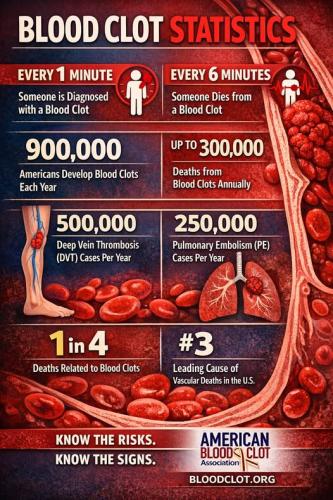
Deep vein thrombosis (DVT) is a type of clot that forms in a major vein of the leg or, less commonly, in the arms, pelvis, or other large veins in the body. In some cases, a clot in a vein may detach from its point of origin and travel through the heart to the lungs where it becomes wedged, preventing adequate blood flow. This is called a pulmonary (lung) embolism (PE) and can be extremely dangerous.
It is estimated that each year DVT affects as many as 900,000 people in the United States and kills up to 100,000. Despite the prevalence of this condition, the public is largely unaware of the risk factors and symptoms of DVT/PE.
Living With Excess Thrombosis
I'm on anticoagulatant medication to reduce my rate of thrombosis but lifestyle factors are equally if not more effective in reducing my risk of repeats. I try to keep my activity levels high to avoid blood pooling (stasis) in the veins in my lower legs in particular, stay well hydrated (3 - 3.5 ltrs of water daily but upto 4 ltrs in hot weather) and keep my body fat percentage at sub 22%. Excess body fat leads to higher fat lipid levels in the blood with fat lipids forming upto 70% of blood clots, so the lower by body fat levels the less risk of a substantial clot forming. To this end I changed from sedentary occupations to working night shifts in a supermarket where I'm constantly moving throughout the shift averaging from 16K to 22K steps each shift, I head to the gym every morning as soon as I get up to lift my heart rate which then remains elevated for a few hrs afterwards and I'm conscious not to sit or stand still for extended time periods, certainly no more than 90 minutes.The need to keep active and the increased risk of internal bleeding from the anticoagulants has meant I no longer cycle as the risks are too high (some survivors still do), it also has made long distances drives, train travel and flights in particular a much higer risk. I have to avoid any contact sports and have to be particular mindful of any head injuries. A couple of years back I had a small glass bottle fall onto my head whilst working so went for checks at A&E, 17 hrs of observations later they allowed me home.
What’s a PE?
@jesusredeemedme2425
PE is an abbreviation for pulmonary embolism, blood clot (thrombus) in lungs. The CT scan I had on the first one showed that the clots were converging 96-97% of my lungs and virtually obstructing my pulmonary artery that feeds the deoxygenated blood to my lungs from the heart. The blockage causes my heart too stop twice in the ambulance needing defribilation to restart it