M42, The Orion Nebula
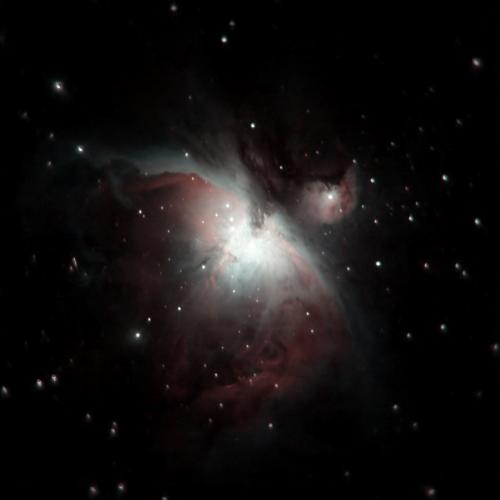
Here is an image I've taken of The Orion Nebula, located just below Orions belt (a group of 3 stars forming a line), within the constellation of Orion of course :P
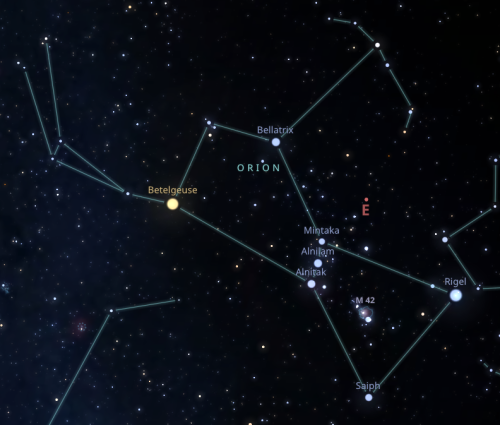
It's probably one of the easiest constellations to spot in the night sky, with the nebula also being one of the closest and brightest up there which makes it visible to the naked eye even in moderately light polluted skies. The nebula itself is a huge stellar nursery, forming new stars and planets too, a fan favourite for many armature astronomers and astrophotographers alike.
The constellation of Orion is also home to the absolutely monstrous Betelgeuse, a red giant star nearing the end of its life. We often think of the Sun as being big, but you could fit 1,000,000 Suns inside of Betelgeuse making the Sun seem tiny in comparison. Still... compared to what's out there Betelgeuse is also considered "small" 😫
Any day now (maybe tomorrow, maybe in another 10,000 years) Betelgeuse will reach the end of it's life and explode in a supernova, which will be seen from the Earth. Thankfully it's far enough away that it wont cause an extinction, but it will shine brighter than the full moon and even be visible during the daytime for a few weeks. What a sight that would be! ✨

@SentryTheDefiant
Wow! I would love to see Betelgeuse blow up, I imagine it would be a event of a lifetime! Thanks for showing us your beautiful picture 🌲
@AsherTree
Thank you! Here's hoping for the greatest fireworks display ever💥
@SentryTheDefiant
Fascinating!

@caringShoulder1357
😂
@SentryTheDefiant I can grade your picture, if you can send the raw , i colour grade astrophotography as hobby lol , wait attach my works
@blissfulSoul2956
That's so cool, I'm trying to learn how to bring out more colours here and I would love that! The raw DNGs are the subject of short exposure (0.5 second) afocal eyepiece photography which is then run through extensive processing and stacking to reach the final result. Unfourtunately they're too large to upload in raw, and JPG destroys the details. But here is a few anyway in PNG!
Single 0.5 second exposure: https://ibb.co/HLRWGZ2H
Stacked image with no processing: https://ibb.co/HLRWGZ2H
With background extraction if that helps: https://ibb.co/YTZVH4Z2
There's also a number of other processing steps I've done with the images to reach the final result, noise reduction and deconvolution in particular, starless processing and more! But maybe you can play around with these and see what you can come up with! I recommend careful adjustment of curves and blackpoint to get the most out of them, but as you can see they are rough in their initial state :D
@SentryTheDefiant thanks a lot xd
@SentryTheDefiant if you have Lightroom you can take dng image btw , by this way you can preserve details, also if you have open camera , you can do focus bracket for moon btw , and stack it for more quality, idk how you do it , but just wanted to share a bit. : )
@blissfulSoul2956
Open Camera is the one I used for lucky imaging with the Moon and Planets! It's so good. Unfortunately Samsung likes to lock off access their hardware so exposures longer than about 0.2 seconds are pre-processed and live stacked, which makes most camera apps practically useless for AP. But there's another app called Deep Sky Camera that can uses some hacks to access the linear sensor readout that's perfect for AP, and will get true long exposure linear readouts.
To focus I'm setting the camera to focus at infinity and then using the telescopes focuser along with a bahtinov mask, and then pointing it at a bright star like Vega to get precise focus. The mask creates a specific pattern in the diffraction spikes that allow you to really tune in the focus. But there will always be some amount of blurryness with afocal phone photos still, it's just the nature of doing things the "wrong" way.
Here's one I took of the moon with Open Camera, not sure if it will load properly because it's huge but you can zoom in a fair amount. Of course JPG has ruined a lot of it :D The original image is a lot cleaner but it's 500 gigabytes soo, not easy to share 😂 It's composed of about 50+ images of the moon recorded in open camera and then stitched together to form a large mosaic image of the moon.
https://i.ibb.co/GQMdfJvH/Moon-Mosaic-10000x10000-25-05-2026.jpg
@SentryTheDefiant deep sky camera , I don't have money bro 🥀 I'm saving up for a sony camera also probably will buy only if I pass a entrance exam too 🥀
@blissfulSoul2956
Deek Sky Camera is an app like Open Camera, it's free :)
@SentryTheDefiant vega mentioned 😂 idk , I look at stars daily 🥀 , about 12,000 years vega will be north star ✨
@blissfulSoul2956
Vega is one of the brightest stars in the sky, one thing you can do is download an app called Stellarium and it will show you where everything is. You can point your phone at the sky with it too and it can overlay what everything is that you see
@SentryTheDefiant i have that app premium version for free 😂 i can recognise most of the stars in night sky, what's your favourite asterism and constellation, mine is tea cup
@blissfulSoul2956
Vega is my favourite star, haha. Mostly because of a movie called Contact, which was also my favourite movie until Interstellar came along. I'm not sure about asterism but my favourite constellation is probably between Lyra (because I'm always in that region so much) or Cygnus. I tried taking a picture of SADR, but unfortunately the nebula is far too dim for the way I'm doing things so it didn't come out so good.
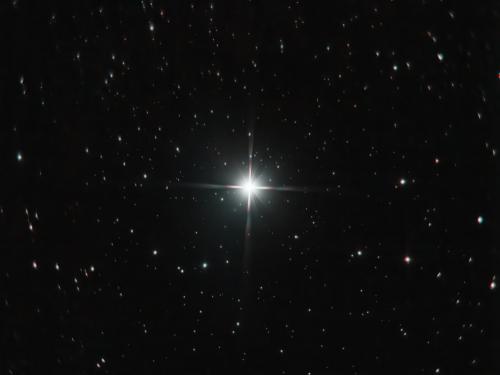
There is actually some nebulosity in the image but bringing it out proved far too difficult without a ton of noise with it!
@SentryTheDefiant here is your moon idk what i did , but hope you like would have been better if i got the raw https://ibb.co/Q3t57TTX
@blissfulSoul2956
https://ibb.co/Q3t57TTX
@blissfulSoul2956
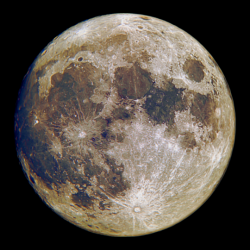
That is absolutely incredible!! What you did is known as mineral composition, you can stretch out the subtle differences in the wavelengths of light to reveal what the different parts of the moon is made of. I didn't even know that data was in this image!
Blue = titanium rich basalt
Orange/brown = iron rich highlands
Yellow = fresh ejecta/glassy material
Purple = mixed basalt + highland material
Grey/dark brown = older, low‑titanium basalt
I've done this before with another image (it's my profile image) but I'm really surprised to see it in this image too! Thank you, really happy to see this 🌕😄
@SentryTheDefiant I'm not rookie 😭 ik something too
@SentryTheDefiant I love the moon , can I download it?
@SentryTheDefiant can I get the orginal : l ,i know a way but you should have it in your photos app
@blissfulSoul2956
Feel free to download it! I don't actually have the original file anymore because the hard drive it was on died :(
@SentryTheDefiant also if you have Lightroom, you can convert the image to tiff while exporting, the share through files
@SentryTheDefiant
Fabulous picture!! I love this post as this is my favorite constellation. It is always out around my birthday in my place in the world (November) so I get to stand out in the cold and look at it lol thank you so much for posting!!
@TovaCares76
I seen the constellation (and the nebula) for the first time ever only a few nights ago and I couldn't believe that I've never noticed it before, it's literally unmissable now that I see it 😂 It's easily become my favourite! Thank you so much :) I could see a faint Andromeda galaxy too with my own eyes! So much becomes noticeable in the night skies when you take a few moments to look around, I love it so much!