The Different Types of Attachment Styles

What Is Attachment?
Attachment is a special emotional relationship that involves an exchange of comfort, care, and pleasure. The roots of research on attachment began with Freud's theories about love, but another researcher is usually credited as the father of attachment theory.
Characteristics of Attachment
Bowlby believed that there are four distinguishing characteristics of attachment:
- Proximity maintenance: The desire to be near the people we are attached to.
- Safe haven: Returning to the attachment figure for comfort and safety in the face of a fear or threat.
- Secure base: The attachment figure acts as a base of security from which the child can explore the surrounding environment.
- Separation distress: Anxiety that occurs in the absence of the attachment figure.
Ainsworth's Strange Situation Assessment
During the 1970s, psychologist Mary Ainsworth further expanded upon Bowlby's groundbreaking work in her now-famous "Strange Situation" study.2 The study involved observing children between the ages of 12 to 18 months responding to a situation in which they were briefly left alone and then reunited with their mother. Ainsworth's Strange Situation Assessment followed this basic sequence:
- Parent and child are alone in a room.
- The child explores the room with parental supervision.
- A stranger enters the room, talks to the parent, and approaches the child.
- The parent quietly leaves the room.
- The parent returns and comforts the child.
Attachment Through Life
Before you start blaming relationship problems on your parents, it is important to note that attachment styles formed during early childhood are not necessarily identical to those demonstrated in adult romantic attachments. A great deal of time has elapsed between infancy and adulthood, so intervening experiences also play a large role in adult attachment styles.
While we cannot say that early attachment styles are identical to adult romantic attachment, research has shown that early attachment styles can help predict patterns of behavior in adulthood.
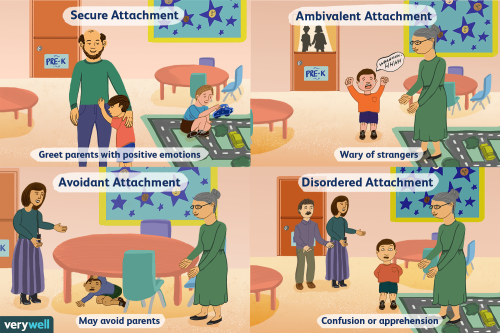
Secure Attachment Characteristics
As Children
- Separates from parent
- Seeks comfort from parents when frightened
- Greets return of parents with positive emotions
- Prefers parents to strangers
As Adults
- Have trusting, lasting relationships
- Tend to have good self-esteem
- Share feelings with partners and friends
- Seek out social support
Ambivalent Attachment Characteristics
As Children
- May be wary of strangers
- Become greatly distressed when parents leave
- Do not appear comforted when parents return
As Adults
- Reluctant to become close to others
- Worry that their partner does not love them
- Become very distraught when relationships end
Avoidant Attachment Characteristics
As Children
- May avoid parents
- Do not seek much contact or comfort from parents
- Show little or no preference for parents over strangers
As Adults
- May have problems with intimacy
- Invest little emotion in social and romantic relationships
- Unwilling or unable to share thoughts or feelings with others
Conclusion
While adult romantic attachments may not exactly correspond with early childhood attachments, there is no question that our earliest relationships with caregivers play a role in development. By better understanding the role of attachment, you can gain a greater appreciation of how the earliest attachments in your life may impact adult relationships.
Source: https://www.verywellmind.com/attachment-styles-2795344
What are your thoughts on attachment and its effect in adulthood?
#Attachment #Relatinships #Psychology

@calmDew1576 yes attachments affect our entire self a lot, it is a better option to become aware of our attachment style and work on any areas that have gaps, so it doesn't meddle with our future relationships :) thanks Dew

@calmDew1576
WOW... i never knew!