Cognitive Restructuring
Goal
To be able to identify faulty thoughts and change the way you think, feel, and act
Introduction
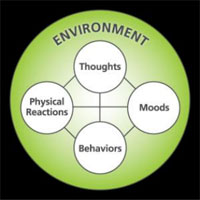 A common, effective treatment for stress related issues is Cognitive Behavioral Therapy (CBT), which involves cognitive restructuring. Stress can be reduced by decreasing your perception of helplessness or by increasing your confidence in meeting your demands at work. Evaluating stress-aggravating thoughts is helpful in order to more quickly and accurately evaluate problematic or unhelpful thoughts and its consequences. Your stress will likely decrease once you examine the evidence for your thought and discover that the problem you face may not be as bad as you initially thought. Furthermore, it is helpful to figure out strategies to best cope with problems you face.
Interpretation of Problems (Greenberger & Padesky, 1995, p. 4)
How we understand our problems has an effect on how we cope. Our interpretation of the problems is influenced by thoughts (i.e. beliefs, images, memories), moods, behaviors, physical reactions, and environment (past and present). Notice that the five areas are interconnected as shown in the image to the left. The connecting lines convey that each different aspect of a person’s life influences all the others. For example, changes in our behavior influence how we think and also how we feel (both physically and emotionally). Behavior changes can also change our environment. Likewise, changes in our thinking affect our behavior, mood, and physical reactions and can lead to changes in our social environment. Some thoughts are automatic-making it difficult to understand the influence it is having on the other areas. With practice, however, even automatic thoughts can be improved.
Watch the following video to better understand automatic thoughts:
Identifying Stressful Thoughts Exercise (Greenberger & Padesky, pp. 180-181)
Instructions: To identify the thoughts that are associated with anxiety or fear in your own life, complete the table below. Think about a recent time when you were anxious, fearful, or nervous. Recall the thoughts you had (in words, in images). If you had a visual image, describe it. If your thoughts were in words, notice if the thoughts began with “What if...”.
| Situation Who? What? When? Where? |
Moods
|
Automatic Thoughts/Images
|
|---|---|---|
|
|
|
Tip: By completing this activity often, it will likely become easier to identify your stressful thoughts. In time, you should be able to recognize which thoughts are automatic and be able to decide whether they and the associated emotions make sense or need to be challenged or changed.
 Faulty Thinking
Thoughts are not always accurate. What we tell ourselves may or may not be correct. Stressful thoughts create ruts in our brains, which can automatically lead us down a path toward feelings of fear or nervousness. It is time to get out of the rut and be on a new path with more realistic, accurate, and truthful thoughts and beliefs. One of the ways you can do this is by challenging your existing thoughts.
Challenging Faulty Thinking Exercise (Barlow, 2008, p. 101)
Instructions: Identify a single faulty thought or belief and answer the following questions on a separate piece of paper:
- What is the evidence for and against this idea?
- Is your belief a habit or based on facts?
- Are your interpretations of the situation too far removed from reality to be accurate?
- Are you thinking in all-or-nothing terms?
- Are you using words or phrases that are extreme or exaggerated? (i.e., always, forever, never, need, should, must, can’t, and every time)
- Are you taking the situation out of context and only focusing on one aspect of the event?
- Is the source of information reliable?
- Are you confusing a low probability with a high probability?
- Are your judgments based on feelings rather than facts?
- Are you focused on irrelevant factors?
Example: You may believe that others will reject you. Consider the evidence for and against this belief. Yes, people may have rejected you in the past, but that does not mean that everyone will reject you.
Thinking Mistakes Exercise (Beck, 2007, pp. 146-147)
Instructions: Read through the table on the next page of 12 common thinking mistakes. Put a check mark next to the mistakes that you frequently experience. For the checked items, write an example of when you have made the thinking mistake.
Tip: Identify additional faulty thoughts or beliefs and evaluate them using the questions from the challenging faulty thinking exercise. Learn more about thinking mistakes by watching the following video:
| ✓ | Thinking Mistake | Description | Example | Your Example |
|---|---|---|---|---|
| All-or-nothing thinking | You see things in only two categories when it is really on a continuum. | Either I’m perfect or I’ve completely failed. | ||
| Jumping to conclusions | You take one observation and are sure it has only one implication. | Since I didn’t meet the deadline, trying to improve my performance is impossible. | ||
| Negative fortune-telling | You make a negative prediction without recognizing it is not the only possible outcome. | I won’t go to the party since no one will talk to me anyway. | ||
| Positive fortune-telling | You are overly optimistic about the most likely outcome. | I will be able to complete my 10 page paper in an hour. | ||
| Discounting the positive | You unreasonably discount your positive actions or qualities. | It doesn’t matter if I’ve lost a few pounds. I deserve credit only after I’ve lost all of the weight I need to lose. | ||
| Emotional reasoning | You think your thoughts must be true because they feel true, even if there is conflicting evidence. | Since I feel so hopeless about my marriage improving, it really must be hopeless. | ||
| Labeling | You label yourself (or someone else) in a globally negative way without really considering the whole person. | I’m bad for not taking my dog for a walk today. | ||
| Mind reading | You are sure you know what others are thinking, even in the absence of compelling data. | Everyone will think I am stupid if I ask a question. | ||
| Self-deluding thinking | You tell yourself things that you really do not believe at other times. | I don’t deserve a speeding ticket for going 20 mph over the speed limit since I was in a hurry. | ||
| Dysfunctional (unhelpful) rules | You mandate what you/others must/must not do without considering circumstances. | I can only express happy, positive feelings. | ||
| Irrelevance | You link two unrelated concepts. | It’s okay to go shopping because I’m so stressed out. | ||
| Exaggeration | You make a sweeping statement on the basis of a small set of data. | My kids are totally out of control. |
Alternative Thoughts & Beliefs
Once the faulty thoughts or beliefs are challenged, new truths need to be identified. By practicing the new and more realistic way of looking at life experiences, over time your feelings will positively respond to your new way of thinking.
Thought Record Exercise (Barlow, p. 105)
Instructions: Use the table on the next page to construct alternative thoughts to various situations. Complete the exercise once per day for the next 7 days. Identify and rate your thought(s)/belief(s) and emotion(s) about a situation and challenge your thought(s) just like you did in prior lessons. Next, determine if you are making a thinking mistake. Then, ask yourself what else you could say instead of your original thought(s). Lastly, rerate your original thought(s) and reexamine your feeling(s) about the situation. Keep in mind that if you do not make a thinking mistake, you likely will not experience a change in your feeling(s).
| Thought Record | Situation | Thought(s) & Emotion(s) | Challenge | Thinking Mistake | Alternative Thought(s) |
|---|---|---|---|---|
| Describe what led to the unpleasant emotion(s). | List your primary thought(s) about the situation and specify your emotion(s). Rate how strongly you feel the emotion(s) from 0-100%. | Use the questions in lesson 4 to examine your initial thought(s). | Use the thinking mistakes table in lesson 4 to determine if this is a particular pattern of thinking. | What else can I say instead of my initial thought(s)? How else can I interpret the event? Rate your belief in the alternative thought(s) from 0-100%. Rerate how much you now believe your initial thought(s) from 0-100%. List the emotion(s) you are experiencing about the situation now and specify how strong it is from 0-100%. |
|
|
|
|
|
Tip: It takes time for a new thought to replace the original, problematic thought. Once you have completed this exercise, you may find it helpful to re-read what you wrote down to help solidify your shift in thinking.
 Next Step
If you own an Apple product, an app called CBT Pad is available for a nominal fee (less than $5) to aid CBT exercises.