Relaxation Training
Goal
To be able to reduce stress through relaxation
Relaxation Training
 Relaxation can be accomplished through either physical relaxation or mental relaxation. Both methods can be equally effective. When we are physically relaxed, mental relaxation follows and when we are mentally relaxed, physical relaxation follows. Relaxation training can alleviate feelings of stress and anxiety because it is difficult for the body or mind to be simultaneously relaxed and anxious. If you develop the ability to relax before and during stressful situations, then you can substantially reduce the frequency and severity of the stress you experience.
Diaphragmatic Breathing
Diaphragmatic breathing can be a highly effective relaxation strategy. In order to do it properly, it is important to breathe from your diaphragm (abdomen) rather than from your chest muscles. It takes practice to learn how to breathe properly. The following video introduces diaphragmatic breathing and its benefits:
Progressive Muscle Relaxation (Bourne, 1995)
Progressive muscle relaxation is an additional form of relaxation and consists of relaxing all of your muscles completely and to recognize when they are relaxed. This is done by alternately tensing and relaxing your muscles while attending closely to the internal activities and sensations you are feeling at the time.
In order to learn how to do progressive muscle relaxation effectively, it is helpful to have someone with a soothing voice read a muscle relaxation script to you (sample script provided below). Record them reading the script so you will always have it. Alternatively, use a pre-recorded script that can be found online. Here’s an example:
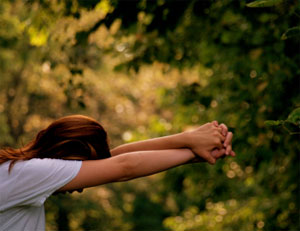 Script: Take three deep abdominal breaths, remember to exhale slowly each time, imagine the tension draining out of your body. Clench your fists. Hold for 10 seconds, before releasing and feeling the tension drain out of your body (for 15 seconds). Tighten your biceps by drawing your forearms up toward your shoulders and make a muscle with both arms. Hold, then relax. Tighten your triceps (the muscles underneath your upper arms) by holding out your arms in front of you and locking your elbows. Hold, then relax. Tense the muscles in your forehead by raising your eyebrows as high as you can. Hold, then relax. Tense the muscles around your eyes by clenching your eyelids shut. Hold, then relax. Imagine sensations of deep relaxation spreading all over your eyes. Tighten your jaws by opening your mouth so widely that you stretch the muscles around the hinges of your jaw. Hold, then relax. Tighten the muscles in the back of your neck by pulling your head way back, as if you were going to touch your head to your back. Hold, then relax. Take deep breaths and focus on the weight of your head sinking into whatever surface it is resting on. Tighten your shoulders as if you are going to touch your ears. Hold, then relax. Tighten the muscles in your shoulder blades by pushing your shoulder blades back. Hold then relax. Tighten the muscles of your chest by taking in a deep breath. Hold, then relax. Tighten your stomach muscles by sucking your stomach in. Hold, then relax. Tighten your lower back by arching it up (don’t do this if you have back pain). Hold, then relax. Tighten your buttocks by pulling them together. Hold, then relax. Squeeze the muscles in your thighs. Hold, then relax. Tighten your calf muscles by pulling your toes towards you. Hold, then relax. Tighten your feet by curling them downwards. Hold, then relax. Mentally scan your body for any leftover tension. If any muscle group remains tense, repeat the exercise for those muscle groups. Now imagine a wave of relaxation spreading over your body.
Progressive Muscle Relaxation Exercise
Practice progressive muscle relaxation by either playing the recording of the muscle relaxation script or watching the following video. Make sure you are in a quiet, dimly lit setting with as few of distractions as possible.
Imagery (Greenberger & Padesky, 1995, pp. 185-186)
Imagery involves visualizing scenes that are tranquil and relaxing to you. Scenes may be actual places you know that feel safe and relaxing, or they may be scenes you create to be tranquil, safe, and relaxing. The specific scene is less important than how the image makes you feel. The more senses you can incorporate into your image, the more relaxing imagery is likely to be. If you can imagine the smells, sounds, and tactile sensations as well as the visual aspects of the scene, you will improve your ability to relax.
Imagery Exercise
Instructions: Watch the following guided imagery video and reflect on the experience by thinking about your answers to the following questions:
- How did you feel before, during, and after the exercise?
- What thoughts did you have during the exercise?
- Did your feelings of stress decrease after completing the exercise?
 Next Step
To determine which relaxation methods work best for you, rate your level of anxiety or tension on a 0-100 scale before and after completing them. Practice the one or two methods that work best for you regularly to make them fully effective.