Are you emotionally intelligent?

Emotional intelligence (EI) is a critical leadership skill that enables leaders to understand and manage their own emotions while effectively influencing and empathizing with others, driving team engagement and organizational success.
Unlike IQ, EI emphasizes self-awareness, empathy, interpersonal skills, and emotional regulation, all of which are essential for effective leadership. Leaders with high EI are better equipped to handle stress, resolve conflicts, and foster collaboration, making them more effective in guiding teams through complex and dynamic work environments.
- Self-awareness: A leader should recognize their emotions, strengths, weaknesses, and triggers to make better decisions
- Self-regulation: A leader should manage their emotions to remain calm under pressure and respond thoughtfully rather than react impulsively
- Empathy: A leader should understand and consider the emotions of team members, which enhances communication and inclusivity
- Social Skills: A leader should build relationships, resolve conflicts constructively, and inspire collaboration
Leaders can use practical strategies to strengthen their EI.
- Keep a journal. Reflect on your daily emotional responses and interactions to identify patterns and areas for improvement
- Get 360-degree feedback. Seek input from your peers, managers (in 7cups case, this could be your ambassador, mentor leader, admins, etc.), and team members to uncover blind spots
- Utilize active listening. Focus fully on conversations, demonstrate engagement.
- Learn more about EI by taking training and courses, take EI assessments and skill-building exercises to work on your EI.
EI assessment Methods
- Self-reflection & Journaling. Track daily emotional experiences, noting triggers, reactions, and outcomes. This builds self-awareness and identifies patterns.
- Strengths and weakness reflection. List personal strengths and weaknesses, then compare with feedback from trusted others to gain perspective.
- Feedback circles. In small groups, share areas for improvement and receive constructive, empathetic feedback
- Active Listening Challenges. Practice paraphrasing and summarizing what others say to gauge empathy and comprehension
- Structured EI workbooks. You can use guided exercises (e.g., emotion journaling, self-regulation scenarios) to self-assess and track progress. Click here for the workbook (it is a safe, free PDF).
Skill-Building exercises
- Self-Awareness
Emotion Journaling: At the end of each day, record three emotional events, your feelings, and your reactions
Mindfulness Meditation: Regular practice to notice internal states without judgement - Self-regulation
Pause before responding: Breathe and reflect before reacting to stress
Visualization: Imagine handling challenging situations calmly to prepare for real-life scenarios - Empathy & Social Awareness
Active listening challenge: One person speaks, the other listeners and paraphrases to show understanding
Personal story sharing: Tell a non-work-related story and listen without judgement to build empathy - Social skills
Feedback circle: Share one area for feedback, then receive constructive input from peers
Role-playing scenarios: Practice difficult conversations or conflict resolution in a safe environment
Practical tips for implementing these activities
- Be consistent. Dedicate time weekly for reflection or group activities.
- Debrief. After exercises, discuss insights and applications in real life.
- Integration. Combine individual self-assessment with group activities to reinforce learning.
- Track your progress. Use checklists or journals to monitor improvements over time.
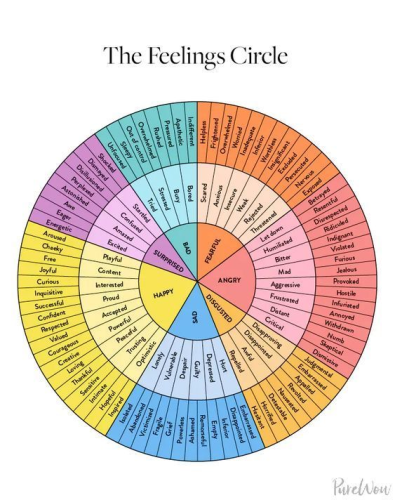
Interact with this post by pausing for a moment to reflect on how you are feeling, what you are thinking, and share it in this thread. The feeling wheel can used to assist you. The image below is the feeling wheel or you can try this link here for it.
You can click here to take an EI quiz and then share the results in reply to this thread.

@Remina
Highly informative. Thank you for posting.
@trueconfidant123
You're welcome!

@Remina
I'm perplexed. My mechanic lied and told me that he was going to fix my car today, but when I checked out the problem with the car it was already fixed. He repaired it already and lied and said he didn't fix it.🌲
@AsherTree
That can be confusing and weird. It gets you wondering why he lied. Have you sat with this emotion for a bit before reaching out to ask him?
@Remina
Well I haven't had this emotion for long.. For the last couple of days I felt victimized.. I just don't trust mechanics and I am so anxious when there's anything to do with my vehicle..🌲
@AsherTree
Yeah, I get that. I hope you are able to get this resolved smoothly
I took the quiz listed on my post. And my EI type is the rock. It says that my EQ superpower is being the master of my own emotions. It says I am great at making myself feel how I want to feel, powering through challenges, and keeping a cool head in tough times. It shows my score for each area. Self-awareness 67 percent, Other awareness 61 percent, Emotional control 86 percent, empathy 74 percent, wellbeing 68 percent

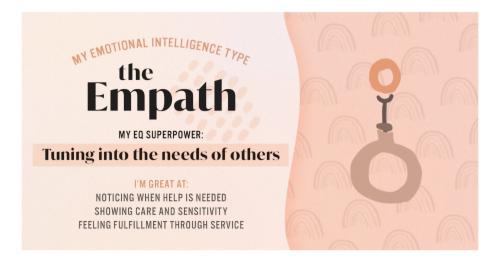
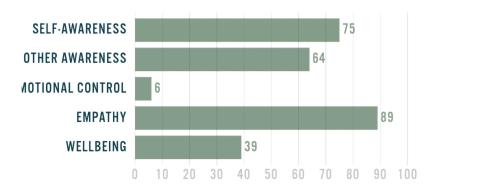
@Remina My results:
@YourCaringConfidant
Thank you for sharing your results. I find that this can be pretty enlightening and lets you know what skill might need more work.

@Remina
This was fun and informative, I got the intuitive when I answered the quiz 🥰
@Amanda84
Heyy! I am glad you had fun while learning!