The Science behind Gambling Addiction

Hi all, I'm Hox and I am one of the forum supporters here in the addiction community. I will be posting content weekly here in the Gambling Addiction section.
I am posting today's topic, about the science of how gambling addiction occurs, because I find there are a lot of myths about gambling addiction that should be cleared up. I run a group in real life with people with substance abuse addictions, and I find that they always have mixed opinions on gambling addiction, but I have had multiple clients with, say, addictions to heroin, look me dead in the eye and say they are thankful that it is heroin and not gambling. Gambling addiction can be debilitating, and somehow it is even more minimized than substances, I think because up until recent brain science research, was unexplained because there was no chemical involvement as there is in substance use. I am here today to clear up some of these myths and hopefully validate some experiences. Gambling becomes an addiction at the same time as other addictions, when it becomes a compulsion and a need instead of something that is fun, and by that time is generally negatively affecting your life.
The Reward Centre
First we must understand how addictions can occur at all, what causes them? When your addiction is detroying your life, it's not like you're actively choosing this, so what causes us to make decisions that go against our interests? What causes a behaviour or a drug to become a compulsion?
The reward centre is how our brains learn to do things that help our survival. Things like eating, sleeping, having sex, etc. These are things that have evolved to help us survive and procreate, and so these things developed to give us happy feelings when we do them, encouraging us to actually do them, otherwise we may die if we have no reason or good thing to come out of our actions. These happy feelings are triggered by a few chemicals in our brains called neurotransmitters, specifically dopamine. The reason that many addictive substances are addictive is because they have a chemical in them that mimics certain neurotransmitters, and therefore alters our mood-state, often causing a release of dopamine (euphoria).
Gambling causes the release of dopamine because of the risk and reward system that gambling innately possesses. It is very fun to win things. However, some individuals potentially have some vulnerabilities to addictive behaviours. One of these vulnerabilities is impulsivity. If someone's brain isn't naturally geared towards thinking through to an end result and being able to correct their course of action, this is known as impulsivity and can be a genetic predisposition. Often people claim they have an "addictive personality" and impulsivity is a big part of that. Being impulsive in our ancient atmosphere could have been seen as brave, the ability to overcome self-doubt and fear to overcome an obstacle. Remember, that being impulsive is not necessarily a personality flaw. There are positives to all personality traits, however unfortunately this one can be a vulnerability for addiction if you're not aware of it.
Tolerance
Tolerance is our brain attempting to create equilibrium. Our bodies all have a natural state they wish to stay in according to our genetic codes. Our bodies constantly adjust to changes in our environment to keep us running smoothly. Recently, we have discovered that our environment can even change our genes (known as epi-genetics, check it out, it's a fascinating concept!). In the case of addictions. Tolerance is developed because our brain changes its ability to be affected by a specific behaviour or substance. The brain does this not only to reduce the euphoria, but also to reduce the crash afterwards, as generally that is what your brain is more concerned about. If you use a bunch of dopamine at one time, there isn't enough later on, causing a crash with the opposite of euphoria - despair, anguish, guilt, shame, sadness. Therefore, the brain increases tolerance by destroying receptors (the part in a brain cell that receives the chemical and tells the next cell what to do) for certain chemicals - less ways to get in, less ways to be affected. Repeated actions or use of the same amount will mean less and less high. But your body will crave the same amount as at the beginning, meaning you need to up your take to get the same amount of euphoria. In the case of gambling addiction, this can take the form of bigger bets, games with worse odds, or placing more and larger bets, perhaps on sports or games you aren't as knowledgeable about.
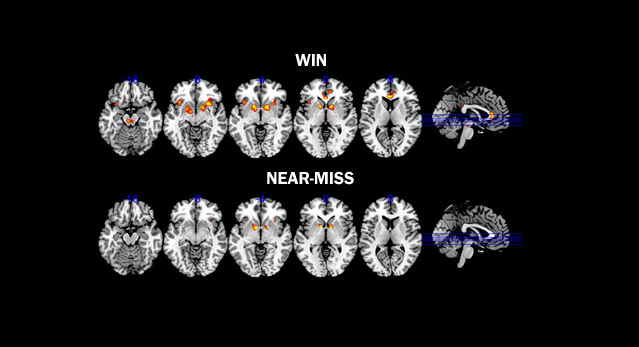
Gambling has an added layer that isn't existent in substance abuse. Gambling has the fallacy that another bet can actually restore what you've lost. There is an urgency in compulsive gambling that has a psychological element based on various gambling fallacies, such as "being due for a win" or "near misses." Fallacies such as these can cause us to "expect a win" and this expectation can alter our brain chemistry, see the following brain scan as an example.

Our brains believe that there is balance in the world and the concept of true randomness is difficult to come to terms with. Sometimes a loss can give us a rush (say a near miss, being THAT close to winning), meaning that even losses can reinforce gambling addiction. Check out this brain scan for how near misses still have a reinforcing effect.
Reward Schedules
There is another psychological component that is a piece of gambling addiction that is rare in substance addiction (but not impossible). Research has shown that when you are rewarded unpredictably, as opposed to reliably, this actually causes a stronger habit that is more resistent to extinction (loss of habit). This is because if we are rewarded every time, or even on a set schedule such as once a week, as soon as we stop getting our reliable reward, the behaviour is less inviting. To connect with this feeling, think of something you get an unpredictable reward for, perhaps scratch tickets. They are fun in some ways because of this unpredictability, hence their addictive capability. In substance use, depending on the drug of choice and how it is "manufactured" you may get unreliable results causing this effect, but in general this applies more to gambling addiction than substance addiction. So, in gambling addiction, the odds being against you also strengthens the addiction.
The New Normal
All of these factors together create a new normal existence where you need to gamble instead of wanting to gamble. it isn't just the most fun thing, it is the only fun thing. It is the thing you need to feel normal, otherwise existence is sad, empty, and all the things you loved before shrivel in comparison. The dopamine centres in your brain can now only respond to gambling, as you have so few recepters that other activites struggle to see an effect.
However, like in most forms of recovery, time, patience with yourself, building a coping toolbox, and using your support system, are ways to rebuild the parts of your brain that have been affected by gambling. In my next few posts we can go through some strategies, discuss the healing process, dive into myths and fallacies. I would love feedback if you want a specific topic explored.
Discussion Questions
Do you connect with some of the explanations in this post? Do you feel it applies to you?
If this thread gave you some additional awareness, how are you going to apply it to your recovery?

Thanks for all the great information on this. Can't wait to see all your cool posts.

I can relate. After overcoming my drug addiction I started gambling online with the belief that it was better than using drugs. I quickly spent money in the hopes of making more. It wasn't until my boyfriend brought up my bad habit that I realized that it may be a problem. We argued over it every week. Whenever I got paid the first thing I did was go online to look for places to spend it. I'm working on trying to avoid gambling sites. I didn't think I'd ever have a gambling problem.
@MeeshyRB
It's interesting how it can creep up on you in that way. The line between having fun and having a problem. Also, it's so common for one addiction to replace another. We always have to be careful. I've met so many people who if it isn't gambling, they could replace it with energy drinks, gaming, porn. When we're used to our brains going in that habit, it's hard to break. it takes time, but you know it's a problem now and you're working on replacing the behaviour with something more healthy. You've got this :)

I don't think that it's a huge mental problem for those people who love spend some time on gambling. Of course, you can find some different persons, who would have a strong addiction, but most of people can handle with it with no problem. Although it's much harder to keep yourself in a calm state of mind, for example, when you get joe fortune casino login, like I did recently, and all the in-game bonuses. It just opened new boundaries to me as a poker player.

@Hoxenos
Thank you for such an informative answer. This is useful enough information to help people understand how our body works and how it reacts to gambling.

This is a fantastic post. Thank you.