Breaking Barriers for disabled people facing inaccessbility
So welcome back, everyone, to an unwanted or wanted sequel, like popular Disney movies, about the other problems that disabled people face on a daily basis, from red bathroom cords to service dog distractions and more
Lack of Money for Fun
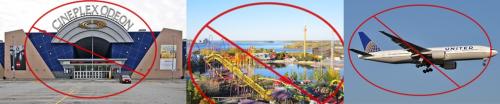
Disabled people barely have money for basic necessities like food, a roof over their heads, or medication. Because their income, either through disability programs like ODSP (Ontario Disability Support Program) or through work, isn’t enough to live on, they can’t save money for enjoyable activities like going to see a movie, experiencing live theatre, visiting a theme park, or traveling the world without needing to be a social media creator or having someone “take pity” on them and take them to these events.
Some people think that a Disney+ account is cheap, but for someone on disability income, it’s not affordable. In Canada, the “standard” plan with ads on Disney+ is $8.99/month, so that multiplied by 12 months is $107.88/year. In contrast, an actual movie theater experience (not counting snacks)—let’s say a person goes to 3 movies a year—costs $15 x 3 = $45.00/year. That makes a movie experience cheaper for a lot of people, not even counting the possibility of rebates that disabled people might be able to get through attending events like live theater and then claiming money through an additional service provider.
Inaccessible Affordable Housing
Service Dog Distractions
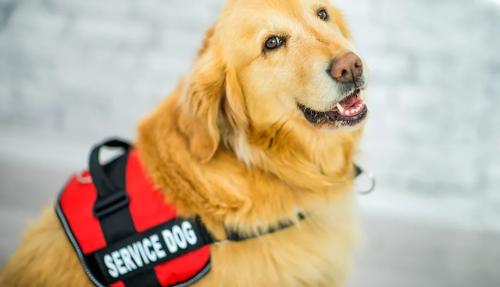
There are four types of distractions for service dogs: petting the dog, calling the dog’s name, children trying to bother the dog, and fake service dogs. I already covered fake service dogs in the previous thread.
The reason these four distractions are a problem for service dogs is that if the dog is petted or called by people who aren’t their handler or their handler’s family, it means they wouldn’t be able to focus and do their job with their handler, who is their entire focus. This could cause the handler real harm and even a trip to the hospital because the dog’s focus was elsewhere. Some of these distractions are so severe that some handlers even give out fake names for their service dogs.
In 2018, one service dog handler in New Brunswick, Canada, had to start slapping people’s hands away on the bus when they tried to pet her service dog. People thought the handler was crazy; it’s like these people “had never seen a dog before,” as the handler puts it.
In late September of 2024 in Victoria, B.C., there was a case that showed why service dogs should be left alone. At a mall during a training session with a seizure alert dog and a new client, the new client had a seizure in the corridors. When the service dog was doing “pressure therapy,” as it was supposed to do, a member of the public tried to engage with the dog, telling it it was a “good boy” and attempting to pet the dog. It wasn’t until the head of the organization training service dogs was brought in that the member of the public was forced to leave the dog alone.
Author's note: I have a picture for this particular last one but due to the image I don't think I can post it on here so don't know about what I can do about it.
In 2015, Hailey, a handler, was training a service dog, Flynn, to alert her to seizures. But when the team went to visit Hailey’s dad, another human started petting Flynn, which meant he was distracted. As a result, Hailey had a seizure and suffered a serious rug burn on her head from falling down because she didn’t have time to find a safe place to fall since the dog didn’t alert her.
If You Need Someone to Access, Operate or Enter It is Not Accessible
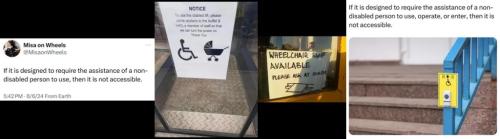
So on April 17th,2025 I had the fun experience of getting trapped in a public washroom. At the local grocery store, there’s a public washroom; previously, you could just enter it whenever you needed to use it—but now there’s a sign on the door saying you need to ask a staff member for a key. I was able to use it, but when I went to leave the washroom, the door opened only enough for me to poke my hand out a bit and yell for someone to help, which, coincidentally, is part of this particular topic.
Another example in Los Angeles, California, is an expensive gym that she and her boyfriend go to, and until recently, every time Molly Burke went, she needed her boyfriend’s help in starting and stopping the treadmill. They changed that recently, and now the treadmill is accessible for Molly because the treadmills now have tactile buttons.
In early April, I was in Toronto to see a concert. My friend had a bundle buggy like we normally do, but we hadn’t done so for the last two trips into Toronto. We were at Roy Thomson Hall. It turns out the escalators in the basement of Roy Thomson Hall don’t direct downwards after a concert, so we had some help getting the elevator (calling for the elevator required using an intercom), which was only big enough for my friend, myself, and the bundle buggy. A wheelchair wouldn’t have fit in there, and when we were in there, we had trouble figuring out how to operate it, so we had to call for help again. They told us to press two buttons together to make the elevator move down.
In Toronto, there’s a subway station where you can transfer to the other line; it’s called Spadina Station. There are two accessibility issues: one that has been there since 2005 and one that’s more recent. We will tackle the first one, then move on to the next one.
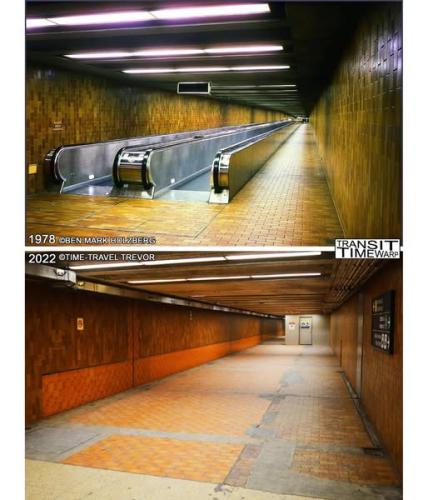
From Spadina station being created in the 1970s until around 2005, there were these huge long moving sidewalk escalators (like the ones you see at the airport) that went from one end to the other end of the subway station. In 2005, the moving sidewalk was removed due to at least one of three issues: the salt making the sidewalk corrode the escalator, a slight problem with the grade of the escalator, or the fact that children were supposedly “riding” the handrail—whatever the case, it was removed. So it takes two to three times as long on foot to get from one end to the other, regardless of the direction you’re going.
Another accessibility issue at this station is that, because they’re trying to add elevators to Spadina station, not only have they blocked off the normal escalators at the entrances, but they have also blocked so much of the stairs that there’s only one set of stairs that is about 95 cm wide or 30 cm wide, and it’s only enough for people to go up or down depending on the direction they’re going. Since there’s no room for someone to pass by you on the stairs, it means if you are at the top wanting to go down, you have to wait for the crowd to clear before you can go down. There was only enough room for my friend to bump the bundle buggy down, but it was really annoying having to wait for stragglers to come up because I was just about to go down when two people appeared at the bottom, and I basically yelled at them to hurry up because they were being really slow. My friend and I are lucky to be able to use our feet to get up and down, but what if someone who used a walker showed up or something?
Another final example is if someone is going to have an operation, but the hospital or center doing the operation doesn’t call you until the day before your operation. How are you supposed to arrange for someone when you need to book “a service” anywhere from two weeks to two months in advance, especially if you might not have anyone nearby to help you?
Needing an additional person to access, enter, or operate an elevator, building, or whatever means two ways of being inaccessible for disabled people, and I’m going to address both issues before I continue to the next topic.
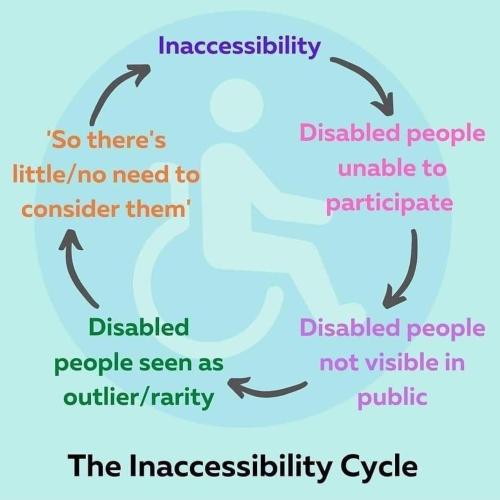
In the first example, it basically implies that we, disabled people, shouldn’t exist in this society—inaccessibility → disabled people unable to participate → disabled people not visible in public → disabled people seen as outliers/rarities. So there’s little to no need to consider them, and we are back at the start of the circle—inaccessibility.
On April 23rd, 2024 on social media Misa on Wheels (some of the pictures post here are from her page) had a chart about inaccessbity which she borrowed from another website.
The 2nd and also final reason is one topic. The pictures at the top of this post show a sign saying, “Wheelchair ramp is available; please ask at the desk,” which basically assumes that disabled people always have someone (read: able-bodied) with them in order for them to go and get help. How is someone in a wheelchair supposed to get to the desk of the business without the need for the ramp in the first place?
Theatres/Concerts being inaccessible
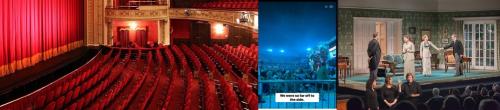
In this topic, I’m going to talk about four things specifically. Those topics are basically that wheelchair users have to, most of the time (but not all the time), book seats in the orchestra level, which is double the expense of the cheap seats in the balcony at a theatre, or they’re off to the side at a concert (and pay more). The last mobility device topic is the accessible seats in movie theatres. The other topic we will discuss is how Deaf people aren’t getting good access to shows they might want to see.
Theatres
From my experience in going to live theatre, I have found that the cheap seats are in the balconies as opposed to the orchestra level, which is more expensive. All but two of Toronto’s theatres are accessible; the two that aren’t are the Royal Alexandra Theatre and C.A.A. Ed Mirvish Theatre (not to be confused with the nearby “off-Mirvish” C.A.A. Theatre). The former has stairs all over the place with no elevators at all, so that if someone with a mobility device wanted to check their coats at the coat check in the basement, they would have to ask a theatre employee or their companion, if they had one with them, to do that. I saw SIX the Musical with my Mom the other year and Mom had to bump her bundle buggy up and down the stairs to get to and from the coat check before and after the show. At the C.A.A Ed Mirvish Theatre you can get a lift at the "Accessible" door (ie backdoor) to the orchestra level but you must hope to be able to climb several stairs to get to the first of the balcony levels. If you have a mobility device and wanted to see plays like Six at the Royal Alex or anything going on at CAA Ed Mirvish you would need to pay more for orchestra level seating because you don't have other options.
Concerts
Last summer, disability content creator Spencer West went to see Pink’s Summer Carnival in concert at the Rogers Centre/Sky Dome. Since he uses a wheelchair, he decided to try the “accessible” seats of the venue. He normally doesn’t do that when he gets to go to a concert. What he found is that despite the fact there are elevators and ramps to get to the accessible seats, the accessible seats are not really accessible; he and his friend, who he was with, were basically at the far edge of the venue and couldn’t see anything happening at the concert without the help of the gigantic video screens Pink had up, or if he zoomed in with his phone. What’s even worse about this? These “accessible” seats are double the cost of normal concert seats
Movie Theatres
In most movie theatres, the accessible seats are not really accessible. Due to the closeness of the screen to these accessible seats, it means people who are in them have to tip their heads back for the entire duration of the movie. This is what happened to my friend and me when we went to see The Grinch in 2018. My friend didn’t realize the seating plan at the movie theatre was backwards compared to how it is at other movie theatres, so we ended up sitting in accessible seating, and for the entire movie, we had to tip our heads up to watch. If it was hard on us, who are just about normal sizes, it would be more challenging for people with limited movement in their bodies or for someone who is a little person, like Cassidy Huff.
Deaf People trying to See Shows
Deaf people who try to see shows, whether it’s a concert or a play, have a lot to deal with. An interabled couple, with the wife who is deaf and the husband who isn’t, lives in Florida. They have always had issues with trying to go see shows in some form or another. I don’t know when this happened, but they went to see a concert and emailed the venue beforehand about needing an ASL interpreter. Originally, the venue said they were going to provide one, but then backed out by the time they got there and told them to either a) Google the lyrics for the song or b) have the husband sign the lyrics. Last I heard, the couple was looking to sue that venue for not providing the accessibility they promised.
This same couple also had a problem at a live theatre show they attended. They did get an ASL interpreter, but the venue placed them in seats that were blocked by a column or something, obstructing their view of the ASL interpreter. As a result, they couldn’t enjoy the show because the wife couldn’t see the person she needed to see in order to enjoy the play.
While working on this topic, I was trying to find a picture to go above, and I came across something a bit closer to home. Sometime around 2019, the Mirvish company, which puts on most of the bigger-name plays in Toronto, stopped offering ASL-interpreted performances. The company says that when Deaf people ask about ASL interpreters, it replies that there are “open captioning performances.” However, as Deaf people have stated, open captions (which are what movies use) are not as good as ASL interpreters. There’s also the bonus that ASL interpreters are present during the actors’ rehearsals.
The theory is that hearing folks thought the ASL interpreters were “too distracting” for them and complained about the “distracting” people—despite the fact that they’re probably at an ASL-interpreter-based performance.
But what hurts even more is that despite the fact that Mirvish got rid of ASL interpreters, they introduced a different kind of accessibility—”relaxed performances” for people who are sensitive to light or sound. Why have accessibility for some but not for all?
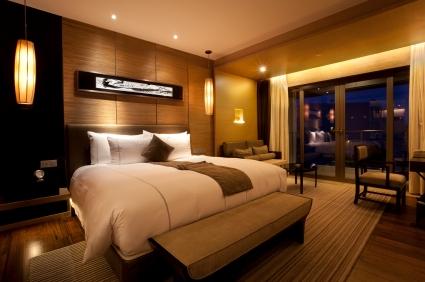
One major problem of accessible rooms is that often people will found there's no way to shower or bath if you're in a wheelchair-it's not a roll in. Sometimes the shower requires you to step into the bathtub. Some people have found that apparently the front desk needs to deliver a shower chair up to you instead of having it in the room itself. Some people have said that sometimes there's also is no grab bars in a shower or other places in the bathroom a person might require it. Another shower issue is that sometimes a shower chair is on the opposite side of the shower to where the controls are, so it's another example of assuming a disabled people are always travelling with someone.
Theme Park Inaccessibly
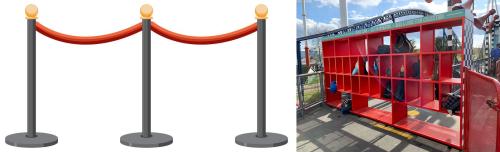
This topic will be about theme park inaccessibility mostly about queue lines and also potential about why having no storage bins at the rides might be a barrier for some disabled people to use a park.
An inaccessbity at theme parks is when queue lines instead of using metal or steel barriers to make the queue line they instead use a rope barrier. Why is this an inaccessibility issue? For a number of reasons- children playing with the ropes mean that the children could accidently get hit by a mobility device or by a cane. It’s easier to hop over and under the ropes in order to cut a queue then its is to cut a line with a steel or metal barrier. Mobility devices depending on the kind of device could potentially get stuck with a rope barrier versa is less likely to get stuck with a metal or steel frame.
Another inaccessibility barrier is apparently in the queue lines at Galaxy’s Edge at a Disney park, that someone had the smart idea of putting stuff like garage cans in the queue lines. Why is this an accessbity issues? it’s an accessbity issue due to the fact there’s no kind of bumps, or indicator of some kind to tell blind people who might be using a cane that there’s something in the way so it means they’ll bump into it.
At Cedar Park until sometime recently, Cedar Park’s theme park rides had storage bins at the rides for people to leave their backpacks and such but not too long ago they got rid of the storage bins and told people to use the paid lockers at the front of the park. Why is this an accessbity issue? It’s an accessbity issue because people need to have their medicine or equipment nearby- Diabetics, people with asthma, Epi-Pens for people with allergies. Or people like myself might have time-sensitive medicine we need to take at a certain time depending on what time we get up in the morning. So banning backpacks and bags at rides means that there’s the risk of an emergency happening or people having to walk all the way back to the front of the park to get their equipment or medicine especially if they’re not feeling well
Fear of Asking for Accessibility
Cassidy Huff mentioned in a video from 2024 that sometimes she's afraid of asking for accessibility in places she goes or wants to go. Sometimes disabled people are afraid of asking for accessibility because they're afraid of being dismissed, rejected, humiliated, feel like a burden, "just seeking attention", "Too high maintenance" for "daring to ask" for a basic human right. It's even worse if they had previous negative experiences with people dismissing or humiliating them for such stuff-so basically its a Catch 22.
This is an accessibility issue for two reasons. The first one is needing to ask for help robs disabled people of independence. Its really annoying as a disabled person needing to ask for help-its even worse when disabled people ask for help and they get treated as stupid for even daring to ask.
Some examples of this is an article I found an professor at the university who is visually impaired had to fight for an office with better lightening and then once they got it people were accusing her of “stealing it from someone else”. Sometimes they got treated as stupid for not being able to see the room number on the conference because it somehow isn’t high contrast so when they ask if they’re at the right room people would say “it’s right there” or “look around”,
The second reason is that disabled are afraid of asking for help is they think if they ask for help they will make disabled look like they can’t survive without help. That by asking for help it means they’re incapable of doing things by themselves if they try to ask for accommodations both in professional (work or School) or just to get around town or stores.
Another reason for disabled people don’t ask for help is the fact they or if they’re underage their parents get tired of always having to advocate and educate people about their disabled and what accommodations they need But by not asking for help can lead to dangerous situations where they could have a problem and not be able to get help. That the fatigue of always having to ask for help even has a name “Accessibility Fatigue” It’s either having to do it all the time to get help, or it could take years to get the accommodation you asked for in the work place
General Ignorance II
As I mentioned in my previous post, General ignorance from the able bodied people is a major problem for disabled people. So I’m going to talk about several incidents talking about General Ignorance- the first one is going to be something I saw first hand the other month, and another one is going to be talking about Molly Burke’s experience in finding a Literary agent. The others will tie back to previous topics in this post.
One of the times I was in Toronto, my Mom and I were going to go home and we kind of had a problem due to the general ignorance. We’re going to get on the accessible car and there was a guy in a scooter just ahead of us. The guy was mostly up the ramp that the Customer Service Rep in the accessible car puts down on to the accessible platform-but the problem comes from the people getting on the same car from the south side of the train. The people coming on the accessible car from the south side were just barging/barreling past the guy in the scooter as they went to the 2nd level of the train as the guy tried to get on the train. My Mom and I didn’t have time to wait so we got ourselves and the bundle buggy until a non-accessible car to my dismay.
A couple of weeks before July 1st Molly Burke posted a video in an early part of that video, she mentioned it took her a long time to write her book Unseen: How I Lost My Vision But Found My Voice (out now) but before before she wrote the book she was having a hard time in trying to find a literary agent because all but the last one, Courtney, thought they knew better then Molly, and insisted that Molly would need a Ghostwriter, or a co-writer. Courtney is the only one who had another trust in that Molly could do the work for herself without needing to hire an extra person-ghost or co-writer
So something I have seen a lot of online is that when topics of Service dog teams and people allergic to dogs come up that more then 50% of people believe that the allergic person takes precedence over the Service Dog team which isn’t really true service dogs are consider medical equipment and can’t be left outside they have to be with their handlers at all times unless the handler leaves them with someone at home or otherwise.
The last bit of General ignorance will go back to the inaccessible Ontario Courthouse that I mentioned early on in this post.
Conclusion
So as I said at the beginning not much has changed since the last year’s post. In some cases stuff has gotten much worse in the past year-the inaccessible courthouse for instance. But some things have changed there’s more disability advocates in the world to try to fight for accessibility rights for disabled people whereover we might live. Thanks for reading.