Community: A Source of Support (Day 3 of Living Beyond a Label!)
The LGBTQ+ community is made up of various LGBTQ+ identities often united by common experiences of exclusion, discrimination, or even “otherness”. While not all people who identify as LGBTQ+ consider themselves part of the community, the community can still be our chosen family, our support network, the place we can be ourselves and be accepted, and a group of people who will fight for us or beside us for our right to exist, to love the way we love, and be who we are. This community can be found locally or globally, online or in person, even here on 7 cups.
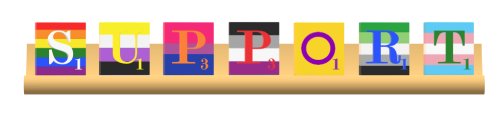
[Image consists of lgbtq+ flag themed scrabble tiles spelling support]
A Source of Support
Perhaps the most common forms of support we associate with the LGBTQ+ community are emotional and social support. It is a place where we can come together, share our experiences, be seen, be validated, as well as build friendships and a sense of belonging. Much like the community we find here on 7 Cups.
The community can also be a source of informational and practical support, helping us find the resources we need or even assist us in day to day tasks or filling out paperwork and forms, along with 7 Cups, GLAAD is another great example of one such support.
Often the community has banded together to provide physical support as well, often on a smaller scale, but a larger scale historical example may be when many of the nurses and caregivers for impacted gay men during the AIDs epidemic were from the lesbian community.
There are even efforts in the LGBTQ+ community to support one another financially through a wide variety of scholarship programs, foundations and trusts.
Even if you feel slightly apart, the LGBTQ+ community can be a source of mutual understanding, acceptance, respect and perhaps most of all support.
Questions:
Do you feel included and/or supported by the LGBTQ+ community? Why or why not?
How can the community work to be a better source of support for you?
What organizations are you aware of that offer support to LGBTQ+ people?
@EmotionsListener
1) Do you feel included and/or supported by the LGBTQ+ community? Why or why not?
Even if sometimes I experience biphobia within the community, I'm still deeply attached to the LGBT+ community, it has been an incredible source of support as I was beginning the journey of discovering myself, and throughout the years it has helped me find community, common values and a purpose to fight for.
2) How can the community work to be a better source of support for you?
This is not necessarily about me, but I feel like part of the community has lost sight of our political goals and settled for much less than what we're owed. It's not enough to strive for representation in media or companies. Rainbow washing enough is not going to solve the discrimination we face daily in our communities, in healthcare, in the workplace, in bureaucracy.
Also, everyone should remember that we need to fight for all identities, particularly the most marginalized and vulnerable ones, with a special care for the trans community considering what's going on in the world right now.
3) What organizations are you aware of that offer support to LGBTQ+ people?
There are so many! I'm Italian, but since I don't want to give a West-centric perspective, I encourage everyone to look up the list of associations affiliated to the ILGA network: it's a wordwide network that includes associations from all countries, even the ones in which LGBT+ are more marginalized or even criminalized.

@EmotionsListener
Do you feel included and/or supported by the LGBTQ+ community? Why or why not?
It depends who I run into within the community. Some are accepting of all and some are only accepting of some. I've had mostly positive experiences.
How can the community work to be a better source of support for you?
By being more accepting of my gender identity and sexuality. As a community we need to E=ensure all identities feel represented. Sometimes, certain groups within the LGBTQ+ community can feel left out or marginalized, like non-binary people, asexual people, people of color, or those from different cultural backgrounds.
What organizations are you aware of that offer support to LGBTQ+ people?