When You Clock Out, But Your Brain Doesn't

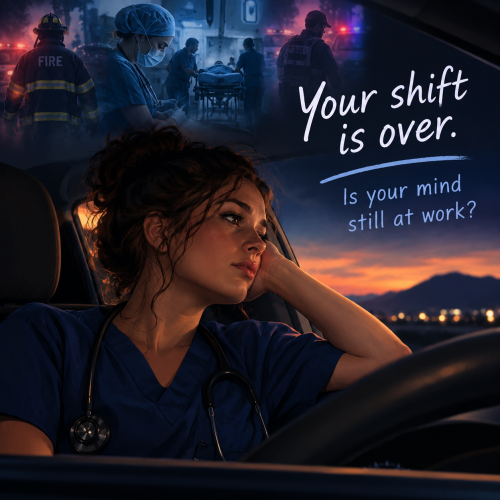
For our first responders, healthcare workers, and anyone whose job involves caring for patients or responding to people in crisis, I wanted to open up a conversation about something that doesn't always get talked about: how much of our work follows us home, even after our shift ends.
When you work in these fields, you can see and experience things that are difficult to process. You might witness someone experiencing the worst day of their life, deal with situations that stay in your mind long after they've passed, or carry the weight of knowing that someone was hurting and you could only do so much to help.
Sometimes, you want to talk about what happened during your shift, but you don't. Maybe you don't want to burden your loved ones with the things you've seen. Maybe you feel like someone who hasn't worked in the field wouldn't understand. Or maybe the experiences are so heavy that you don't even know how to put them into words. Sometimes, keeping it to yourself feels easier than trying to explain it to someone else.
Then there's the challenge of actually coming down after a shift.
When you're at work, you may spend hours in a state of heightened awareness, constantly assessing situations, anticipating problems, making decisions, and being ready to respond at a moment's notice. You learn to keep moving because people are depending on you.
But what happens when you get home and you're finally supposed to relax?
Your shift might be over, but your mind is still replaying conversations, thinking about patients, remembering difficult moments, or staying alert as if something else is about to happen. You might feel irritable, exhausted but unable to unwind, or disconnected from the people around you. Even simple things, like sitting on the couch and enjoying a quiet evening, can feel surprisingly difficult when your brain hasn't gotten the memo that it's safe to slow down.
And sometimes, you might not even realize how much you've been carrying until you finally stop moving.
You deserve to have space to process what you experience, too. Being the person who helps others through difficult moments doesn't mean those moments don't affect you. And you don't have to be unaffected by your work to be good at what you do.
I'd love to open up this conversation to anyone who can relate.
Do you ever struggle with leaving work at work? Do you find it difficult to relax after a shift, or do you ever feel like you can't fully explain what you experience to the people in your life?
If you're comfortable sharing, I'd love to hear about your experiences. What does it look like for you when work follows you home? Have you found anything that helps you switch out of work mode, or are you still figuring that part out?
Share as much or as little as you feel comfortable with. You don't have to share specific patient details or anything you're not ready to talk about.
Sometimes, it helps just to know that other people understand what you're going through. You spend so much of your time showing up for others. This can be a space to talk about how it affects you, too.
Our taglist of first responders and interested people.
@Darkgalaxy55555 @Remina @likeatattoo @Punkin89 @berrycheesecake90 @RunningMachine @scorpionpolktanktree @interestingRoss @Brightwords12 @justmiles @RoseGarden149 @persistentStrings6409 @rationalBunny4381 @AnxiousOrange00 @OfficerDerek1999 @ivoryFan8651 @conscientiousFriend7743 @RossyPuppy @HourglassEMT @FlightMedic38 @MissMonaBlue @peonybabez @River @AceSkoli
(Please PM me if you're a first responder or interested in first responder support)

@Remina
Thank you for this post and such an important topic about self-care. When I find work "follows me home" (I mean, even if I'm working from home and I'm doing, it's still here)....
Some things that tell me work is still with me:
- I'm still replaying things from work (e.g. people, messages, tasks)
- It's hard to focus on what I'm doing right now, or even where I am
It can also mean when I'm having a hard time transitioning that might look like: not feeling in touch with myself (physically or otherwise), tension, or anxiety and stress.
Some things I do to transition from work:
- Take a shower and imagine washing away whatever related to work down the drain.
- Change my clothes. Normally I'm wearing something somewhat professional and the act of changing "uniforms" helps my mind know a shift is happening to a different mode.
- Turn off my work computer and leave my work phone aside. Do not check it. This means respecting my boundaries and indicating that it's time for something else.
- Journal my thoughts/feelings. This can be a reflection of what happened, wishing something well, or acknowledging if something personal came up for me that I need to attend to and take care of.
- Visualize work somewhere else. This can be: putting it all in a safe box for later, pushing them away, or shaking it off me.
@carrotgoosoup
You're welcome and thank you for responding! I mean yeah, that's true, it can be difficult if work is at home because the brain associates home with work, and work is home, and Ah!
Thank you for sharing the signs that tell you work is still with you. I have definitely noticed that in myself. Sometimes I am going through conversations I had with people. Thank you for sharing some things that you do to transition yourself from work to home. I think changing clothes is a really good one because the clothes really do hold a lot of our day and it's a nice shift to change to something that screams I am home and I am comfy.
@Remina
Yeah, it's comfy time afterwards, not continued work time! Comfy clothes, blankets, and spaces are very nice afterwards :)
@carrotgoosoup
Yess! Blankets, hot chocolate and sweet treats.
@Remina
I'm not actually working in the medical field at this exact moment but even still it sticks with me. I worked in a place where I saw a lot of repeating faces. I got to know them well. I wonder about them all the time, it was so so hard to leave them and I still feel guilty.
And not currently working in healthcare is strange. Things happen at work and I can help using what I know sure but ultimately im much more helpless than I was when it was my job. Mostly I just have to call for someone else. We had a medical emergency at my new work (a fairly minor one). and after the people whos job it was showed up I just had to walk away and live with it. I had the worst panic attack ive had in years. I've seen that same thing happen to people, ive been the one to get them through it, or been there to not see them make it but it never hit me as hard as that one.
@MissMonaBlue
Hi! Thank you for sharing this with us. I can imagine how difficult it must have been to leave a field where you had gotten to know so many people and cared about what happened to them. When you see the same faces regularly, they stop being just people you see at work. You get to know them, you worry about them, and it's understandable that you still think about them and feel that sense of guilt after leaving.
I can also understand how strange and difficult it must be to go from being someone who could step in and help to being in a position where you have to step back and let someone else take over. Even when you know that calling the appropriate people is the right thing to do, I imagine it can be hard to go from being actively involved in those situations to having to walk away and not know what happens next.
I'm sorry that the medical emergency at your new workplace brought on such an intense panic attack. It sounds like this situation affected you in a way that even similar experiences in your previous role didn't. I wonder if part of what made this one different was being in a position where you couldn't do what you were used to doing, or if there was something else about the situation that made it hit you so hard?
If you're comfortable talking about it, I'd be interested in hearing more about what that experience was like for you. ❤️

@Remina
A coworker shared his insight on the panic attack; when its your job to do that, you do it all day, you're almost ready for it, or at least trying to be. When you're clocking in for your shift at a thrift store you aren't expecting it. I had an earbud in, I was daydreaming about nothing, just helping a customer and then I turn around and someone I know and care about is on the dirty floor. its a different day in a different environment. maybe thats not all it was but it was def a big part of it.
Something that also perturbed me was everyone's indifference. A coworker with a radio on his chest same as me came up and laughed while saying "well call a manager over". everyone just kinda glanced over, maybe stopped to look, but went right back to looking at all the stuff on the shelves. its not like that in the work places im used to.
@MissMonaBlue
That's a good point. You expected it more when you were in healthcare but now that you're working in an unrelated field, your guard was down. So when this medical incident happened, it was shocking and you were full of so much adrenaline, and sometimes that causes you to panic like you did. It makes sense that it would have been a big part of why it happened. I get that it perturbed you that everyone there was indifferent, just laughing about the incident, which you took way more seriously. I get how that work place is not how the work places that you are used to. You are used to your coworkers sharing the same belief when it came to someone having a medical problem, not people just finding it to be a funny "joke".
@Remina
Exactly, thank you :)
@MissMonaBlue
You're welcome!!

@Remina
This is such a great post. I wish leaving things in work is as easy as it sounds. I think exhaustion (as I also go have a chronic immune condition) is one major factor for me.
Things that usually help me is:
1. One good showerrr!
2. Skipping meals even when you come home after a long night shift is a no-no. I whip up something, even something as simple as an egg.
3. Honestly, I think work culture plays a big role too. In our hospital, we keep organizing hangouts so its always easier to switch the work button off when you are with friends and going out.
Excited to hear other people too!!
@River
Thank you, River! Right, it would be great if it was as easy as it sounds. I know my partner would be happier. It makes sense that exhaustion would be a major factor for you. I have heard my partner say before that a hard part is that he spends most of his time at work, so it feels weird and unnatural to be home at times, and like he's always waiting for the other foot to drop.
Thank you for sharing what usually helps you. I think taking a good long shower is a good idea. Wash away the shift, wash away whatever you saw that day and so true about eating. We have to eat. Doesn't matter if you're tired, have something! I love that your hospital organizes hangouts and encourages that work-life balance by doing that. I wish every work environment had that culture.

Thank you for bringing up this important topic, Remina. ❤️ I think we sometimes forget that the people who spend their time caring for others also need care, understanding, and emotional support themselves.
When someone spends their day helping people through difficult situations, it can be hard to switch off mentally once the work is over. Even when the body is tired, the mind may still be thinking about what happened, what could have been done differently, or whether everyone is okay. Carrying those thoughts alone can be exhausting.
I believe it's important to remember that being strong doesn't mean we are never affected by what we experience. We are human beings, too, and it's okay to need someone to listen to us without expecting us to have all the answers. Sometimes, talking to someone trustworthy, taking a quiet walk, listening to music, or simply giving ourselves time to breathe can help us begin to unwind.
I especially appreciate your reminder that people shouldn't feel pressured to share details they're not comfortable discussing. Everyone deserves the space to process their experiences in their own time and in their own way.
Thank you for creating a space where people who spend so much time supporting others can feel supported themselves. ❤️ Sometimes, knowing that someone is willing to listen without judgment can make a real difference.
I'm curious, what do you think is the most helpful first step in transitioning from a stressful workday to a more peaceful evening? 🌿
Hiii! You’re welcome! I think that the first step is taking a hot shower, scrubbing work off yourself. Smell is a strong thing and sometimes getting rid of the work smell can be beneficial as well as switching from work clothes to being at home clothes. Also if you have a radio, make sure you turn it off. There’s no need to listen to calls when you’re home, constantly being hearing the tones.
These are really helpful suggestions! 😊❤️ Taking a hot shower and changing into comfortable clothes can make a big difference in helping someone relax after work. And I agree, turning off the radio and giving yourself some quiet time is important for separating work from home life. Thank you for sharing these thoughtful tips! 🌿✨
You’re welcome! Pleasure talking with you about this ^.^
@Remina actually I don't work for shifting. I work for people. I'm practicing the balance between family and work. You know i used to work overtime and the contribution to my family was 0. It changed until 2024. I think it wasn't a long time.
That’s a great change, @minimum00 ! I’m glad you recognized that and made the change. I hope it’s going well.