Skip to main content Skip to bottom nav
Community /

Reading & Writing Forum

Create a New Thread
Gif Photo Link
tommy profile picture
What are you currently reading?
by tommy
Last post
Monday
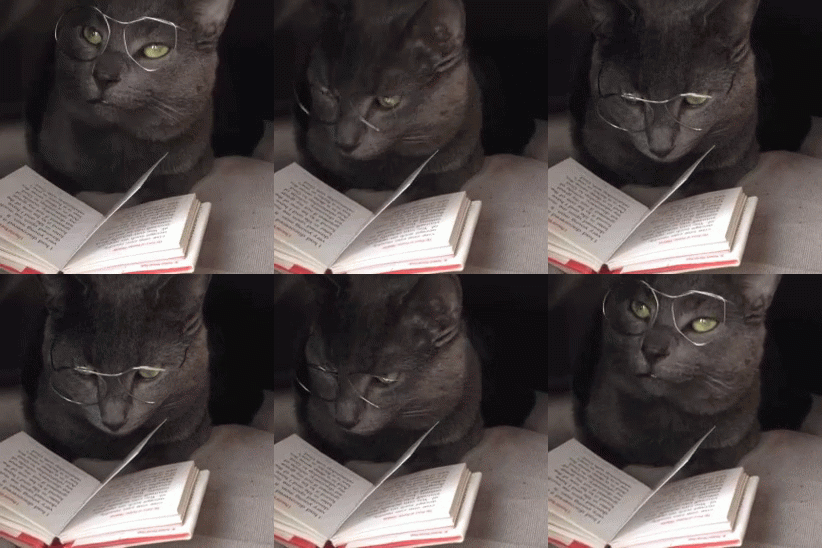
...See more Tell us what book you're currently reading! Are you enjoying it? Would you recommend it to someone else so far? {GIF of a cat reading a book}
tommy profile picture
Reading & Writing Automated Taglist!
by tommy
Last post
August 16th
...See more Welcome to the Reading & Writing Taglist This thread is an auto-updating list. The list is regularly updated by forum leaders and can be found below. Having issues? Reply below and someone will help you! Why should I join the taglist? ✔ Never miss out on sub-community check-ins, discussions or events ✔ Get tagged and notified by community leaders whenever a new relevant thread has been posted ✔ Become a more active member of the community. What do I need to do? ✅ To add yourself to this taglist, press the Post to Thread button below and write the exact words Please add me. ❌ To remove yourself from this taglist, press the Post to Thread button below and write the exact words Please remove me. ------------------------- Current taglist as of 27 August (updated by @tommy) @amiableBunny4016 @calmmoon2104 @dancingGrotto @GwydionRowan @hanasophia @HarmonyBlossom @HatsEatYou @LoveMyMoonflowers @softForest4843 @tommy
cyanessence profile picture
body homed, houses
by cyanessence
Last post
July 31st
...See more Some measure their worth by IQ. Some, EQ. But, are such things measures of worth? Can worth even be measured? Is it worthwhile to measure worth? And, what comes from measuring or comparing worth? The wise may think it wise to never measure wisdom, never gauge or count intellect. Is it wise to litter for a crow Does the crow tell the magpie when to swoop Litter for littering crow from bag of bread could provide bag for hand When emotion is lost, what drives intellect? When those that cannot or will not communicate, cannot or will not do or quote an IQ test, is their intellect diminished? To be confined within a box, where all properties and characteristics of the walls, floor, and ceiling are known, the air breathed could be forgotten; count the rocks in a cave long enough and you may have counted rocks that led to a chamber with no atmosphere. Without wit, could there be creativity? Sand from a beach can depict image on bitumen in town–the cost of pen, paper, brush, paint, pencil, chalk, charcoal... it can limit those burdened by the expense of survival. And, without wit, could there be humour? We do not grade senses of humour in schools, yet we laugh, guffaw, and cheer with our comedians, comedians that may act, speak, and/or portray whilst struggling with conditions such as dyslexia and PTSD; humour helps in that it enlightens softly–to relate joyously can be reparative. The cunning could never speak, yet bestow their community with gifts contributed anonymously; something never lost, mysteriously found, can confound so much so, it causes a kind of kind metamorphosis. Can the agile outpace those that dwell in intellectual pursuits? Can agility outspeed those that climb cliffs seeking wisdom? A rock thrown never strikes the agile; water thrown can be deflected by those quick with an umbrella. Further, the agile need not move fast to foster a landslide. Neanderthals would have had senses of morality, like birds that mourn those lost too soon, like felines that accompany the lost and/or fading, like the hound that flees upon sighting a hissing kitten. Did they have dexterity? How could they not? To craft a tool with no tools surely is a dexterous act–to thread a needle may be difficult, but to craft either with only hands would have been a handful of handy work. Can someone outsmart intellect? Intelligence may make a vehicle, but the smart may walk the alleyways, finding all sorts of sorts while giving the gym a run for its money. Can a scoundrel outmanoeuvre the agile, the dexterous, the cunning? Such wit can be disarming... to tamper with a weapon may make the wieldy falter, no matter their speed, precision, and skill. When we measure worth, by things such as money, we lose sight of inherent worth. Nature may bring flora and fauna into the world, but without conscientious nurture, nature can become mortar and pestle. Energy provided by sugar alone can erode the walls that home the body that build the walls for the home and the body deserves to be homed *body homed, houses*
cyanessence profile picture
*An Angel Ember Scorches*
by cyanessence
Last post
June 2nd
...See more *An Angel Ember Scorches* To whom it most definitely should concern, Australia is a multicultural nation. I do not think that can be denied. Does that mean there are people from Pakistan living in Australia? Is their music heard on the radio, or must they listen to what the common person deems popular? How is Australia to develop culture if radio segregates music genre? Are there people from China living in Australia? Do Chinese business owners lose their culture by playing popular music over radio, as radio selects what the common person deems popular? Japan also creates wonderful and wondrous music, yet where can it be heard? I am tired of hearing the same old tired tunes, especially the tune that Australia claims to be multicultural while not playing music from other lands in populated areas. Please regard, @cyanessence @Creamyyy @Amanda84
trueconfidant123 profile picture
Confess
by trueconfidant123
Last post
May 2nd
...See more Hey everyone! I'm back with yet another twisted question for the community.  We all have secrets. Dark, neat, wild, and all the kinds that can possibly exist. No one is a saint. No one can be a saint. We all have a past. A past worth cherishing or a past worth loathing. What's your best kept secret?  Or  What's something no one knows about you? ------------------------- Let's CONFESS
unassumingEyes profile picture
The child that is fear
by unassumingEyes
Last post
May 2nd
...See more You throw parties and don't invite it, but it sneaks in anyways; the unwanted child. And most of the time you yell at it, or try to keep it away with the weapons your therapist equips you with, weapons like deep breathing and grounding and all those things that you don't believe in but are desperate enough to try. You don't yell at it, today, or grab your weapons, because you have made a mistake and looked into fear's eyes, and seen your own soul glittering back at you through them. Perhaps it is this that weakens your rage against it, or perhaps you know what it is like to be the unwanted child yourself, but today you pick it up and hold it close, this being you have inadvertently created, and party on as though nothing has changed at all. You get looks, ofcourse, pitying ones and ones of genuine sympathy, and some try to take the child away from you, well-meaning friends and family, but you hold it close, almost protectively, and watch them shake their heads in arrogant concern. The child that is fear frightens at each of these attempts, but inevitably quietens once you two are left to be. Your arms tire, as they are wont to do, and you feel your resolve weaken. The day is darkening. The party is over. The child is asleep. You breathe, properly this time, and lay it aside with blankets and old toys you haven't seen in years and years, remnants of love and hope now long lost. You sing a lullaby, and sleep takes you in her arms, gentle and motherly, and you are the child that is fear and the one who holds it, and you are stronger than you realize.
JasGab200519970 profile picture
Reflective Exercise: Femininity
by JasGab200519970
Last post
January 28th
...See more Trigger warning - The following post deals with sensitive themes. Its about exploring your own thoughts and feelings kindly. I understand I have used absolute language like "should" its just so that the statements aren't neutral. You do not need to post any replies here as its for personal reflection. If you found the post helpful leave a like, if you want to give feedback im open to it on anything you would have wanted me to improve I welcome it. Exploring ideas of femininity: 1. Women are soft. (truly believe, neither agree or disagree, truly dont believe). 2. Women should be in the kitchen (truly believe, neither agree or disagree, truly dont believe). 3. Women make better leaders (truly believe, truly dont believe), 4. Women should be nurturing (truly agree, truly don't agree, neither agree or disagree), 5. Women should be more practical (truly agree, truly disagree, neither agree or disagree), 6. Women should have children (truly agree, disagree, neither agree or disagree), 7. Women are dominant (truly agree , truly disagree, neither agree or disagree), 8. Women are more objectified than men (truly agree, truly disagree, neither agree or disagree), 9. Women are more vulnerable (truly agree or disagree , neither agree or disagree, 10 Women should consider themselves feminist (truly agree, disagree, neither agree or disagree), 11. Women should think with their emotions (truly agree, disagree , neither agree or disagree). 12. Women should think with their thoughts (truly agree, disagree, neither agree or disagree). 13. Women should seek advice from their female friends (truly agree, disagree, neither agree or disagree), 14. Women should seek advice from their male friends (truly agree, disagree, neither agree or disagree). 15. Name one women in the media who you consider embodies femininity for you and why you gravitate towards her.  Stay safe,  Jas 
BlaiseAce profile picture
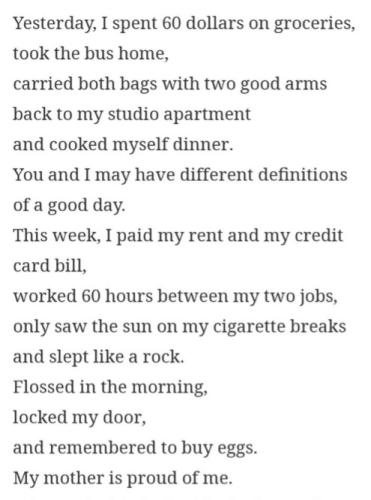
I wanted to share this poem, is sad but helpful
by BlaiseAce
Last post
December 30th, 2025
...See more TW!: Depression,Suicidal ideation (non‑graphic), Mental health struggles, Self‑harm references "A Good Day" by Kait Rokowski
azurePond profile picture
Knitted Words (This one's a long story)
by azurePond
Last post
December 16th, 2025
...See more ⚠️ This is a work of fiction ⚠️Any resemblance to real persons, living or dead, is purely coincidental. This story contains themes of parental emotional/physical abuse, creative suppression and anxiety. Also, apologies for the swearing in the dialogues.Knitted Words  I pick the wrong seat, but it’s the only one left— squeezed between  Anne, who has opinions about everything, and a drafty window. The yarn she passes me is forest green. She’s already mid sentence. “Oat milk” Anne says with a kind of world weary disgust. “too wet.” “too…?” I echo, trying not to drop the ball of yarn. “Wet” she repeats, “doesn’t froth. Just sit there in your tea like it’s judging you.” I nod and smile too broadly. My fingers tremble. I’m not new to knitting but today it feels foreign.That’s why I came: the numbness of it… counting stitches, following patterns, being in control. Yet the yarn keeps slipping through my fingers like something alive—or like something I’m afraid to grip too tightly. Like grief. Or a pen.  Anne leans over and watches me cast on, uninvited “You okay, sweetheart?” “Just rusty,” I murmur, pretending to count stitches. She shrugs. “Don’t worry. Repetition rewires the brain. I read it in a newsletter. Or from my dentist. Might’ve been both.” I try again. Across the room, someone quotes aloud from a poem. The cadence hits me before the words do. The wool slips.  I freeze. It’s mine. Something I wrote three  years ago—raw and furious, about isolation and the rage of being called gentle when you are not. “I miss that Calliope girl” Anne murmurs, reverent. “Disappeared like Amelia Earhart. Probably dead or in marketing.” I can’t breathe. “I wonder why she stopped,” someone adds. “Some say a nervous breakdown. Or writer’s block. Or motherhood?” My mouth tastes like dry oats. Oh no. I drop the needles and mutter, “water,” before bolting to the hallway. The door closes behind me with a hollow thud. The corridor smells like mildew and ancient varnish. I press my forehead to the wall. I want to scream but I don’t. The last time I wanted to scream like this was the day my poem went viral. I was twenty when it happened. I’d written the poem on a whim—one of those late nights, no filter, half feral kinds. I posted it around 3 a m, fully expecting it to get buried under sunset shelfies and unboxings. However, by morning, my DMs were flooded. Most of the buzz started with my Bookstagr@m following—originally just a quiet corner for honest reviews and chaotic midnight rants about Sadie Clooney books, echoing my unfiltered Booktube. My mother saw potential. She dismissed the “Sadie Clooney content” as “ navel-gazing for the Guardian crowd” but still pushed me to polish the captions, pre-select the books, and tone down the chaos. Eventually, I became the convenient Gen Z marketing accessory for her publishing house—pretty, curated, and safely above a nepo net. But the poem? That one was mine. Not scheduled content. It wasn’t holding a latte.  Then came the phone call. Her voice cut through the speakerphone with the usual calm: “It’s not strategic.” she said. “It’s too visceral for our brand. Can you take it down?” “I wasn’t trying to build a fre@king brand.” I said. She didn’t argue. Just emailed me a ‘tweaked’ version an hour later—soft metaphors, no body, no blood. Something about longing and doors gently closing. That night, I deactivated my profile @ ReadingWithLulu. A few months later, the same company started rebranding. They wanted edge. Something real, but...containable. They selected ten poets including me because apparently, I also fit the brief. “Your voice cuts through,” one of the editors said. “It’s female rage without the mess.” I told them I’d write but not under my name. Because I wanted a clean slate without my mother’s shadow. I chose Calliope—the muse of epic poetry. Dramatic, I know. But also, plausible deniability. Everyone agreed it was smarter this way. I’d be one of their underground voices. Sharp. Authentic. Marketable. Untouched by bloodlines. At least on paper.  I make it home on autopilot. The streetlights blur like wet paint. When I unlock the door, Alex is on the sofa with a cup of tea and his laptop open. A dozen chat bubbles pop up in the corner of the screen: “Is there a way to recover the staging environment?” “Why does it keep looping on the login screen?” “PLS HELP ASAP” Alex sips his tea, types something fast with one hand. His face stays calm, almost bored—except for the tiny crease between his eyebrows. The only sign he’s focused. “Long day?” I murmur. “Long week” he says. “But I fixed a bug today that’s been haunting people for six months. Got three thank you memes. One was animated.” “Fame.” He smirks. “Infamy. There’s a whole Slack channel where they post screenshots of error messages with my name on them. Like a digital shrine of despair.” “Do they burn little offerings?” “Mostly coffee grounds and broken keyboards.” "Tea?" he asks, oblivious to the chaos unraveling inside me. “Yeah” He gets up. I watch the cursor blink on his screen. A half written message reads: “No worries at all, happy to hel—” The cursor flickers. Waiting to finish. So much of his world is about fixing what someone else broke. Then his lips brush mine, warm and familiar. “Hey.” “Hey.” The scent of him—burnt sugar and and the faint chlorine of his morning swim—anchors me "They read one of mine" I whisper “in the knitting club..actually someone quoted me” He stills. "Did they know it was you?" I shake my head in resignation. "They think I'm dead. Or worse— in marketing." "Fake fans," Alex scoffs. "Real ones know you'd rather shovel mint chip till the glaciers melt than do marketing." "Still baffled by your mint obsession," I say, the heaviness in my chest tightening just a notch. "It tastes like... toothpaste." "Slander." he counters "wait—did you just compare my comfort flavour to Colgate?" "One of them said I probably married a finance bro and settled down." Alex clutches his chest like a shot man. " Finance bro?" His mock outrage sharpens into a grin. "My love, you didn't settle. You upgraded to open-source." He wanders over to the kitchen, sets the kettle on the flame, then tosses a glance over his shoulder. “Still… it feels good, doesn’t it?” His voice softens with pride and happiness “Hearing your poems read out loud?” I remember the first time someone read one of my poems aloud. I was 15. We were cross-legged in the school library, surrounded by the smell of musty spines and dry carpet. A boy named Ben or Dan snatched my notebook and begged to read from it. I said no. He did anyway. “Listen to this,” he laughed. “She says: My body is a burning house—who gave you the matches?” A ripple of chuckles. Someone whistled. I wanted to disappear inside the dusty shelf of encyclopedias. But then Aria David came over and said it was beautiful. “Keep writing,” she told me. “You have a gift.” I’d never felt so seen—and so mis-seen—at once. That night, Mother somehow  found the poem. Said it was “a little dramatic, but promising.” She made me replace burning house with storm shelter. I told her it wasn’t the same.  She told me that’s what editing was.  Alex handed me a cup of tea. It smelled like ginger and honey — he knows I can’t stand bland tea. “Even if you miss writing…it’s still okay. I understand.” Alex doesn't understand  “Literature” unless I diagram it for him. Once, I quoted Dickens  "It was the best of times, it was the worst of"— “–  Crimes. Taylor Swift. I know this one.”. he  interrupted enthusiastically. I threw an apple at him. He caught it, grinning, because of course he did. "I don't know every poem but— " “It’s not a poem,” I said, rolling my eyes. “It’s from a novel—a VERY FAMOUS one, actually. The opening line of A Tale of –” He continued  “—But I know every one of your poems. And I love all of them. Even the angry ones you never published." I took the cup of tea and muttered “It’s alright, I suppose” before turning away. Alex missed the point entirely—just like that time he read Poe and decided ravens were filthy little creatures that could drive anyone insane, completely ignoring the symbolism. It wasn’t that the knitting circle quoted my poem when I was mourning the act of not writing anymore. Nor was it about my mother’s endless criticisms and jabs. It was that people were quoting edited versions of me. They all miss the curated Calliope, not the messy me. I stepped into what I still called my “study.” Once a room where words spilled freely, now it was just sagging shelves of books and a collapsing cardboard box my mother sent me a few months ago. I sit for a minute, then get up and pull down the box from the top shelf—Old Receipts, written in black marker in her handwriting. I drop it on the floor and start digging up the past. The chairs were leather, the water sparkling, the windows too clean to look through without blinking. My poem sat in the middle of the table—printed on creamy stock. My name wasn’t anywhere. Just Calliope. The muse, the mask. “This voice,” said Hilda, the editor, tapping a manicured nail against the page, “it’s sharp. Hungry. It could do well in the socio-political space too. Something about survival or class or hunger.” I blinked. “I—I don’t think I can write about that.” Mother tilted her head. “Why not?” “Because it’s not mine” I said. “I’ve never worried about rent. Or heat. I went to a school where we had a Latin film club, for heaven’s sake.” Hilda laughed unfazed. “You don’t have to have grown up in poverty to write about it. Authors of crime novels haven’t killed anyone.” “That’s not the same,” I said. She leaned forward. “Why not?”. Mother cut in, all smoothed vowels. “She’s always been very sensitive.” “No, I am not sensitive. Just… aware that some things aren’t mine to stylise or romanticise.” “Maybe William is a better candidate for writing socio-political poetry. He has a poli-sci degree from Cambridge.  Mother and Hilda kept on going while I stared down at the contract: Pen name: Calliope.  Minimum output: 2 poems per quarter or equivalent prose features. Themes encouraged: identity, femininity, class, resilience, ‘realness’ Mother nudged the pen toward me. “It’s an excellent offer.” Hilda added: “You’ll get creative freedom. Within a frame, of course.” Now, years later, amid the bills and loose papers, lies the leather bound notebook I thought I’d thrown away —  and with it, the version of creative freedom I shackled to a contract. The first page hits like a slap. I am a museum of my mother’s revisions. Admission: one apology. Her red pen bleeds through the margins: Melodramatic. Simplify. Try harder.  Is this really what you meant? Underneath, in Alex’s handwriting: Bullsh!t. Burn the museum. My mother started editing me when I was a child. At twelve, I found my notebook moved from under my mattress to the desk. A pink Post it on the cover: ‘Beautiful imagery, Lulu darling, but the anger feels unearned. Try writing about forgiveness? Love, Mum.’ She’d drawn a heart. The page was wrinkled—like she’d cried while reading it. Even birthday cards weren’t safe. The same year , I wrote one for my father. She rewrote the closing line. Said it needed a better rhythm. I remember what I wrote: You are the fire, the laugh, the spark / You light our room when it gets dark. Mother crossed out spark. Said it was cliché. “Try a polestar or lighthouse - something perfect and distant,” she suggested. “Or gleam.” “But he’s not a gleam,” I argued. “Do you want it to be good or just emotional?” I changed it. I always changed it. Later that night, I showed Dad the original. The one with spark. He read it, smiled, and said, “That’s you.” “What if it’s not… good?” I asked. “Then it’s honest. That’s better.” He folded the card and tucked it in his wallet. “Don’t tell your Mum.” I nodded, not fully understanding, but sensing the weight of it. A week later, he moved out. Mother said it was amicable. She said things like narratives diverge and your father has different ways of processing emotions. She turned the separation into a paragraph she could control. Then she started h!tting us.  With rage. With correction. When I misspelled “appalling,” she slammed a dictionary down on my hand. When Sam cried because she tore his essay in half, she said, “That tone is unacceptable,” and pushed h1m into the table hard enough to leave a bruise. Then: “If your arm hurts, it’s because you flailed.” At first I thought it was grief. But she was always calm and measured. That’s what made it worse. She thought she was sculpting us. We were clay. Bruisable, bendable.  And dad?  He  just called on Thursdays. Always after dinner. Always to ask what I was reading. He never asked about my writing. He never asked about how life was with her either. Alex sits beside me now, watching me turn the pages. His jaw tightens - just for a second - before he reaches over and stills my hand. "If you don't love it anymore, walk away." His voice drops to a murmur. "No one's making you do this." The words cut wrong - precise but misplaced. "That's not—" Paper crumples in my fist. "I never stopped loving it. I stopped because she—" "Got in your head." His interruption comes too fast, edged with frustration. "But you're still giving her space there. These edits?..reading them again and again.." His knuckle raps the notebook. "This is self destruction." "You think my writing is self destruction?" My voice splinters. "You don't understand. If I don't write, she wins. She will erase me out of existence" “No, I did not mean your writing is–”Alex's exhale isn't quite a sigh but more like the same measured breath he takes before pushing off the pool wall. "I don’t know. Then write. But stop treating her red pen like holy text. Stop answering her calls.” “Just like you don't answer your mom’s calls? Avoidance has always been your MO” I retort His jaw tightens. “This is not  about me.” His voice drops, but the sharpness remains. “Fine. I don’t understand poetry or… or writing… or your depression—but I do know how toxic your mother is, and it is getting worse since you keep enabling—”His phone pings. Another work crisis, most likely. The sound severs whatever fragile thread was left. He stands, hands retreating to pockets. He's already turning when he adds,“This is exhausting.”  It lands like a slap—because he was there the night I curled up on the bathroom floor and forgot how to breathe. The water had gone cold by the time I stopped shaking. My knees pressed to my chest. The lights off. “I can’t find myself,” I whispered when Alex cracked the door. He didn’t speak. Just sat beside the tub and held my hand. His thumb tracing circles into my palm like a grounding spell. “She said if I stopped writing, I’d vanish.” “You’re right here,” he said. “Am I?” He was there when I deleted my mother’s number. And when I added it back three hours later, his hand caught my wrist. “Again?” His voice.“You’re really doing this again?” I yanked my arm back. “It’s just a number.” “Bullsh!t.. “You keep carving the same wound open and wondering why it won’t heal.” “She’s still my—” “Mother. Yeah. I know.” He laughed, bitter. “Funny how that word excuses everything.” He cut himself off, jaw tight. Then he turned and walked out. The door didn’t slam. That was the worst part—how carefully he closed it, like he was afraid of what might happen to us if he didn’t. Grief is strange like that. So is love.  Tucked into the back of the notebook, there’s a folded paper on love — a wedding toast. Sam and Jen’s.  My brother always grieved our mother, even knowing what she was. Maybe because of it. Some part of him still called it love. The day after my mother and I tore into each other—the day I almost  quit– words flung like knives and nothing left uncut—Sam called. I assumed it was to ask how I was holding up. Instead, he said, “You know she means well... right?” “She rewrote my poem about trauma to be about ‘the healing power of breath.’” “Still,” he said. “You’re lucky, in a way. She believes in you.” I laughed. “She believes in a version of me that doesn’t exist.” He fell silent. Then said, quietly, “She framed that first poem—the one that went viral. It’s in her office.” I hung up because I knew which version she’d framed. The one she rewrote. I didn’t speak to him again until the wedding. The wedding was a battleground–  Jen vs Mother.. I watched her "adjust" Jen’s seating chart ("Darling, the divorcées can’t sit together—it’s visually dissonant") Jen just smiled and reverted the changes. "Your mother," she’d whisper, squeezing my hand, "is a vandal with a thesaurus." That’s why I stood as a Maid of Honour. "Five minutes,"  Jen begged. "I want your honesty." I wrote seven. Mother was gone in four . Later I found  Sam outside, chain-smoking cloves like he was trying to smudge his lungs clean. “Jen loved the toast” he said. “Mum… not so much” “I didn’t write it for her.” He nodded. “But she didn’t slap anyone during it, so… progress.” I stared at him.  He shrugged. “You remember, don’t you? When she hi.t me with the workbook?” I nodded slowly. He never used to talk about these things—not until Jen. “She told me I ruined syntax and then sh0ved me into the dishwasher.” He took a drag. “She said if I kept crying I’d never be readable,” I  reply hoping, somehow, he sees it more clearly now. “Yeah.” he murmured. Then came the age old refrain— “But she stayed, Lu. Through everything. Alone. She raised us, educated us, got us through the door when most people don’t even get a key. She’s not a tyrant.” “Maybe. She edits like one, for sure”. That reception  toast was the last honest thing I ever wrote. Now it is buried in one of my old notebooks, like it is still waiting for someone to come back and finish a thought left behind years ago. I leave it there and head into the living room to find Alex. “I accidentally made a tube today,” I announced. “It was supposed to be a scarf.” Alex looks up from his laptop, his half smile flickering like a faulty screen. “Very avant-garde of you. We’ll call it post-linear fashion.” The joke lands softly but the silence between us still hums with the aftershock. I press on before I lose my nerve. "I’ve made my decision. I’m going to write again. But not for her. Never again for her." The words hang between us, still sticky with the residue of the fight. Alex’s thumb taps once against his knee—a silent tell. Then, just: "Okay." It’s not the reaction I expected. Just okay, like I’d announced I’d take the trash out. And somehow, that’s what undoes me. "I’ve always loved writing" I say, the admission clawing up my throat like a shard of glass. "These past few years have been h3ll because I stopped. And I hate knitting. It doesn’t—" My voice cracks. "It doesn’t feel the same." Alex sets his laptop aside. "Oh, I noticed" he says,"you sighed every two minutes and stabbed those needles like they’d personally offended you." A beat. "Also, your ‘scarf’ was a tube."  "We agreed that it was supposed to be avant garde." I choke on something between a laugh and a sob.“ I know I'm unfair to you. Unlikeable. Just another literary snob like my mother” “"Bullsh!t. You're nothing like Thesaurus Rex.” he says, straight faced, and reaches for my hand.  “ You are very likeable." His palm is warm. "You know I love you, right?" The question isn’t soft. It’s a fact, solid as a brick—something to build on or throw. "I know" I say. "I love you too." And then, quieter "Even though you once asked if 'Waiting for Godot' was a metaphor for delayed trains." Alex doesn't miss a beat. "And I love you too" he says, "even though you once asked if I used double equal signs because I stutter when I code." His thumb brushes the welt on my palm - the one from when I gripped my pen too hard in the past. Later that evening,  I pulled one page from the box—thick stock bleeding red ink: Melodramatic. Simplify. Try harder. Her final note folded at the bottom: You can still come back. Alex watches from the balcony door, arms crossed. “You sure you wanna burn them? Could just toss ’em. Scr3w those papers.” But he passes me the lighter anyway. I hold the page over the metal waste bin. Thumb flicks the wheel.  Fire curls the edge slow. Ink bubbles, blackens. Simplify vanishes. Try harder glows orange, then ash. Just before the flame licks come back, I drop it. The plea crisps in the bin. Acrid smoke hangs sharp in the damp air. "Ash, ash— you poke and stir." I quote Plath, dusting ash from my fingers. " We can sell the rest for recycling. I don't care." We watch the last ember die. A curl of ash drifts off the edge like a dark petal. The sky bruises itself purple. She doesn’t get to edit the ending. The next morning  my  phone rings at 9:07 a m—the time she always calls. She thinks it’s less invasive than nine on the dot. I’m sitting on the edge of the bed, one sock on. Alex is by the window, halfway through tying his boots. He’s late for work. Still he pauses, glancing over. “Lulu darling, Good morning” she says brightly. “There was a quote on graffiti that made me think of you: Don’t be pushed by your problems. Be led by your dreams. Isn’t that lovely?” I say nothing. She fills the silence. “Perhaps revisit your old notebooks I sent you” , her voice polished, almost clinical. “A return to poetry… we could frame it as a rediscovery—the prodigal writer reclaiming her craft.” “I burned them” I say, voice flat. Alex’s hands still. Mother sighs—the kind of sigh that wants to sound hurt but only comes off tired. “You were always so dramatic. Did you mumble ‘Tyger  burning bright’ while you lit them up?” “I mumbled Lady Lazarus, Mother. And this is me—officially resigning.” “No need to be so hard on yourself over this, darling. We editors completely understand writer’s block. What you need is a creative retreat, not a bonfire of the verses that made you.” “I do not have writer’s block. I chose not to write. Also verses that made me? Those were never my verses. Those were all you. You turned my poem about physical abuse into a fre@king yoga mantra.”  I didn’t even realize I was yelling until I was. A pause. A breath. Then—“Language, Lulu darling. Art isn’t therapy. And that poem—wasn’t about that. It was about resilience.” “You don’t get to decide what it was about. I’m done. I quit.” Alex stands now, arms folded. "I protected you. Do you think the New Yorker wants to publish some girl’s—" "Mother, Did you hear what I said?  I said I qui––." "—some girl’s raw nerve?" A pause, then she adds “Did you read the folded page?” “Yes.” Another pause. "I meant it," she says softly. "Writer’s block happens. You can still come back to it. Don’t make this harder than it needs to be." This is not  about my writer’s block. Wait—no, I don’t have writer’s block. I just… can’t do this anymore. Why can’t she understand that she is the one who is making it harder She exhales, "Sammy never made it difficult. He always listened to me—well, before he married that little witch. Now he doesn’t even return my calls." My fingers tighten around the phone. Her voice cracks a little, "After everything I’ve done for both of you. You and him, you’re all I have. And this... this is for your own good. You have a gift—don’t throw it away." "Of course I know that, Mother. I didn’t quit writing—I just quit writing for you–" " Lulu darling, don't be petty. You’re still bound by a contract. The publishers have held back this long only because Mum’s been standing up for you—"  I should put an end to this. But some part of me still freezes—years of conditioned obedience like a leash yanking taut.  I glance at Alex. He’s standing by the window, jaw set, watching me. Waiting. I exhale, hold the phone out to him. "Here." A beat of silence. His eyes flicker—surprise, then understanding. He takes it. "Ms. Hartwell? Alex." His voice is calm but edged with steel. "Lu’s done. Our lawyer will handle the rest." A pause. Mother’s voice, tinny and sharp, crackles through the speaker. Alex doesn’t flinch. "No." Another pause. Another demand. "No." A quiet click. The call dies. The silence that follows is louder than any of her words ever were. And I know she won’t accept defeat and retreat—she’ll repackage it, rebrand it, rewrite it into something new.  Alex hands the phone back, his thumb brushing my knuckles  "You should've let me do that years ago," he murmurs. Later that day, I checked the letterbox. Inside: a postcard with a sketch of the sea. No return address. Dad and his simple nomadic life. Just five words in his handwriting: Still got that spark, kid? I crumpled it on the way to my desk. Because I know I do not love him enough to answer— And I know he doesn’t care enough to deserve one. I grab a pen anyway. And then, the line comes: My mother stitched silence into my thr0at. I bit through the thread. When the seam ripped, I retched bl00d— The sound would never be marketable. Good.

politePlace5370 profile picture
Don’t read this
by politePlace5370
Last post
December 13th, 2025
...See more Private for me, don’t look pls 
cyanessence profile picture
The Purple Rose
by cyanessence
Last post
November 7th, 2025
...See more "The Purple Rose" I painted a picture of a purple rose. I made it as simple as possible: one hue, one tone. For, I see something greater than beauty in simplicity. Not quite holiness, but not the ordinary. It is not the stuff of Angels. It is not the thing of any god, spirit, or magician. It is not a trick, but not quite the truth, for it seems to think the mysterious is somewhat serious. It reminds me of time. In comparison, it makes time's logic seem blind. Is it within reason? I'm not sure. The sensation seems to dance on the edge of perception, smiling while it finds the bright in life. You'd think I created something inspired by creation. No. It was a person. They gave me two words, and it turned into yearning. Wanting to see the beauty they see. What I see is something different, a bit too deep. She seems to be at the beach from time to time, and wouldn't it be nice to just like life. Those moments can be rare. When the sun is just right, no fright, no sound but delight. Yet, these words are too sharp, for the actual feeling is quite mellow. When the light is a kind shade of yellow, and the sky a gentle blue, it makes me want to paint a purple rose, for just you.
cyanessence profile picture
The Dog
by cyanessence
Last post
October 26th, 2025
...See more Trigger warning: a sad story, but with a happy ending. Themes of animal abuse and abandonment, though there are no gruesome details. I thought about sharing one of my older stories, one from about 14 years ago, but my stories from then were more bleak. They did inspire me to use darkness, but I want to turn darkness into light. Hence, this story. I present: The Dog The dog began his life in a fairly ordinary manner. After being fostered for the usual time, a seemingly kind and loving family adopted him. This family received him for free, for his foster parents were giving people and merely wanted to see more joy in the world. The dog was happy and joyous to be alive, appreciating all that crossed his path. The adopting family had put on a collective mask when picking up the dog. Darkness lived in their hearts, and they had no intention of providing the level of care required for a dog to thrive in life. In fact, the dog was to serve as an outlet for the family's frustrations. He received no name, and was simply called "dog". The family consisted of a mother, a father, and a young child. None were particularly bothered whether the dog was fed and so he was often left hungry. Occasionally, he would be given bad food, and rarely, the cheapest kibble that the family could find, not conducive to a healthy life. No comfort food was ever given. The child would pull on the dog's ears and tail, causing great distress. It was not gentle or playful in any respect. The mother would chastise the dog for no reason, yelling at him and blaming him for things that could not possibly have anything to do with him. The father would physically assault the dog. The dog endured the hardships, clinging to hope that if he remained good, the family would see him for what he was: a pure-hearted boy with no ill-intent whatsoever. He was forced to sleep outside with no kennel or bedding. Each day he awoke with renewed vigor—only to have it dashed. This continued for years. He lost weight, and his health suffered greatly. The family refused to address his condition and actually laughed at his poorly state. It was a vicious cycle, with the family not learning anything and the dog having endless forgiveness. However, the dog was capable of learning, and although it took a long time, he saw that the family was not changing. On a dark and cold winter night, the dog escaped. He knew his life was coming to an end and was determined to see a little of the world before he passed. He limped slowly around the town in the rain, not entirely sure what he was looking for. He was just seeking. Anything was better than the horror he had experienced. He happened upon an abandoned, homeless child, hiding in a vacant and rundown house. The two became fast friends, finding great solace in each other's company. The child was not especially creative, but wanted to give the dog a name. The child simply called him: "Buddy". There was not much the child and Buddy could do. Buddy was too sickly to play, and the house was empty regardless. So, the child just held him and talked to him softly. The child spoke of nice things: the sun shining; leaves whispering in a cool and gentle breeze; birds flying free and high. He named all the colours he could, and even sang songs. On the last line of the last song the child could remember, Buddy drifted into an eternal and peaceful sleep. The child wept deeply. He was ever grateful that he had found a friend in the cruel world that neglected them both. Thankfully, when morning came, the child left the house in search of help, keen to find more light in life. They were assisted by empathetic people, and their life improved dramatically. Buddy found himself in a strange situation. His consciousness continued on into a realm where he met a being, one of infinite compassion. This being had a colourful and pleasing aura that put Buddy at utmost ease. Although this realm was unlike anything Buddy had known, he had no anxiety at all. He felt peace and love, and knew that everything was as it was meant to be. The two could somehow communicate. The being explained to Buddy that his perseverance in life, his unwavering kindness and ceaseless hope, was to be rewarded. Buddy came to know of the cyclical nature of existence, and that as there was reason, everything made sense. That sometimes, one must live a hard life in order to learn great lessons. Buddy had learned the value of sacrifice: without his presence, the family that mistreated him would have directed their anger elsewhere. Buddy became human. Ordinary at first, he lived a regular life of minimal suffering, but was, in time, named a saint of modern times. He reformed the worst criminals; he discovered the cure for cancer; he improved the justice system so no-one was treated unfairly; and he treated everyone who came into his life with respect. One day, Buddy visited an aged care facility. He came across an elderly woman who told him a story of a random dog that found her on a harsh winter night when she was a homeless child. She said that although she had only known the dog for that night, that dog was her favourite friend and most pleasant memory. She recalled the name: "Buddy". Funnily enough, this was the saint's nickname, and for some reason, he cried tears of joy upon hearing the name for the millionth time.
cyanessence profile picture
Confession
by cyanessence
Last post
October 23rd, 2025
...See more I have a confession. It is deeply personal. I rarely share this about myself, so I would appreciate kindness. I was diagnosed with schizophrenia in about 2013. I had my mental break down after attending university for a year. I learned a lot, but I think it overloaded me. For about a year, it felt like I couldn't think. The absence of thought is very hard to explain. The whole thing was bizarre and confusing. Schizophrenia is frightening. It was later rediagnosed as schizo-affective. However, now, after having learned about myself and my conditions, I don't feel I suffer. My thoughts are not scattered. I don't jump from topic to topic. Rather, I have clarity. I can think clearly. It seems obvious to me. The broken are diamonds in the rough. It sounds cliche. Hear me out. I think it's clear to see how empowered and active one becomes after overcoming struggle. After living in long darkness, the light is precious. If one makes sense of their thoughts, amazing things happen. Therefore, if you have an immense burden, like schizophrenia, but you manage to shake it, make sense of it, then the knowledge that there is reason in "madness" is compelling. The world looks different now. More promising. The world we live in is not random. There is a sense to it. Even in schizophrenia, there is an underlying logic. Things don't happen for no reason. I often weep for those with schizophrenia. I can't imagine very well what their world is like, with its persistent stream of shifting thoughts. It must be hard to keep on track, get things done. And the way the world looks at the schizophrenic, like they have no purpose, breaks my soul. @jesusredeemedme2425 @Amanda84 @Creamyyy @Torean @azurePond @BastionKnight @PiecesOfWhoeverIWas
azurePond profile picture
Knitted Words (This one's a long story)
by azurePond
Last post
October 23rd, 2025
...See more ⚠️ This is a work of fiction ⚠️Any resemblance to real persons, living or dead, is purely coincidental. This story contains themes of parental emotional/physical abuse, creative suppression and anxiety. Also, apologies for the swearing in the dialogues.Knitted Words  I pick the wrong seat, but it’s the only one left— squeezed between  Anne, who has opinions about everything, and a drafty window. The yarn she passes me is forest green. She’s already mid sentence. “Oat milk” Anne says with a kind of world weary disgust. “too wet.” “too…?” I echo, trying not to drop the ball of yarn. “Wet” she repeats, “doesn’t froth. Just sit there in your tea like it’s judging you.” I nod and smile too broadly. My fingers tremble. I’m not new to knitting but today it feels foreign.That’s why I came: the numbness of it… counting stitches, following patterns, being in control. Yet the yarn keeps slipping through my fingers like something alive—or like something I’m afraid to grip too tightly. Like grief. Or a pen.  Anne leans over and watches me cast on, uninvited “You okay, sweetheart?” “Just rusty,” I murmur, pretending to count stitches. She shrugs. “Don’t worry. Repetition rewires the brain. I read it in a newsletter. Or from my dentist. Might’ve been both.” I try again. Across the room, someone quotes aloud from a poem. The cadence hits me before the words do. The wool slips.  I freeze. It’s mine. Something I wrote three  years ago—raw and furious, about isolation and the rage of being called gentle when you are not. “I miss that Calliope girl” Anne murmurs, reverent. “Disappeared like Amelia Earhart. Probably dead or in marketing.” I can’t breathe. “I wonder why she stopped,” someone adds. “Some say a nervous breakdown. Or writer’s block. Or motherhood?” My mouth tastes like dry oats. Oh no. I drop the needles and mutter, “water,” before bolting to the hallway. The door closes behind me with a hollow thud. The corridor smells like mildew and ancient varnish. I press my forehead to the wall. I want to scream but I don’t. The last time I wanted to scream like this was the day my poem went viral. I was twenty when it happened. I’d written the poem on a whim—one of those late nights, no filter, half feral kinds. I posted it around 3 a m, fully expecting it to get buried under sunset shelfies and unboxings. However, by morning, my DMs were flooded. Most of the buzz started with my Bookstagr@m following—originally just a quiet corner for honest reviews and chaotic midnight rants about Sadie Clooney books, echoing my unfiltered Booktube. My mother saw potential. She dismissed the “Sadie Clooney content” as “ navel-gazing for the Guardian crowd” but still pushed me to polish the captions, pre-select the books, and tone down the chaos. Eventually, I became the convenient Gen Z marketing accessory for her publishing house—pretty, curated, and safely above a nepo net. But the poem? That one was mine. Not scheduled content. It wasn’t holding a latte.  Then came the phone call. Her voice cut through the speakerphone with the usual calm: “It’s not strategic.” she said. “It’s too visceral for our brand. Can you take it down?” “I wasn’t trying to build a fre@king brand.” I said. She didn’t argue. Just emailed me a ‘tweaked’ version an hour later—soft metaphors, no body, no blood. Something about longing and doors gently closing. That night, I deactivated my profile @ ReadingWithLulu. A few months later, the same company started rebranding. They wanted edge. Something real, but...containable. They selected ten poets including me because apparently, I also fit the brief. “Your voice cuts through,” one of the editors said. “It’s female rage without the mess.” I told them I’d write but not under my name. Because I wanted a clean slate without my mother’s shadow. I chose Calliope—the muse of epic poetry. Dramatic, I know. But also, plausible deniability. Everyone agreed it was smarter this way. I’d be one of their underground voices. Sharp. Authentic. Marketable. Untouched by bloodlines. At least on paper.  I make it home on autopilot. The streetlights blur like wet paint. When I unlock the door, Alex is on the sofa with a cup of tea and his laptop open. A dozen chat bubbles pop up in the corner of the screen: “Is there a way to recover the staging environment?” “Why does it keep looping on the login screen?” “PLS HELP ASAP” Alex sips his tea, types something fast with one hand. His face stays calm, almost bored—except for the tiny crease between his eyebrows. The only sign he’s focused. “Long day?” I murmur. “Long week” he says. “But I fixed a bug today that’s been haunting people for six months. Got three thank you memes. One was animated.” “Fame.” He smirks. “Infamy. There’s a whole Slack channel where they post screenshots of error messages with my name on them. Like a digital shrine of despair.” “Do they burn little offerings?” “Mostly coffee grounds and broken keyboards.” "Tea?" he asks, oblivious to the chaos unraveling inside me. “Yeah” He gets up. I watch the cursor blink on his screen. A half written message reads: “No worries at all, happy to hel—” The cursor flickers. Waiting to finish. So much of his world is about fixing what someone else broke. Then his lips brush mine, warm and familiar. “Hey.” “Hey.” The scent of him—burnt sugar and and the faint chlorine of his morning swim—anchors me "They read one of mine" I whisper “in the knitting club..actually someone quoted me” He stills. "Did they know it was you?" I shake my head in resignation. "They think I'm dead. Or worse— in marketing." "Fake fans," Alex scoffs. "Real ones know you'd rather shovel mint chip till the glaciers melt than do marketing." "Still baffled by your mint obsession," I say, the heaviness in my chest tightening just a notch. "It tastes like... toothpaste." "Slander." he counters "wait—did you just compare my comfort flavour to Colgate?" "One of them said I probably married a finance bro and settled down." Alex clutches his chest like a shot man. " Finance bro?" His mock outrage sharpens into a grin. "My love, you didn't settle. You upgraded to open-source." He wanders over to the kitchen, sets the kettle on the flame, then tosses a glance over his shoulder. “Still… it feels good, doesn’t it?” His voice softens with pride and happiness “Hearing your poems read out loud?” I remember the first time someone read one of my poems aloud. I was 15. We were cross-legged in the school library, surrounded by the smell of musty spines and dry carpet. A boy named Ben or Dan snatched my notebook and begged to read from it. I said no. He did anyway. “Listen to this,” he laughed. “She says: My body is a burning house—who gave you the matches?” A ripple of chuckles. Someone whistled. I wanted to disappear inside the dusty shelf of encyclopedias. But then Aria David came over and said it was beautiful. “Keep writing,” she told me. “You have a gift.” I’d never felt so seen—and so mis-seen—at once. That night, Mother somehow  found the poem. Said it was “a little dramatic, but promising.” She made me replace burning house with storm shelter. I told her it wasn’t the same.  She told me that’s what editing was.  Alex handed me a cup of tea. It smelled like ginger and honey — he knows I can’t stand bland tea. “Even if you miss writing…it’s still okay. I understand.” Alex doesn't understand  “Literature” unless I diagram it for him. Once, I quoted Dickens  "It was the best of times, it was the worst of"— “–  Crimes. Taylor Swift. I know this one.”. he  interrupted enthusiastically. I threw an apple at him. He caught it, grinning, because of course he did. "I don't know every poem but— " “It’s not a poem,” I said, rolling my eyes. “It’s from a novel—a VERY FAMOUS one, actually. The opening line of A Tale of –” He continued  “—But I know every one of your poems. And I love all of them. Even the angry ones you never published." I took the cup of tea and muttered “It’s alright, I suppose” before turning away. Alex missed the point entirely—just like that time he read Poe and decided ravens were filthy little creatures that could drive anyone insane, completely ignoring the symbolism. It wasn’t that the knitting circle quoted my poem when I was mourning the act of not writing anymore. Nor was it about my mother’s endless criticisms and jabs. It was that people were quoting edited versions of me. They all miss the curated Calliope, not the messy me. I stepped into what I still called my “study.” Once a room where words spilled freely, now it was just sagging shelves of books and a collapsing cardboard box my mother sent me a few months ago. I sit for a minute, then get up and pull down the box from the top shelf—Old Receipts, written in black marker in her handwriting. I drop it on the floor and start digging up the past. The chairs were leather, the water sparkling, the windows too clean to look through without blinking. My poem sat in the middle of the table—printed on creamy stock. My name wasn’t anywhere. Just Calliope. The muse, the mask. “This voice,” said Hilda, the editor, tapping a manicured nail against the page, “it’s sharp. Hungry. It could do well in the socio-political space too. Something about survival or class or hunger.” I blinked. “I—I don’t think I can write about that.” Mother tilted her head. “Why not?” “Because it’s not mine” I said. “I’ve never worried about rent. Or heat. I went to a school where we had a Latin film club, for heaven’s sake.” Hilda laughed unfazed. “You don’t have to have grown up in poverty to write about it. Authors of crime novels haven’t killed anyone.” “That’s not the same,” I said. She leaned forward. “Why not?”. Mother cut in, all smoothed vowels. “She’s always been very sensitive.” “No, I am not sensitive. Just… aware that some things aren’t mine to stylise or romanticise.” “Maybe William is a better candidate for writing socio-political poetry. He has a poli-sci degree from Cambridge.  Mother and Hilda kept on going while I stared down at the contract: Pen name: Calliope.  Minimum output: 2 poems per quarter or equivalent prose features. Themes encouraged: identity, femininity, class, resilience, ‘realness’ Mother nudged the pen toward me. “It’s an excellent offer.” Hilda added: “You’ll get creative freedom. Within a frame, of course.” Now, years later, amid the bills and loose papers, lies the leather bound notebook I thought I’d thrown away —  and with it, the version of creative freedom I shackled to a contract. The first page hits like a slap. I am a museum of my mother’s revisions. Admission: one apology. Her red pen bleeds through the margins: Melodramatic. Simplify. Try harder.  Is this really what you meant? Underneath, in Alex’s handwriting: Bullsh!t. Burn the museum. My mother started editing me when I was a child. At twelve, I found my notebook moved from under my mattress to the desk. A pink Post it on the cover: ‘Beautiful imagery, Lulu darling, but the anger feels unearned. Try writing about forgiveness? Love, Mum.’ She’d drawn a heart. The page was wrinkled—like she’d cried while reading it. Even birthday cards weren’t safe. The same year , I wrote one for my father. She rewrote the closing line. Said it needed a better rhythm. I remember what I wrote: You are the fire, the laugh, the spark / You light our room when it gets dark. Mother crossed out spark. Said it was cliché. “Try a polestar or lighthouse - something perfect and distant,” she suggested. “Or gleam.” “But he’s not a gleam,” I argued. “Do you want it to be good or just emotional?” I changed it. I always changed it. Later that night, I showed Dad the original. The one with spark. He read it, smiled, and said, “That’s you.” “What if it’s not… good?” I asked. “Then it’s honest. That’s better.” He folded the card and tucked it in his wallet. “Don’t tell your Mum.” I nodded, not fully understanding, but sensing the weight of it. A week later, he moved out. Mother said it was amicable. She said things like narratives diverge and your father has different ways of processing emotions. She turned the separation into a paragraph she could control. Then she started h!tting us.  With rage. With correction. When I misspelled “appalling,” she slammed a dictionary down on my hand. When Sam cried because she tore his essay in half, she said, “That tone is unacceptable,” and pushed h1m into the table hard enough to leave a bruise. Then: “If your arm hurts, it’s because you flailed.” At first I thought it was grief. But she was always calm and measured. That’s what made it worse. She thought she was sculpting us. We were clay. Bruisable, bendable.  And dad?  He  just called on Thursdays. Always after dinner. Always to ask what I was reading. He never asked about my writing. He never asked about how life was with her either. Alex sits beside me now, watching me turn the pages. His jaw tightens - just for a second - before he reaches over and stills my hand. "If you don't love it anymore, walk away." His voice drops to a murmur. "No one's making you do this." The words cut wrong - precise but misplaced. "That's not—" Paper crumples in my fist. "I never stopped loving it. I stopped because she—" "Got in your head." His interruption comes too fast, edged with frustration. "But you're still giving her space there. These edits?..reading them again and again.." His knuckle raps the notebook. "This is self destruction." "You think my writing is self destruction?" My voice splinters. "You don't understand. If I don't write, she wins. She will erase me out of existence" “No, I did not mean your writing is–”Alex's exhale isn't quite a sigh but more like the same measured breath he takes before pushing off the pool wall. "I don’t know. Then write. But stop treating her red pen like holy text. Stop answering her calls.” “Just like you don't answer your mom’s calls? Avoidance has always been your MO” I retort His jaw tightens. “This is not  about me.” His voice drops, but the sharpness remains. “Fine. I don’t understand poetry or… or writing… or your depression—but I do know how toxic your mother is, and it is getting worse since you keep enabling—”His phone pings. Another work crisis, most likely. The sound severs whatever fragile thread was left. He stands, hands retreating to pockets. He's already turning when he adds,“This is exhausting.”  It lands like a slap—because he was there the night I curled up on the bathroom floor and forgot how to breathe. The water had gone cold by the time I stopped shaking. My knees pressed to my chest. The lights off. “I can’t find myself,” I whispered when Alex cracked the door. He didn’t speak. Just sat beside the tub and held my hand. His thumb tracing circles into my palm like a grounding spell. “She said if I stopped writing, I’d vanish.” “You’re right here,” he said. “Am I?” He was there when I deleted my mother’s number. And when I added it back three hours later, his hand caught my wrist. “Again?” His voice.“You’re really doing this again?” I yanked my arm back. “It’s just a number.” “Bullsh!t.. “You keep carving the same wound open and wondering why it won’t heal.” “She’s still my—” “Mother. Yeah. I know.” He laughed, bitter. “Funny how that word excuses everything.” He cut himself off, jaw tight. Then he turned and walked out. The door didn’t slam. That was the worst part—how carefully he closed it, like he was afraid of what might happen to us if he didn’t. Grief is strange like that. So is love.  Tucked into the back of the notebook, there’s a folded paper on love — a wedding toast. Sam and Jen’s.  My brother always grieved our mother, even knowing what she was. Maybe because of it. Some part of him still called it love. The day after my mother and I tore into each other—the day I almost  quit– words flung like knives and nothing left uncut—Sam called. I assumed it was to ask how I was holding up. Instead, he said, “You know she means well... right?” “She rewrote my poem about trauma to be about ‘the healing power of breath.’” “Still,” he said. “You’re lucky, in a way. She believes in you.” I laughed. “She believes in a version of me that doesn’t exist.” He fell silent. Then said, quietly, “She framed that first poem—the one that went viral. It’s in her office.” I hung up because I knew which version she’d framed. The one she rewrote. I didn’t speak to him again until the wedding. The wedding was a battleground–  Jen vs Mother.. I watched her "adjust" Jen’s seating chart ("Darling, the divorcées can’t sit together—it’s visually dissonant") Jen just smiled and reverted the changes. "Your mother," she’d whisper, squeezing my hand, "is a vandal with a thesaurus." That’s why I stood as a Maid of Honour. "Five minutes,"  Jen begged. "I want your honesty." I wrote seven. Mother was gone in four . Later I found  Sam outside, chain-smoking cloves like he was trying to smudge his lungs clean. “Jen loved the toast” he said. “Mum… not so much” “I didn’t write it for her.” He nodded. “But she didn’t slap anyone during it, so… progress.” I stared at him.  He shrugged. “You remember, don’t you? When she hi.t me with the workbook?” I nodded slowly. He never used to talk about these things—not until Jen. “She told me I ruined syntax and then sh0ved me into the dishwasher.” He took a drag. “She said if I kept crying I’d never be readable,” I  reply hoping, somehow, he sees it more clearly now. “Yeah.” he murmured. Then came the age old refrain— “But she stayed, Lu. Through everything. Alone. She raised us, educated us, got us through the door when most people don’t even get a key. She’s not a tyrant.” “Maybe. She edits like one, for sure”. That reception  toast was the last honest thing I ever wrote. Now it is buried in one of my old notebooks, like it is still waiting for someone to come back and finish a thought left behind years ago. I leave it there and head into the living room to find Alex. “I accidentally made a tube today,” I announced. “It was supposed to be a scarf.” Alex looks up from his laptop, his half smile flickering like a faulty screen. “Very avant-garde of you. We’ll call it post-linear fashion.” The joke lands softly but the silence between us still hums with the aftershock. I press on before I lose my nerve. "I’ve made my decision. I’m going to write again. But not for her. Never again for her." The words hang between us, still sticky with the residue of the fight. Alex’s thumb taps once against his knee—a silent tell. Then, just: "Okay." It’s not the reaction I expected. Just okay, like I’d announced I’d take the trash out. And somehow, that’s what undoes me. "I’ve always loved writing" I say, the admission clawing up my throat like a shard of glass. "These past few years have been h3ll because I stopped. And I hate knitting. It doesn’t—" My voice cracks. "It doesn’t feel the same." Alex sets his laptop aside. "Oh, I noticed" he says,"you sighed every two minutes and stabbed those needles like they’d personally offended you." A beat. "Also, your ‘scarf’ was a tube."  "We agreed that it was supposed to be avant garde." I choke on something between a laugh and a sob.“ I know I'm unfair to you. Unlikeable. Just another literary snob like my mother” “"Bullsh!t. You're nothing like Thesaurus Rex.” he says, straight faced, and reaches for my hand.  “ You are very likeable." His palm is warm. "You know I love you, right?" The question isn’t soft. It’s a fact, solid as a brick—something to build on or throw. "I know" I say. "I love you too." And then, quieter "Even though you once asked if 'Waiting for Godot' was a metaphor for delayed trains." Alex doesn't miss a beat. "And I love you too" he says, "even though you once asked if I used double equal signs because I stutter when I code." His thumb brushes the welt on my palm - the one from when I gripped my pen too hard in the past. Later that evening,  I pulled one page from the box—thick stock bleeding red ink: Melodramatic. Simplify. Try harder. Her final note folded at the bottom: You can still come back. Alex watches from the balcony door, arms crossed. “You sure you wanna burn them? Could just toss ’em. Scr3w those papers.” But he passes me the lighter anyway. I hold the page over the metal waste bin. Thumb flicks the wheel.  Fire curls the edge slow. Ink bubbles, blackens. Simplify vanishes. Try harder glows orange, then ash. Just before the flame licks come back, I drop it. The plea crisps in the bin. Acrid smoke hangs sharp in the damp air. "Ash, ash— you poke and stir." I quote Plath, dusting ash from my fingers. " We can sell the rest for recycling. I don't care." We watch the last ember die. A curl of ash drifts off the edge like a dark petal. The sky bruises itself purple. She doesn’t get to edit the ending. The next morning  my  phone rings at 9:07 a m—the time she always calls. She thinks it’s less invasive than nine on the dot. I’m sitting on the edge of the bed, one sock on. Alex is by the window, halfway through tying his boots. He’s late for work. Still he pauses, glancing over. “Lulu darling, Good morning” she says brightly. “There was a quote on graffiti that made me think of you: Don’t be pushed by your problems. Be led by your dreams. Isn’t that lovely?” I say nothing. She fills the silence. “Perhaps revisit your old notebooks I sent you” , her voice polished, almost clinical. “A return to poetry… we could frame it as a rediscovery—the prodigal writer reclaiming her craft.” “I burned them” I say, voice flat. Alex’s hands still. Mother sighs—the kind of sigh that wants to sound hurt but only comes off tired. “You were always so dramatic. Did you mumble ‘Tyger  burning bright’ while you lit them up?” “I mumbled Lady Lazarus, Mother. And this is me—officially resigning.” “No need to be so hard on yourself over this, darling. We editors completely understand writer’s block. What you need is a creative retreat, not a bonfire of the verses that made you.” “I do not have writer’s block. I chose not to write. Also verses that made me? Those were never my verses. Those were all you. You turned my poem about physical abuse into a fre@king yoga mantra.”  I didn’t even realize I was yelling until I was. A pause. A breath. Then—“Language, Lulu darling. Art isn’t therapy. And that poem—wasn’t about that. It was about resilience.” “You don’t get to decide what it was about. I’m done. I quit.” Alex stands now, arms folded. "I protected you. Do you think the New Yorker wants to publish some girl’s—" "Mother, Did you hear what I said?  I said I qui––." "—some girl’s raw nerve?" A pause, then she adds “Did you read the folded page?” “Yes.” Another pause. "I meant it," she says softly. "Writer’s block happens. You can still come back to it. Don’t make this harder than it needs to be." This is not  about my writer’s block. Wait—no, I don’t have writer’s block. I just… can’t do this anymore. Why can’t she understand that she is the one who is making it harder She exhales, "Sammy never made it difficult. He always listened to me—well, before he married that little witch. Now he doesn’t even return my calls." My fingers tighten around the phone. Her voice cracks a little, "After everything I’ve done for both of you. You and him, you’re all I have. And this... this is for your own good. You have a gift—don’t throw it away." "Of course I know that, Mother. I didn’t quit writing—I just quit writing for you–" " Lulu darling, don't be petty. You’re still bound by a contract. The publishers have held back this long only because Mum’s been standing up for you—"  I should put an end to this. But some part of me still freezes—years of conditioned obedience like a leash yanking taut.  I glance at Alex. He’s standing by the window, jaw set, watching me. Waiting. I exhale, hold the phone out to him. "Here." A beat of silence. His eyes flicker—surprise, then understanding. He takes it. "Ms. Hartwell? Alex." His voice is calm but edged with steel. "Lu’s done. Our lawyer will handle the rest." A pause. Mother’s voice, tinny and sharp, crackles through the speaker. Alex doesn’t flinch. "No." Another pause. Another demand. "No." A quiet click. The call dies. The silence that follows is louder than any of her words ever were. And I know she won’t accept defeat and retreat—she’ll repackage it, rebrand it, rewrite it into something new.  Alex hands the phone back, his thumb brushing my knuckles  "You should've let me do that years ago," he murmurs. Later that day, I checked the letterbox. Inside: a postcard with a sketch of the sea. No return address. Dad and his simple nomadic life. Just five words in his handwriting: Still got that spark, kid? I crumpled it on the way to my desk. Because I know I do not love him enough to answer— And I know he doesn’t care enough to deserve one. I grab a pen anyway. And then, the line comes: My mother stitched silence into my thr0at. I bit through the thread. When the seam ripped, I retched bl00d— The sound would never be marketable. Good.

Reading & Writing


Welcome to Reading & Writing! This supportive place for you to share everything and anything related to Reading & Writing.


What are the different forum topics for Reading & Writing?

Community Space: A place for icebreakers, introductions, discussions and community check-ins.

Writing Prompts: Need something to help inspire you? Find writing prompts here!


How can I help?

You can help us by simply responding to threads and sharing your story (if you're comfortable). Check-in with us, join a discussion, or start one! Alternatively, you can join us as a Forum Leader. Check out this thread for more information.


Helpful Threads

Taglist: Do you want to stay up to date with our community? Then join our tag list to be notified whenever there is a new discussion or update within the community!


Reading & Writing FAQ

Q: Are there any sub-community-specific guidelines that we need to adhere to?

A: You can find Sub-community-specific guidelines below, which you should follow in addition to the general forum guidelines.


Help! I still have a question!  If you need help, feel free to contact a community leader or post here, and someone will contact you!