The Harm from Toxic Positivity

✨Hay you wonderfuls!✨
Today, I want to talk about toxic positivity and the harm it causes.
It’s so ingrained in society that it feels natural, and often we think we’re helping by using it.
But the truth is, it doesn’t help 🙂↔️
While optimism can be healthy, forcing positivity invalidates emotions and blocks authentic coping.
to stay upbeat no matter what.
Whilst dismissing or suppressing difficult emotions like sadness or overwhelm, even grief or anger.
😔Which is far from being healthy.
“Just stay positive”, “Everything happens for a reason”, “It will get better, don’t worry so much about it”,
“Good vibes only,” or my personal non-favorite “It could be worse”. 🙄
These may be well-intentioned, but they dismiss real feelings and can harm both others and ourselves.
🚫Toxic positivity isn’t real support🚫
🤔Why is it harmful?
🔺 It invalidates emotions, making us feel guilty or weak for having them.
🔺It blocks healthy coping, leaving us unable to process difficult emotions and work through our struggles.
It discourages us from working through them.
🔺It worsens mental health, increasing anxiety, depression, and isolation.
🔺It discourages vulnerability, leading to shallow rather than genuine connections.
🔺It replaces empathy with dismissal, leaving people unheard.
and they should just stop talking about what they’re going through.
Acknowledge struggles: Validate that emotions, both good and bad, all emotions are natural.
Use balanced optimism: Pair hope with honesty, e.g., “I’m sorry you’re struggling.
Check language: Avoid dismissive phrases; instead, say, “I hear you, this sounds difficult.”
Create space: Allow room for both joy and sorrow, it builds resilience and genuine connection.
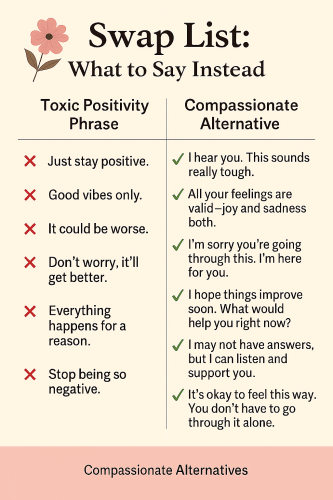
Tl;dr: Toxic positivity is harmful because it silences real emotions, blocks healing, and isolates people. True well-being comes from embracing the full spectrum of human feelings, both light and dark.
🤔Looking at the 'Swap List' above,
💓🐑💓 Thank you so much for taking the time to read this, I hope this helps you 💓🐑💓
Many thanks to @Heather225 for encouraging me and helping me out!
✨💙✨

When I see or feel toxic positivity, the invalidation it conveys is, indeed, difficult for me. That is very true in chats, as Anna's post highlights (thanks for this, Anna). I think we also need to be aware that toxic positivity can also appear in other places: groups, forums, and even in the way someone receives a welcome.
When I post a positive response to a post, I mean it. If that's all anyone posts, though, it can look like that's all we're encouraged or allowed to say. It can convey a culture that doesn't leave room for disagreement, discussion, or anything other than congratulating one another. It looks like toxic positivity, whether or not it's meant that way. If someone is new to listening, it could very well feel invalidating, alienating, and isolating.
I'm definitely not suggesting that we stop our encouragement of one another! I am suggesting though, that we make sure we're reserving equal space for those who might have something else to say, and that we encourage them to say it. It could be a minority opinion, an additional point of discussion, a frustration (expressed respectfully!), a creative brainstorm, or simply recognition that something isn't perfect. We all have these thoughts and feelings. Let's make sure we demonstrate that it's ok to have them, and safe to acknowledge them. Let's make sure we demonstrate just as much support outside of chats as we do inside of them.
It's ok to feel what you feel and think what you think. You are ok. Making sure we all know and feel that builds a culture of trust and acceptance. That's a very, very powerful thing, so let's make sure that we're shouting that from every corner of 7 cups.

@AnnaSilverberg
My dear Anna, I read with interest your post presentation on "Toxic Positivity". I have been managing a mental health situation for a little over 25 years now and pretty much all the work I have done in therapy groups, and sessions, over that time focus greatly on "Positivity".
It brought to mind the old adage, "There is always light at the end of the tunnel." [The metaphor, if not exact phrasing, dates to at least 1879 when it appears in a letter by writer George Eliot according to Wordorigins.org]
A great part of modern group therapy work makes reference to the "re-framing" of negative thinking into positive thinking.
Where do we draw the line between "Helpful Positivity" and "Toxic Positivity"?
Respectfully,
D.
@DireWolf62
I really appreciate this perspective, DireWolf. My personal answer to your question is that each person needs to find what works for them, and if positivity works well for you that's fantastic. I think dealing with toxic positivity is not about telling anyone to be less positive. It's about making plenty of visible and safe space for anyone who is not feeling so positive, and not assuming that everyone likes or needs the same thing.
@JustSophia
My dear JustSophia, as I appreciate your perspective... 😊
As you say, not everyone "likes", nor "needs", the same thing and that's the line I am referring to. I believe it is, frequently, very difficult to gauge the differences between people and not only is that "the line" I refer to but also the most difficult area to manage and discern. It is also the most common "trap" to fall into.
Respectfully,
D.
@DireWolf62
Hi D. I so appreciate your sharing your thoughts. I totally agree with you that trying to figure out what someone else needs or likes or wants is extremely difficult. No one should be expected to try. I think I understand what you mean about a trap. It's so easy to just sort assume without realizing it that we know what kind of support someone needs (did I understand that correctly?). But people seem to generally figure that out on their own, If there's space for them to do that. So trying to define any particular lines is less important, I think, than... well... making sure we have space without lines, even though that might be hard to do. Thoughts?
@JustSophia
Good morning Ma'am,
you are correct in understanding what I meant by "trap". It is the assumption/s that we make from what people are saying when we try to reference them within our own framework of understanding and experience. Because we do not share a person's history, because we have not "experienced" their experiences we cannot, in my mind, define where the boundary between our understanding, and their circumstances, lies - a somewhat dangerous grey area.
That is what prompted my curiosity, how can we effectively, caringly and, more importantly, safely, negotiate the boundary between us and others?
Thank you for your response.
Namaste,
D.

@AnnaSilverberg
Thanks you so much for posting this, toxic positivity is so invalidating, and I am thankful that you brought this up. While I try not to be toxicly positive, I think I often tell myself that things will get better, and that I should just deal with it.
@Starwarsfan1234
Dear StarWarsFan, I hope you are as well as you can be given the current circumstances. I think it is a great idea to reinforce the idea within yourself that things can, and will get better but I would cut the, "I should just deal with it" from the end. There is no doubt, in my mind, that these two thoughts, when put together give you the "positive" form "Things will get better" but the latter part, "I should just deal with it", to me, tends to reinforce the negative aspects of the situation and tend to make you force yourself to accept the bad parts of what's happening.
Just a thought.
Respectfully,
D.

@AnnaSilverberg
thank you for posting this i growing up with others being that way i remember how it felt i try not to do it but at times i use like cheer-up it not that bad could be worst
another one not on list but was older one is just pull your self up by your boot strings my dad used that a lot felt so dismissed to me like my feeling did not matter
but for me it not as much being positive toxic to others as is the self talk within i seem to repeat within things said to me that was that i know it unhealthy and unhelpful too
wonder if others do the same

@AnnaSilverberg
I truthfully find myself saying "Everything happens for a reason" quite frequently. Whilst I do believe that lots of things happen for a designated reason based on religious beliefs, a lot of things also happen just based on the conditions we live in- therefore, not everything happens for a reason. And it's definitely not justified to try and invalidate someone's emotions by claiming that everything happens for a reason when it's most likely not true in the first place.

@AnnaSilverberg
I think once in my life i has used the "everything happens for a reason" phrase and I actually hate myself for doing so lol
All the other phrases on the alternative good side I have used them all (no wonder i m the psychologist of the school😂) and i still use them because those are the words I would want someone to tell me when I m struggling.
My personal non-favorite as you said is the: it could be worse phrase. I heard it so many times in my life that whenever I heard it again i was like: oh come on at least use other words I m bored of hearing it the same way every time.
Instead of toxic positivity I use gratitude. I would be a liar if I say that gratitude hadn't helped me. Gratitude for me Is a lifeline. Let me know your thoughts on gratitude as well.
Thanks for this amazing post fellow Anna. Take care✨️🩵🫂

thank you😍@AnnaSilverberg

@AnnaSilverberg I so needed to see this !!! Ty

Thank you for sharing this. it feels like sometimes people forget that having a positive mindset means to brush everything off and never acknowledge the struggles, but that's not true. that will just lead to the issues piling up!
and sometimes people say these words like "just stay positive" because they don't know what else to say but honestly just listening and acknowledging what the other is saying and going through can be enough.

@AnnaSilverberg Thank you for sharing this. I heard a podcast yesterday on emotional intelligence, and managing your emotions. This resonates a lot with what I heard in the podcast. This was a great read and wonderful resource. Thank you again :)