Part V: Understanding the River Map: Finding Your Flow

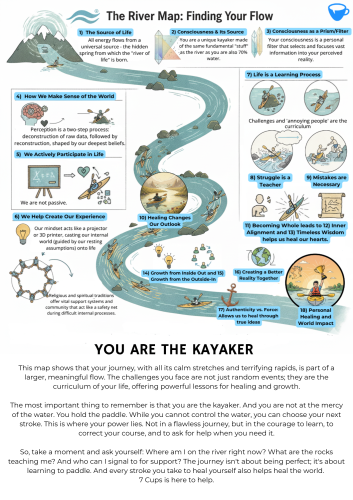
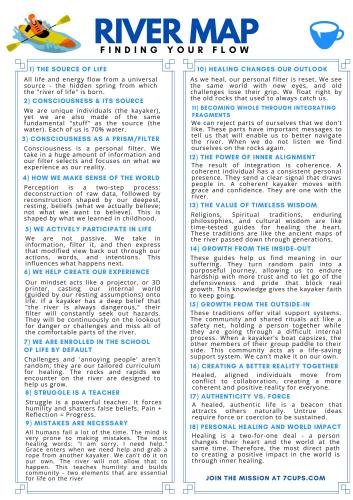
Find the complete infographics here.
When you're going through a difficult time, life can feel chaotic and overwhelming, as if you're lost in a storm without a compass. This document is intended to serve as a map. It’s a framework to help you find your bearings and understand the currents of your experience, no matter how turbulent they may seem.
This framework is designed to complement any spiritual, religious, or personal belief system you may hold. Think of it as a way to sharpen the focus on your own path, helping the wisdom you already carry become even more relevant and helpful in your journey.
Let’s begin by imagining your life as a river…
🔹 If you would prefer visuals over text, read through this graphical slide deck, which covers the material below. 🔹
Part I: The Nature of the River (The Foundation)
Point 1: The Source of Life
Explanation: Life and energy come from a deeper, universal source. This is the fundamental wellspring of existence from which everything we see and experience originates.
The River Analogy: This source is the hidden spring high in the mountains from which the "river of life" is born. As we navigate our kayak, the river unfolds before us, presenting a continuous stream of experiences: the currents, rocks, other people, and safe harbors. These are the "life elements" that constitute our journey.
Point 2: Consciousness and Its Source
Explanation: Human consciousness is a unique expression of this universal source of life. We exist in a paradox of being both a distinct, individual person and simultaneously made of the same fundamental "stuff" as everything else. For example, everything - including us - is made up of atoms.
The River Analogy: In our analogy, the kayaker on the river is separate from the water in the river, but the kayaker - like all humans - is 70% water.
Point 3: Consciousness as a Prism/Filter
Explanation: Consciousness functions as a personal filter. We are constantly taking in a huge amount of information, and our filter - shaped by our awareness and our subconscious - selects, interprets, and focuses this information to construct what we experience as our reality.
The River Analogy: The kayaker on the river isn't seeing everything at once. Their particular 'filter' - their focus, mood, and past experiences - determines what they notice. The river offers infinite details, but our personal filter determines which ones form our actual experience.
Part II: Learning to Paddle (The Inner Work)
Point 4: How We Make Sense of the World
Explanation: Perception is a two-step process. First, our minds unconsciously break down incoming information. We take what we see, hear and feel and pull it all apart to make sense of it. Second, we immediately begin the reconstruction process to make sense of the information. We build a new model of our experience with this information. Our heart’s resting assumptions - not what we want to believe, but what we actually believe - are baked into this reconstruction process. This way of seeing the world mostly happens on an unconscious level. We tell ourselves a story that makes sense to us. This story is not purely objective; it is shaped by our deepest, most fundamental beliefs about ourselves and the world.
For example, I grew up taking care of my family during challenging times. For most of my life - on an unconscious level - I would seek out and help people that needed help. I did this in part on a conscious level, but mostly it was unconscious. It was something I naturally did because it reinforced patterns I learned in childhood.The River Analogy: As a kayaker navigates a river, they constantly process a stream of information - the speed of the current, the water temperature, the placement of rocks, and the contours of the banks. This sensory data is deconstructed and then reassembled through the lens of memory. Past experiences with similar currents and obstacles actively shape their perception, informing how they interpret the river's challenges and opportunities in the present moment.
Following this analogy, I have met all kinds of people on the river of life, but I found myself consistently drawn to those who needed help. My resting belief, the core assumption I held about myself, was that I was valuable only when I was helping others. This validation felt good, even when it was detrimental to my own well-being—I would often sacrifice my own needs past a healthy limit. I did this because these resting beliefs acted like a current, influencing me to focus on certain elements of life (people in distress) while ignoring others (people who could support me or simply be my peer).
Point 5: We Actively Participate in Life
Explanation: We are not passive observers; we are active participants in life. Every moment, we are engaged in a dynamic cycle: we take in information from the world, filter it through our unique perspective (our beliefs and past experiences), and then express that modified view back out through our actions, words, and intentions. This output isn't just a reaction; it's our own energy and meaning being added back into the flow, constantly influencing what happens next.
The River Analogy: The kayaker feels the river's current (input). This raw information is instantly filtered through their experience and assumptions. Their paddle is their tool for action (output). How they use it - with a confident, powerful stroke or a timid, hesitant one - is a direct expression of their inner state. That single paddle stroke immediately changes their position in the current and alters their path forward. They are in a constant, active dance with the river, not just being carried by it. Another example - a kayaker talks with a person on the river. They hear the words the other person is saying, interpret the words, infuse their meaning and then respond to the person. The words they send back to the person they encounter can change the other person. The information that has been modified through the kayaker’s mind has an active impact on the world.
Point 6: We Help Create Our Experience
Explanation: In this way, our mindset acts like a projector, casting our internal world onto the screen of our life. Or you can think of it like a 3D printer where our internal code is transmitted onto the canvas of the world. Remember, it is our heart’s resting assumptions - what we really believe about ourselves and the world - that provide the script.
Above, when I highlighted the example of me actively helping others, I am showing how I interpreted the information, saw that the person needed help, and then helped them. When I help another person I am impacting their life.The River Analogy: If a kayaker has a deep belief that "the river is always dangerous," their filter will constantly seek out hazards. They will be continuously on the lookout for danger or challenges and miss all of the comfortable parts of the river.
Point 7: We Enrolled in the School of Life by Default
Explanation: We are all enrolled in the "school of life" by default. Life’s challenges are not just random events but can be seen as tailored lessons. They are designed to dismantle the ego's defenses and create the necessary conditions for the heart to heal. You don’t have to start a new program or turn over a new leaf. You are already in the school of life whether you realize it or not. The annoying people and problems we are currently facing are the curriculum. The things we don’t love about life are at least, in part, an expression of our underlying resting beliefs. The way we modify information that comes through our mind and pass it onto others - informs and creates the world we experience around us. It is not the only variable, but it is a significant variable.
The River Analogy: Getting stuck on the same type of rocks again is the river's way of showing us that there is a lesson we have yet to learn. The reoccurring obstacle is a part of the curriculum. We help create our world whether we realize it or not. It isn’t that we just have bad luck. We are an active force in creating and shaping our lives. When we find ourselves making similar mistakes on the river it is a good signal that there is an opportunity for us to learn an important lesson.
Point 8: Struggle Can Be a Powerful Teacher
Explanation: Painful experiences are often the most powerful teachers for this kind of healing. When we talk about our difficulties with people we trust, suffering can bring healing because it changes the heart. Struggle forces humility, shatters our false beliefs, and makes us truly aware of what needs to change. This dynamic was summarized by Dalio (2017): “Pain + Reflection = Progress.”
The River Analogy: Being pinned against a rock by the current is terrifying. In that moment of suffering the kayaker is in a state of struggle. They feel squeezed. Then they start to come out of it. This gives them a greater respect for the river and teaches them important lessons on how they will approach the next set of rocks.
Point 9: Mistakes are Good and Necessary
Explanation: Many of us are taught the damaging lie that we must be perfect. This message, communicated by parents, school, and work, suggests perfection is an achievable reality when it is very far from the truth. The actual truth is that all humans are limited. Our minds are powerful, but they are also prone to mistakes. Failure isn’t just possible; it’s a core part of what makes us human.
We struggle with this truth because we are often treated harshly when we make mistakes. This can wound our pride, making it difficult to apologize or admit we dropped the ball, as it feels like a public acknowledgment of our imperfection.
But all humans fail a lot of the time. Let me say it again: All humans fail a lot of the time. Believe it or not, this is a good thing.
Mistakes are a particular type of suffering that forces us to realize our limitations. They reveal our blind spots and show us where we have room to grow. Most importantly, they often require us to apologize and ask for help. When we do that, especially when it’s painful, our defenses break down. We become less rigid and more flexible. Our heart heals. When the other person forgives us, we experience grace.
I believe the six most powerful words in any language are:
I am sorry. I need help.
As soon as we speak them, the light floods in and we feel a deep sense of relief. We know we are back on track.The River Analogy: Every kayaker knows two things: the river is unpredictable, and they have inherent weaknesses. When a hidden current exploits a blind spot, a mistake isn't just possible - it's inevitable. This is a normal and expected part of life on the river.
Grace enters the picture when the kayaker acknowledges that they need help, and the quicker they do this, the better. They realize they are in over their head. Another kayaker throws them a rope. They grab it. The act of grabbing the line shows the kayaker that they can’t do it on their own; the river will not allow that to happen. Repeatedly, over and over again, kayakers rely on help from one another. This is a necessary part of the process because it teaches humility and builds community - two elements that are essential for life on the river.
Part III: The Fruits of the Journey (The Transformation)
Point 10: Healing Changes Our Outlook
Explanation: As we heal, our entire state of being changes. Our outlook, or personal "vibe," is uplifted and with it, we begin to see the same world with new eyes. Our personal filter is reset. As a result, old, recurring challenges lose their grip on us because we no longer feed them with our old assumptions. Old arguments that used to hook us no longer bother us. We have matured past them and are no longer interested in taking the bait.
The River Analogy: After learning the lesson of the rocks, the kayaker’s perspective changes. Those stubborn rocks that used to catch them every time - and seemed impossible to miss - are now on the other side of the river. The current takes the kayaker effortlessly by them. The kayaker looks at them and thinks - how on earth did I always steer right into these sorts of rocks before? Suffering has opened their eyes and taught them new ways of navigating the river of life. They no longer have to overcome the same old challenges. They instead have new challenges to overcome.
Point 11: Becoming Whole
The healing process involves bringing together the fragmented parts of ourselves. Past hurts and unprocessed experiences can leave us feeling conflicted and at war with ourselves. Carl Jung called these split-off parts the Shadow to symbolize their existence outside of our conscious awareness. These are typically parts of ourselves that our parents (or early caregivers) could not accept, and we learned to hide them to maintain connection.
The truth is that these parts yearn for integration - to be woven back into your being so that you can become a whole, vibrant person. They will surface unexpectedly, especially when you are feeling overwhelmed or tired, in an attempt to be seen and heard.
When we behave in these "bad" ways, we can trigger an intense sense of shame. Guilt is a focus on behavior: "I did a bad thing," which motivates us to make amends. Shame is a focus on identity: "I am a bad person." Shame hits us at our core and attempts to compel change through self-condemnation, screaming: “Hey! Stop that! What is wrong with you?!” Guilt can help us grow, but shame traps us in self-condemnation, making us hide again instead of healing.
We then try to hide those rejected parts of ourselves again, and the cycle repeats because those feelings remain split off, or dis-integrated.
We need to take a different approach: listen to these hidden parts of ourselves.
Imagine your mind as a system. The parts you’ve rejected are like a skilled engineer you’ve locked in the basement. At first, everything runs smoothly, but eventually, they start sabotaging the system just to get your attention. Instead of yelling at them, invite them upstairs for tea. Listen to what they’ve been trying to tell you. Rather than getting angry at them, we must invite them up from the basement to the kitchen table, offering them a cup of tea and a meal. We want to listen deeply to their wisdom and their hurt.
One powerful approach is to have a dialogue (which you can write out like a script) between the part that is acting out (the "engineer") and the part that is critical or judgmental (the "boss"). Ask the critical part to step back so you can listen to the exiled, hurting part. The mistakes (see Point 9) are not failures; they are signals that this engineer has an important message that can help you. Here is an example:
Boss: “Why can’t you control yourself?”
Engineer: “I’m scared and tired. I just need you to notice me.”
This practice helps transform inner conflict into understanding. When the engineer's message is heard and their energy is integrated, you become whole. Compulsive or "bad" behaviors - especially those linked to addiction - often diminish or dissolve because the underlying force driving the compulsion is no longer a desperate plea for attention but a valued, understood part of your unified self.
In short, we have to learn how to be good parents to ourselves. We have to provide space, listen to our weaknesses, and have the courage to keep trying and growing, especially when it is challenging. Becoming whole isn’t about fixing yourself - it’s about listening to every part of you with compassion. When you do, you stop fighting the river and start flowing with it.
The River Analogy: A fragmented kayaker argues with themselves mid-rapids. A part of them knows exactly what to do, but another part of them - the fearful or shamed part - tells them it is too dangerous or they will make a mistake. This second-guessing and inner conflict cause the kayaker to unnecessarily struggle and risk capsizing.
Point 12: The Power of Inner Alignment
Explanation: The result of integration is coherence, or inner alignment. A coherent individual has a clear and consistent personal presence, like a perfectly tuned radio station. They send a clear signal. Their thoughts, emotions, and actions are all in sync. This genuine alignment is felt by others and naturally draws people in. People that are not coherent have a radio signal that has a lot of static.
The River Analogy: A coherent kayaker moves with grace and confidence. They are one with the river. They can fluidly navigate around rocks and challenges. An incoherent kayaker paddles erratically and radiates anxiety.
Point 13: The Value of Timeless Wisdom
Explanation: Religions, Spiritual traditions, enduring philosophies, and cultural wisdom are like time-tested guides for healing the heart. Having survived for thousands of years, they offer proven frameworks for navigating the universal human experiences of suffering and growth.
The River Analogy: These traditions are like the ancient maps of the river passed down through generations. The maps provide wisdom that would otherwise take a lifetime of painful trial and error to acquire.
Part IV: The Kayaker and the River Community (The Outward Impact)
Point 14: Growth from the Inside-Out
Explanation: From the 'inside-out,' these guides help us find meaning in our suffering. They turn random pain into a purposeful journey, allowing us to endure hardship with more trust and to let go of the defensiveness and pride that block real growth.
The River Analogy: The ancient maps help a kayaker make sense of why a difficult portage or a treacherous canyon exists. This knowledge gives them the faith to keep going.
Point 15: Growth from the Outside-In
Explanation: From the 'outside-in,' these traditions offer vital support systems. The community and shared rituals act like a safety net, holding a person together while they are going through a difficult internal process.
The River Analogy: When a kayaker's boat capsizes, the other members of their group paddle to their side. This community acts as a life-saving support system. The river, like life, is often challenging and it is comforting to know that we don’t have to make it on our own.
Point 16: Creating a Better Reality Together
Explanation: As individuals and groups heal, they become more aligned and can work together effectively. They move from conflict to collaboration, becoming a powerful force that can positively shape their shared environment. When people in a group heal, they become more synchronized. There is less disagreement. One set of people becomes very good at doing one thing, whereas another group excels in another domain. The group becomes much more cohesive. This coherence accelerates healing in individuals and amplifies the group’s positive social impact.
The River Analogy: A group of healed, coherent kayakers becomes a community. Their collective competence and harmony create a different, safer, and more joyful reality on the river for everyone. People on the river banks see that there is something special about this group of kayakers. They excel, naturally, at helping one another. This spirit of camaraderie is contagious and more and more people want to join the group.
Point 17: Authenticity vs. Force
Explanation: A healed heart, aligned with life, becomes an example of an authentic and true way of being. True ideas heal and they stand on their own. They are beacons, clear signals, or lighthouses guiding the way. When a group of people is aligned with true ideas they amplify healing and unity. These authentic ways of being are naturally attractive to other people. Ideas that are not true require force or coercion. They fade when they are not fueled with money.
The River Analogy: A kayaker who understands the river's true nature paddles with it. This is magnetic. Other people want to paddle alongside this kayaker because they can see that they are effective and want to help others. This person knows that there are more than enough resources on the river. They do not have to hoard resources or fight, because their heart is healed and they can see that there is abundance.
Point 18: Personal Healing and World Impact
Explanation: If people and groups want to have a positive impact on the world then they have to heal. Healing is how people change the resting assumptions of their hearts. That allows the information to flow through them and create life-giving possibilities in relationships with others.
Healing is a two for one deal - a person changes their heart and the world at the same time. Therefore, the most direct path to creating a positive impact in the world is through inner healing.The River Analogy: To have the greatest impact, the person must first become a master of their own kayak. By healing themselves and mastering their own vessel, their positive impact on the entire river community becomes inevitable. The greater the individual and collective healing, the greater our coherence and positive social impact
Conclusion: You are the Kayaker
This map shows that your journey, with all its calm stretches and terrifying rapids, is part of a larger, meaningful flow. The challenges you face are not just random events; they are the curriculum of your life, offering powerful lessons for healing and growth.
The most important thing to remember is that you are the kayaker. And you are not at the mercy of the water. You hold the paddle. While you cannot control the water, you can choose your next stroke. This is where your power lies. Not in a flawless journey, but in the courage to learn, to correct your course, and to ask for help when you need it.
So, take a moment and ask yourself: Where am I on the river right now? What are the rocks teaching me? And who can I signal to for support?
The journey isn't about being perfect; it's about learning to paddle. And every stroke you take to heal yourself also helps heal the world.
You are not alone on the water. We are all here paddling alongside you. The state of the river is nothing more than the sum of every kayaker’s choice. A kinder, more compassionate world is not a distant dream; it is a reality built one conscious paddle stroke at a time. I speak for all of us when I say I am very glad you found us.
River Snapshot Exercise
Take a moment to reflect on where you are on the river right now. As you read through The River Map, notice which parts feel especially true for you.
Then, use these questions below to guide your reflection and share it as a reply to this thread:
1. Identify 1-2 points (or more!) that you like and find meaningful. Why do they resonate with you?
2. Identify 1-2 points that you want to learn more about or deepen your understanding. Let us know if there is anything we can do to help you on this part of the river.
There’s no right or wrong answer - this is just your snapshot of where you are on the river today. You will notice that this helps you as you progress with this series.
Mastery is daily navigation. You have the full map, and now you can find consistent support to stay in the flow. The Way of the River room is your 24/7 community hub to ensure these personal growth tools stick long after you finish the series. Apply to join the exclusive closed group here!

@GlenM This was such a beautiful and profound read. 🌊
@thoughtfulSail5983 thank you for your kind words and summary! i'm glad that several points resonated with you. the river of life sure is interesting and we are all going to make a lot of mistakes as we move through life. glad to be paddling here with you!
@GlenM I'm also glad that I'm padding. Lol

@thoughtfulSail5983 Hey. This is random, but just wanted to let you know I absolutely love your username. It fits sooo perfectly with this whole series! :)
@YourCaringConfidant aww thanks. I did just realised it does fit perfectly! I want to be your friend if you don't mind.

@thoughtfulSail5983
I've been excited about the river metaphor since we were in the earliest stages of developing this haha!
Thank you for taking this reflective journey!
@Heather225 interesting. Yeah, wlc heather
@thoughtfulSail5983 
@GlenM Truth be told, I am unable to answer this question. I really want to be able to pinpoint an exact place I am on the river, but I know I can't. Regarding some things in my past, I have been at every single point and those are chapters in my life that I closed... simply because those are the ones I have learned and evolved from. Currently with life and certain events taking place, I know I am just going where the currents take me. I know I am supposed to be the kayaker and the one with paddle in hand. I know supposedly I can take the paddle and determine my next stroke, but right now I am just at the point where I go where the current takes me no matter the dangers. I choose to trust God right now over myself or anyone else. That's just where I am at and I need to ride this out. :)
@YourCaringConfidant words of wisdom! we are here with you - riding out the current alongside you :)

@GlenM
1. Identify 1-2 points (or more!) that you like and find meaningful. Why do they resonate with you?
Here are two points I might find meaningful from everything I’ve explored so far — and why they may resonate with me in particular:
1. Small things I avoid can drain more energy than significant struggles.
Why it resonates:
Because I’ve been dealing with pressure, overwhelm, and emotional storms — and it’s easy for tiny tasks, thoughts, or worries to pile up until they feel huge. But realizing this gives me power again. It shows me that I don’t need to “fix my whole life” to feel better — sometimes moving one small thing can make everything lighter, and that's a powerful realization.
2. Struggles can become teachers that strengthen me.
It's a shift in perspective that's truly transformative. I’ve survived a lot — emotional pain, school pressure, fear of letting people down, and relationship stress. But seeing these not as proof that I am failing, but as experiences that shaped my compassion, resilience, and empathy, shifts the whole story.
It validates my strength instead of my hurt, reminding me of my resilience and empowering me to face future challenges with confidence.
2. Identify 1-2 points that you want to learn more about or deepen your understanding. Let us know if there is anything we can do to help you on this part of the river.
Here are two points I want to learn more about or deepen, based on what I've been reflecting on:
1. How to keep small "waste items" from building up and overwhelming me.
I am aware of how tiny tasks and thoughts pile up, but learning practical ways to stop that cycle — like micro-routines, emotional check-ins such as taking a few minutes to assess my current emotional state or journaling about my feelings, or boundaries with myself and others — could make my days feel steadier and quieter.
2. How to turn struggles into teachers in the moment, not just after I survive them.
I have already done well at reflecting on growth afterward.
What might help me now is learning how to pause during challenging moments and ask,
"What is this teaching me right now?"
Mastering the skill of pausing during challenging moments and asking, "What is this teaching me right now?" could provide a sense of calm and peace, softening my emotional storms before they take over.
@VampireBats I'm with you on trying to see the teacher in the moment and not only in looking back. i think that is an extremely helpful skill. i'm still learning how to do it. i celebrate each time i can close the gap. like instead of it taking me months to see the teacher i celebrate if I see the lesson i'm supposed to learn in weeks.
@VampireBats

Please join me, everyone, and keep sharing what you've learned about yourself and our world through this series! I'm looking forward to reading about your journeys alongside me down the river 🥰

@GlenM
1. Points I found meaningful & why they resonated
Point 4 – How We Make Sense of the World
This one hit deeply because it explains why some patterns keep repeating in my life. The idea that we unconsciously reconstruct things through our resting beliefs makes sense. I’ve definitely acted on old wounds or assumptions without realizing it, and seeing it framed this way helps me understand myself with more compassion rather than judgment.
Point 9 – Mistakes Are Good and Necessary
This was comforting. I tend to beat myself up when I mess up because it feels like proof that I’m “too much” or not enough. Hearing that mistakes are part of the curriculum — and that they actually push growth by breaking down shame — helps me breathe a little easier. It reminds me that I don’t have to be perfect to keep paddling.
2. Points I want to learn more about
Point 11 – Becoming Whole (Shadow integration)
This part makes sense, but it also feels hard. The idea of sitting down with the parts of me that I’ve pushed away — especially the ones that yell or panic — feels important, but I’m not sure how to actually do it without getting overwhelmed. I want to learn how to approach these parts gently without letting them take over.
Point 12 – The Power of Inner Alignment
I want to understand what coherence feels like in real life. How do I know if I’m aligned? What does that look like day-to-day? I want help noticing the early signs — both when I’m aligned and when I’m drifting into “static.”
@ScorpiaD i am glad those points resonated with you. those seem to be relevant to most of the readers, especially the mistakes point.
it is indeed hard work to integrate those fragments and to do shadow work in general. we are often more afraid of those things than we need to be. and great question on inner alignment. let me think on this more. from a jungian perspective, it is more about a person being fundamentally integrated (like the becoming whole paragraph) and then as a consequence of that they have alignment. it isn't about adding something or being in a particular way, it is more about healing and then operating from that standpoint.
@ScorpiaD
It's a big shift when you start seeing repeating patterns as old narratives instead of personal failures. That realization usually makes it a lot easier to trade judgment for some much-needed self-compassion. I love your take on mistakes, viewing them as a way to break through shame rather than proof of a flaw gives you so much more room to just breathe and be human while you're out there on the water. As for shadow work and alignment, those are definitely some of the more advanced stretches of the river. It's very common to feel a little intimidated by the idea of sitting with those louder or more panicked parts of yourself. Finding that sweet spot where you can acknowledge a feeling without letting it take over the whole boat is a practice that gets steadier over time. Same goes for noticing the static in your alignment; just having the intent to watch for those early signs is often the best way to stay on course.
Congrats on getting to the end of the series and I look forward to seeing how you carry everything here out into supporting others within our community <3
@GlenM
There's so much wisdom in this final chapter!
Identify 1-2 points (or more!) that you like and find meaningful. Why do they resonate with you?
What resonates with me most is the connection between authenticity vs. force. The idea that "Flow" is that state of true authenticity, and "Force" is the struggle we feel when we're pushing against it gets me thinking about where I might benefit from better alignment within myself. I was also moved by the point on personal healing and its world impact. The idea that how we heal by moving from Force to Flow isn't just for us, but that it actually affects our world, is an eye-opener. All in all, this series made me more aware of myself and my influence on others.
Identify 1-2 points that you want to learn more about or deepen your understanding.
I think I just want to continue to do inner work and revisit this post, especially 4-6, whenever I feel like my filter is getting muddy and I am reacting in ways that don't aid me (and by extension others) to certain circumstances as they arise in my life. All in all, this series has "replay value," and I am grateful to have this accessible visual model to ensure I never lose my compass on the river.

@GlenM
Thank you for sharing this. I will be applying for the taglist to be able to engage with this content!
@addtwd excellent!

Love this! Thanks so much.
@modestApple3456 you are welcome! what resonates with you about it?

@modestApple3456
Yes so true, such an amazing series💙

@GlenM
Point number six:
"If a kayaker has a deep belief that the river is always dangerous, their filter will constantly seek out hazards. They will be continuously on the lookout for danger or challenges and miss all of the comfortable parts of the river."
I have been in several "always dangerous" situations. In those situations, I have survived by "constantly" seeking out hazards. For example, I worked security at a steel mill. A large percentage of over 2000 workers regarded me with open hostility. They tried to run me over with vehicles. They threw things at me. They dropped heavy objects from overpasses, hoping to hit me. Most of those who were hired for security would work for a couple of hours, then leave and never come back.
I also worked at a chemical plant, also full of hazards. Fortunately, I got along with my coworkers quite well. There was always risk of equipment failure, and the safety protocols weren't always effective. One day I was drenched with carbolic acid, due equipment failure. The safety gear I was wearing didn't protect me. I stripped and ran to a safety shower, but it didn't work. I ended up finding a hose, but it wasn't great at removing the acid. I ended up with 3rd° burns on my chest and both arms. During training, I was taught that only 5% of that level of exposure would be lethal. I was very near death, and it certainly seems that some kind of otherworldly Grace kept me alive.
I was at that out-of-state chemical plant for training, as a new plant was being built close to my home, and they wanted employees that were fully trained to initiate the new plant. Incredibly, I was the person chosen to be the first to operate the transfer of the same acid-with untested equipment. It must have been Grace that tapped me on the shoulder, and said to trust myself and that it would be okay. Indeed, it was okay. Because I faced that challenge and risk, my status among my peers was clearly elevated.
By the time I left the steel mill, rather than hostility, the relationship between the workers and the guards was congenial. In fact, the workers took measures to protect the guards from potential injury related to equipment failure. I can't say that I influenced 2000 workers, instead, it was more like the "butterfly effect," in which interacting with one or two individuals, led to a "viral" spread of goodwill.
Those experiences, among others have convinced me that there are situations that are "always" dangerous, and one must remain alert to possible hazards.
They also taught me in a very profound way, that even in such circumstances, there is so much more going on, among individuals, and even the environment itself, that can be experienced as amazing and wonderful, especially when it comes to healing relationships.
While in my kayak, dodging rocks and avoiding waterfalls, even if my progress demands constant attention, I am aware that there is also beauty, and things to be appreciated around me. I imagine my filter does some filtering, hence there are things that I miss, but I think I manage to avoid a one-dimensional fixation on danger/fear.
Point 9: Mistakes Are Good and Necessary
I have an OCD-ish preoccupation with perfection, but it's rare that I don't get to a point where I say to myself, "okay, that's enough OCD for now." If the goal is to avoid mistakes, is worthwhile to realize that perfectionism is also a mistake. It can actually be a distraction from things that are more important.
I have probably worn the joke out among those close to me, but I've often said, "I'm really good at making mistakes." The inference of that is, that I hope to be really good at learning from mistakes.
I feel for people who have difficulty admitting to mistakes, or facing a mistaken belief. It relates to the idea that a person's identity is attached to their actions and beliefs. Therefore to face being wrong, feels like it's invalidating both the person, and the effort the person put into forming their beliefs. In short, being wrong affects pride and ego. I also think there is some merit in not being too quick to admit to being wrong, because perhaps the person is aware of something that the other person is not.
Finally, I feel that there is wisdom in not taking our thoughts and beliefs so seriously that we become rigid and unreceptive to new information. There is also great potential for seeing humor in at least some of the mistakes we make.
I like how you think.
@Spiritriver thank you for sharing these stories! I'm glad you were protected and also able to build real friendship and community across all of your old work domains. Showing up seems like a big part of it. I've been in similar situations. When you actually help, I think you are right, news travels fast through the network of people. Powerful!
And great point at being good at making mistakes. It is honestly the best option. Pretending we don't make them doesn't work and being super frustrated with ourselves doesn't work either. I like the approach here.
Some of what you said here reminds me of this graduation speech. This is one of my favorite talks: https://fs.blog/david-foster-wallace-this-is-water/.

@GlenM
Hello, it's great to participate in this series. This is my answer:
1. Identify 1-2 points (or more!) that you like and find meaningful. Why do they resonate with you?
I like points 5 and 17. It’s the same as my character, because I want to choose my life. I don’t force another to have a choice like me, but they can’t force me either. I understand sometimes my choice is hurt, but it doesn’t harm anyone.
2. Identify 1-2 points that you want to learn more about or deepen your understanding. Let us know if there is anything we can do to help you on this part of the river.
I’d like to learn more deeply about points 2 and 4. I don’t know why I hide my emotions a lot; I want to have a unique expression to help express my emotions. Sometimes, I feel it’s so a waste of time to express. With point 4, I always believed I was a little girl with no impact on the world. However, I think I need to change my mind
Thank you for creating the meaningful series. It helped me to explore myself a lot.
T
I l
@HealingwithMinionn Hey Healing! I just wanted to put my 2 cents in and say this to you-- no, expressing your emotions is not a waste! It's actually a good thing to be able to express how you feel. We feel so much as humans and I don't believe it's healthy to suppress it. I hope that one day you feel safe enough to do so. ♡ I also wanted to let you know that I'm proud of you for wanting to learn more and how you question things. Self-awareness is do important.
You mentioned "I always believed I was a little girl with no impact on the world. However, I think I need to change my mind." These are your words, and I thinking you are soooo right! In deed, maybe you do need to change your way of thinking here. I don't know you but I do know for a certain that you do have an impact on the world. You are so special. If no one has told you recently, I'm really glad you are here. Keep on being the amazing person you are. Keep learning and growing and doing great things. ♡
@HealingwithMinionn
I want to choose my own life as well. Here is a rose of appreciation for your wonderful share.
@HealingwithMinionn
I think it's great to see how much you value your own freedom and choice. Holding onto your independence while letting others have theirs is a very balanced way to live. Even when a choice leads to pain, there is a lot of strength in knowing it was your own path to take. I also think your curiosity about points 2 and 4 is really important. It can definitely feel like a waste of time to show emotions if you aren't used to it, but finding your own voice is such a core part of healing. Shifting your mindset to realize you aren't just a little girl without influence is a major breakthrough. You truly do have an impact on the world around you. <3 I'm glad you found value in this series and hope you carry it into supporting others here!