Skip to main content Skip to bottom nav
Community /

Way of the River Forum

Create a New Thread
Gif Photo Link
GlenM profile picture
Part I: The River - Exploring Life as a River
by GlenM
Last post
April 3rd
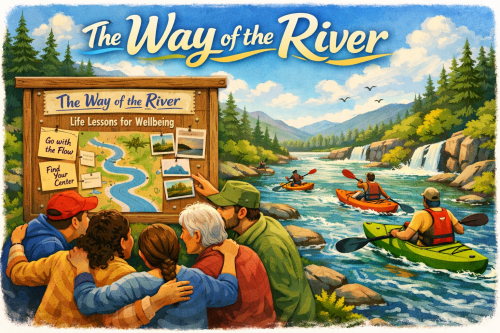
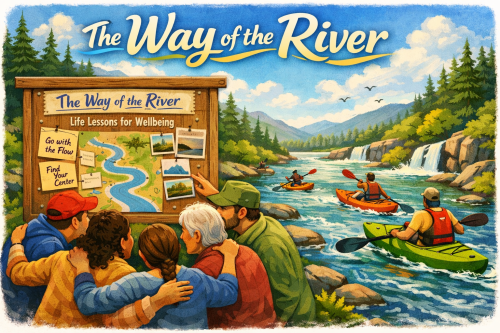
...See more Welcome to part 1 of the Way of the River series [https://www.7cups.com/forum/siteupdates/GlensNookCommunity_547/IntroducingTheWayoftheRiverSeriesMasterpost_367734/]. We are going down the river of life in our kayak. At the start, it may feel unnatural or a little clumsy. Maybe we lose our paddle or get stuck on rocks, but with more experience we gradually learn to read the water. With a little more experience we can begin to feel the current pulling us. Sometimes we might not want to follow the current. Instead, we might have our eye on a beautiful spot across the water on the side of a river bank. Many of us will work really hard to cross the river to get to that spot. It will require a lot of extra paddling because we are going against the current. One sad, but instructive experience happens when you finally make it to that hoped for spot and realize it is not as good as you had imagined. You were sure it was going to be beautiful, but somehow it fell short of that beauty. This is frustrating because it took so much energy to get there. Some of us are stubborn, slow to learn, or both, and we have to make this same mistake many, many, many times. Eventually, however, we too learn how to read the water and follow the current. Sometimes the current leads us right past the spots we wanted to go and then surprises us around the bend with a far better spot. These are great situations. Oddly, even though we shouldn't, we often give ourselves credit for finding the new spot, when most of the credit should go to the current. Still, these are great times and should be deeply enjoyed because they do not happen all the time. Other times the current can lead us down more treacherous waters with rocks, eddies, and sticks that can be tough to navigate. Sometimes we lose a paddle, flip the kayak and get wet. In particularly tough times, we may even get injured. We don’t usually take “credit” for our role in these situations and instead happily blame the current. Why do these more challenging times happen? I believe they happen so that we can learn. Nobody wants to feel the anxiety, difficulties, and sometimes pain that happens during these times, but these are indeed the times that teach us the most skill. We don’t learn to become master kayakers when the river is smooth. We learn how to be master kayakers on the rapids. Adversity challenges us to overcome. So, what is the right approach? The approach is one that goes against our natural impulses. It can sometimes feel like it goes against everything that is within us, especially when it is painful and not what we had hoped for. The stoics were master kayakers and they have a statement, “the problem is the path.” They encourage us to steer into the challenges and to trust the current. Acceptance and Commitment Therapy (ACT) [https://www.7cups.com/act-therapy-techniques/] encourages us to see the challenge as an opportunity to learn to solve a problem that we’ve been ignoring. These are wise words. Abraham Maslow, another master kayaker, tells us to go further. He instructs us to see the challenges as a gift, to embrace them like we would a friend, to listen deeply and carefully to what they are telling us, to listen to their whispers. He encourages us to see the challenges as ends in and of themselves; and warns us not to look past them as a means to an end. He wants us to see and appreciate them for what they are – independent, difficult, and beautiful experiences. The river of life brings us smooth, deep, and troubled waters. Thankfully we do not paddle alone. We find other kayakers on the water that also teach us lessons. Most of the lessons come down to following the current rather than insisting on our own plans. This key lesson is a lifetime lesson. Reflection question: We have all gone through challenging times, or rough rapids, and overcome them in the past. What would you tell a friend going through difficult waters now? I’m thankful that I have found all of you on the river. Thank you for paddling alongside me 🙏✨❤️. ------------------------- This post is part 1 of The Way of the River Series. Find the complete information and all related posts here [https://www.7cups.com/forum/siteupdates/GlensNookCommunity_547/IntroducingTheWayoftheRiverSeriesMasterpost_367734/]  ------------------------- Reading the theory is just the map, but the real progress happens in the water. Apply to join the exclusive closed group here and kayak together! ------------------------- >>> Proceed to Part 2! [https://www.7cups.com/forum/siteupdates/GlensNookCommunity_547/PartIINavigatingYourOwnKayak_367866/]

Heather225 profile picture
Join the Way of the River Huddle, a week-by-week walkthrough of the series!
by Heather225
Last post
March 27th
...See more We are excited to launch a 5-week walkthrough of the Way of the River series, and we would love for you to join us. This Huddle is a closed group setting where we will read, reflect, and learn together. Week by week, we will discuss practical ways to handle difficult times, build strength, and support one another: We will discuss one part each week: Week 1: Part I – Exploring Life as a River [https://www.7cups.com/forum/siteupdates/GlensNookCommunity_547/PartITheRiverExploringLifeasaRiver_296728/] Week 2: Part II – Navigating Your Own Kayak [https://www.7cups.com/forum/siteupdates/GlensNookCommunity_547/PartIINavigatingYourOwnKayak_367866/] Week 3: Part III – Paddling Alongside Others [https://www.7cups.com/forum/siteupdates/GlensNookCommunity_547/PartIIIPaddlingAlongsideOthers_368094/] Week 4: Part IV – Charting a Course for All of Us [https://www.7cups.com/forum/siteupdates/GlensNookCommunity_547/PartIVChartingaCourseforAllofUs_368358/] Week 5: Part V – Understanding the River Map & Finding Your Flow [https://www.7cups.com/forum/siteupdates/GlensNookCommunity_547/PartVUnderstandingtheRiverMapFindingYourFlow_367733/] If you are looking for a supportive space to grow and want to practice handling life's challenges alongside peers, come join the group. You will earn badges, discuss weekly prompts, and build connections along the way. Sign Up HERE [https://docs.google.com/forms/d/e/1FAIpQLSfdUljhoiZW9Iwf-8NGit6kW_l4z_hwZ7PAfJxg8jcMHJJzXQ/viewform] Space is limited to keep our group size small, so do not wait to secure your spot!  For your future planning, the Huddle schedule for 2026 is as follows: * (In Progress) March 23 – April 26 * April 27 – May 31 * June 1 – July 5 * July 6 – August 9 * August 10 – September 13 * September 14 – October 18 * October 19 – November 22 * November 23 – December 27 * December 28, 2026 – January 31, 2027
Heather225 profile picture
The Way of the River Huddle: Frequently Asked Questions!
by Heather225
Last post
March 23rd
...See more What's a Way of the River Huddle? The Way of the River (affectionately abbreviated WotR) is a 5-part series designed to help you discover actionable insights for handling adversity, building personal resilience, and supporting those around you. It changes the way you look at the currents you face. The Way of the River Huddle [https://www.7cups.com/forum/groupmod/7CupsHuddles_2394/IntroducingtheWayoftheRiverHuddle_377109/] is a peer-supported closed group chat that follows all five weeks, focusing on one part every week, and is reserved for discussing the content What is the structure of the 5-week journey? Each week, we discuss one part of the series over 5 weeks: Week 1: Part I – Exploring Life as a River [https://www.7cups.com/forum/siteupdates/GlensNookCommunity_547/PartITheRiverExploringLifeasaRiver_296728/] Week 2: Part II – Navigating Your Own Kayak [https://www.7cups.com/forum/siteupdates/GlensNookCommunity_547/PartIINavigatingYourOwnKayak_367866/] Week 3: Part III – Paddling Alongside Others [https://www.7cups.com/forum/siteupdates/GlensNookCommunity_547/PartIIIPaddlingAlongsideOthers_368094/] Week 4: Part IV – Charting a Course for All of Us [https://www.7cups.com/forum/siteupdates/GlensNookCommunity_547/PartIVChartingaCourseforAllofUs_368358/] Week 5: Part V – Understanding the River Map & Finding Your Flow [https://www.7cups.com/forum/siteupdates/GlensNookCommunity_547/PartVUnderstandingtheRiverMapFindingYourFlow_367733/] How does the room work? Because our members join us from all over the globe and across several time zones, the interactions in the room are largely asynchronous. The room is open 24/7, and we provide weekly and daily prompts to help you navigate The Way of the River material. The key to a thriving space is continually nurturing communication, so we highly encourage you to interact with one another, engage in conversation about the readings, and cheer each other on as we complete our weekly forum responses. Fostering these connections is what makes the huddle such a supportive environment for everyone! What if the room is quiet or no one is there when I log in? Don't let a quiet room discourage you! Since our community spans across so many different time zones, there will naturally be moments when the chat is less active. We encourage you to still share your thoughts on the week's part, answer the daily prompts, and leave encouraging messages for others to read when they log on. Your messages help keep our momentum flowing, and your peers will see them and reply as soon as they are online! Are there live sessions? Do I have to attend them? We host one optional live session each week to introduce the new material and discuss it together in real-time. It will be on Fridays (1PM ET). Since interactions are asynchronous and the room is always open, you can still fully participate, discuss the series, and get support even if you can't make the live chat. What is expected of me if I join? To make the most of your experience, we ask that you participate in the group chat at least once a week. You are required to introduce yourself and share your initial thoughts on the series in Week 1 to confirm your spot. Be open to discussing the weekly material, completing your forum posts, supporting others, and practicing respectful communication following 7 Cups guidelines. How do I join? This is a closed group, so you must sign up via the Google Form (here) [https://docs.google.com/forms/d/e/1FAIpQLSfdUljhoiZW9Iwf-8NGit6kW_l4z_hwZ7PAfJxg8jcMHJJzXQ/viewform]. Invites are sent out before the start of each new 5-week cycle. What if I'm too busy to join right now? The WotR Huddle is an ongoing initiative. We onboard new participants every 5 weeks. If your schedule is full right now, you can always catch the next round when you have more time! ------------------------- All this info and more is in the official guide. [https://docs.google.com/document/d/1hRvQWdQlsWRG34IooHJ3sTrAtvT4ipW4RsT3ufozht0/edit?tab=t.0]
ClaraField profile picture
fellow traveler on this river
by ClaraField
Last post
June 8th
...See more Events in life can feel like sudden storms or unexpected bends in the river. I'm thrilled to join this space as a listener who's learning to navigate my own rapids.
GlenM profile picture
Part IV: Charting a Course for All of Us
by GlenM
Last post
May 5th
...See more <<< Part 3 [https://www.7cups.com/forum/siteupdates/GlensNookCommunity_547/PartIIIPaddlingAlongsideOthers_368094/] ------------------------- In Part 4 of the Way of the River series, we explore what it means to move from personal growth to shared purpose - to chart a course together. This part is about the power of community and collective compassion: how each act of giving strengthens the fleet, how grace sustains us when energy fades, and how the gift economy transforms generosity into a shared current that carries us all. Take your time - this section invites reflection on contribution, collaboration, and trust. As you move through the material, notice how your own gifts, time, and care ripple outward to support others. Our private group is a safe place to reflect on these ideas and share what “sailing together” means to you. How to Participate 1) Read the slides for Part 4: Charting a Course for All of Us [https://docs.google.com/presentation/d/1E1xerXtwQVYAm-O5VC0S4FcVQqdDqIThuiU_rw2pwE8/edit?usp=sharing] 2) Reflect on the questions and activities after each section. 3) Share your reflections in this thread - you can answer all the reflection time questions in this space. Spend some time reading everyone else’s thoughts, too, to learn from everyone else. Questions  These are the questions that you will find. Answering them after pausing on the relevant section they appear will be helpful. We do recommend trying to answer all of the questions, but if you would like, you can choose to answer any 3 publicly!  * What brought you to 7 Cups?  * When was a time you gave freely to someone else, and how did it make you feel? * What 'surplus' do you bring to the 7 Cups community (e.g., a surplus of time, a specific lived experience, or simply a patient ear)? How does sharing it make you feel? * Think of your M’s (on or off 7 Cups). What are they? My Mentor… Map… My Mission… My Mountain Haven… * Who is your hero? Who is someone who inspires you to paddle? * Our collective mission is to scale compassion. What does 'scaling compassion' mean to you, and what's one small way you contribute to this big mission? * What is a 'Big Rock' you want to prioritize? How do you make sure you schedule it first? * What are some Distractions interrupting you? * What are some Waste items taking over other quadrants that you can move today? Part 4: Closing Reflections:  * What's one insight from this part that really resonated with you? * How will you carry this new insight forward to support yourself or others in our community? ------------------------- This post is part 4 of The Way of the River Series. Find the complete information and all related posts here [https://www.7cups.com/forum/siteupdates/GlensNookCommunity_547/IntroducingTheWayoftheRiverSeriesMasterpost_367734/]  ------------------------- Pivot through the chaos together. Life happens and Mr. 8 often jumps the line to disrupt your plans. Our community room is a safe space where we use the scaling compassion framework to handle life curveballs without sinking. Apply to join the exclusive closed group here and kayak together! [https://docs.google.com/forms/d/e/1FAIpQLSfdUljhoiZW9Iwf-8NGit6kW_l4z_hwZ7PAfJxg8jcMHJJzXQ/viewform] ------------------------- Proceed to the Conclusion: Part 5! >>> [https://www.7cups.com/forum/siteupdates/GlensNookCommunity_547/PartVUnderstandingtheRiverMapFindingYourFlow_367733/]
GlenM profile picture
Part III: Paddling Alongside Others
by GlenM
Last post
May 3rd
...See more <<< Part 2 [https://www.7cups.com/forum/siteupdates/GlensNookCommunity_547/PartIINavigatingYourOwnKayak_367866/] ------------------------- In Part 3 of the Way of the River series, learn what it means to journey with others - to paddle beside them, not for them. This part is about the art of compassionate connection: drawing from your own experiences, believing in others, and recognizing that our cracks and scars are often the bridges that connect us. Take your time - this section invites gentle reflection. As you move through the material, notice how empathy deepens when we listen, share our light, and let others steer their own path. Our private group is a safe place to explore these ideas together. How to Participate 1) Read the slides for Part 3: Paddling Alongside Others [https://docs.google.com/presentation/d/1a2LoIFoOrR9LGmEtUys-ZBz3wsb5FU_RzQNdiRMNAOo/edit?usp=sharing] 2) Reflect on the questions and activities after each section. 3) Share your reflections in this thread - you can answer all the reflection time questions in this space. Spend some time reading everyone else’s thoughts too to learn from everyone else. Questions  These are the questions which you will find. Answering them after pausing on the relevant section they appear will be helpful. We do recommend trying to answer all of the questions, but if you would like, you can choose to answer any 3 publicly!  * When have you felt someone’s compassion change your direction? * How has something that once hurt you become part of how you help others? * Narrative Therapy Exercise: How did it feel?  * List one event that looked unlucky but later helped you Part 3: Closing Reflections:  * What was one nugget that stood out to you from this part? * Think of a time someone truly "believed" in you. How did that feel? If comfortable, please share that story and try to capture how it changed you or impacted you? If that person was a chapter in your life. What would you call that chapter? ------------------------- This post is part 3 of The Way of the River Series. Find the complete information and all related posts here [https://www.7cups.com/forum/siteupdates/GlensNookCommunity_547/IntroducingTheWayoftheRiverSeriesMasterpost_367734/]  ------------------------- Theory does not heal but connection does. The Wounded Healer is the heart of the 7 Cups peer support model. Our room is where we pool our invisible surplus of empathy to keep the whole fleet afloat and ensure no one paddles alone [https://docs.google.com/forms/d/e/1FAIpQLSfdUljhoiZW9Iwf-8NGit6kW_l4z_hwZ7PAfJxg8jcMHJJzXQ/viewform]. Apply to join the exclusive closed group here and kayak together! [https://docs.google.com/forms/d/e/1FAIpQLSfdUljhoiZW9Iwf-8NGit6kW_l4z_hwZ7PAfJxg8jcMHJJzXQ/viewform] ------------------------- Proceed to Part 4! >>> [https://www.7cups.com/forum/siteupdates/GlensNookCommunity_547/PartIVChartingaCourseforAllofUs_368358/]
GlenM profile picture
Part V: Understanding the River Map: Finding Your Flow
by GlenM
Last post
April 23rd
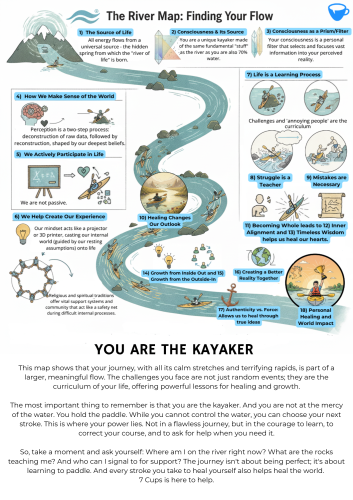
...See more <<< Part 4 [https://www.7cups.com/forum/siteupdates/GlensNookCommunity_547/PartIVChartingaCourseforAllofUs_368358/] ------------------------- Find the complete infographics here. [https://drive.google.com/file/d/15IIp2hZQaxlFauF9wPJrH5ChbbL4SmJR/view?usp=sharing] ------------------------- When you're going through a difficult time, life can feel chaotic and overwhelming, as if you're lost in a storm without a compass. This document is intended to serve as a map. It’s a framework to help you find your bearings and understand the currents of your experience, no matter how turbulent they may seem. This framework is designed to complement any spiritual, religious, or personal belief system you may hold. Think of it as a way to sharpen the focus on your own path, helping the wisdom you already carry become even more relevant and helpful in your journey. Let’s begin by imagining your life as a river… 🔹 If you would prefer visuals over text, read through this graphical slide deck,  [https://docs.google.com/presentation/d/1L2ZetTLLBMuxyU1K3h8bBjudK5S0f95KkV_EA_BDBpY/edit?slide=id.g3b5830e80f9_0_12#slide=id.g3b5830e80f9_0_12]which covers the material below. 🔹 Part I: The Nature of the River (The Foundation) Point 1: The Source of Life  * Explanation: Life and energy come from a deeper, universal source. This is the fundamental wellspring of existence from which everything we see and experience originates. * The River Analogy: This source is the hidden spring high in the mountains from which the "river of life" is born. As we navigate our kayak, the river unfolds before us, presenting a continuous stream of experiences: the currents, rocks, other people, and safe harbors. These are the "life elements" that constitute our journey. Point 2: Consciousness and Its Source * Explanation: Human consciousness is a unique expression of this universal source of life. We exist in a paradox of being both a distinct, individual person and simultaneously made of the same fundamental "stuff" as everything else. For example, everything - including us - is made up of atoms.  * The River Analogy: In our analogy, the kayaker on the river is separate from the water in the river, but the kayaker - like all humans - is 70% water.  Point 3: Consciousness as a Prism/Filter * Explanation: Consciousness functions as a personal filter. We are constantly taking in a huge amount of information, and our filter - shaped by our awareness and our subconscious - selects, interprets, and focuses this information to construct what we experience as our reality. * The River Analogy: The kayaker on the river isn't seeing everything at once. Their particular 'filter' - their focus, mood, and past experiences - determines what they notice. The river offers infinite details, but our personal filter determines which ones form our actual experience. Part II: Learning to Paddle (The Inner Work)Point 4: How We Make Sense of the World * Explanation: Perception is a two-step process. First, our minds unconsciously break down incoming information. We take what we see, hear and feel and pull it all apart to make sense of it. Second, we immediately begin the reconstruction process to make sense of the information. We build a new model of our experience with this information. Our heart’s resting assumptions - not what we want to believe, but what we actually believe - are baked into this reconstruction process. This way of seeing the world mostly happens on an unconscious level. We tell ourselves a story that makes sense to us. This story is not purely objective; it is shaped by our deepest, most fundamental beliefs about ourselves and the world. For example, I grew up taking care of my family during challenging times. For most of my life - on an unconscious level - I would seek out and help people that needed help. I did this in part on a conscious level, but mostly it was unconscious. It was something I naturally did because it reinforced patterns I learned in childhood. * The River Analogy: As a kayaker navigates a river, they constantly process a stream of information - the speed of the current, the water temperature, the placement of rocks, and the contours of the banks. This sensory data is deconstructed and then reassembled through the lens of memory. Past experiences with similar currents and obstacles actively shape their perception, informing how they interpret the river's challenges and opportunities in the present moment. Following this analogy, I have met all kinds of people on the river of life, but I found myself consistently drawn to those who needed help. My resting belief, the core assumption I held about myself, was that I was valuable only when I was helping others. This validation felt good, even when it was detrimental to my own well-being—I would often sacrifice my own needs past a healthy limit. I did this because these resting beliefs acted like a current, influencing me to focus on certain elements of life (people in distress) while ignoring others (people who could support me or simply be my peer). Point 5: We Actively Participate in Life * Explanation: We are not passive observers; we are active participants in life. Every moment, we are engaged in a dynamic cycle: we take in information from the world, filter it through our unique perspective (our beliefs and past experiences), and then express that modified view back out through our actions, words, and intentions. This output isn't just a reaction; it's our own energy and meaning being added back into the flow, constantly influencing what happens next. * The River Analogy: The kayaker feels the river's current (input). This raw information is instantly filtered through their experience and assumptions. Their paddle is their tool for action (output). How they use it - with a confident, powerful stroke or a timid, hesitant one - is a direct expression of their inner state. That single paddle stroke immediately changes their position in the current and alters their path forward. They are in a constant, active dance with the river, not just being carried by it. Another example - a kayaker talks with a person on the river. They hear the words the other person is saying, interpret the words, infuse their meaning and then respond to the person. The words they send back to the person they encounter can change the other person. The information that has been modified through the kayaker’s mind has an active impact on the world.  Point 6: We Help Create Our Experience * Explanation: In this way, our mindset acts like a projector, casting our internal world onto the screen of our life. Or you can think of it like a 3D printer where our internal code is transmitted onto the canvas of the world. Remember, it is our heart’s resting assumptions - what we really believe about ourselves and the world - that provide the script.  Above, when I highlighted the example of me actively helping others, I am showing how I interpreted the information, saw that the person needed help, and then helped them. When I help another person I am impacting their life. * The River Analogy: If a kayaker has a deep belief that "the river is always dangerous," their filter will constantly seek out hazards. They will be continuously on the lookout for danger or challenges and miss all of the comfortable parts of the river. Point 7: We Enrolled in the School of Life by Default * Explanation: We are all enrolled in the "school of life" by default. Life’s challenges are not just random events but can be seen as tailored lessons. They are designed to dismantle the ego's defenses and create the necessary conditions for the heart to heal. You don’t have to start a new program or turn over a new leaf. You are already in the school of life whether you realize it or not. The annoying people and problems we are currently facing are the curriculum. The things we don’t love about life are at least, in part, an expression of our underlying resting beliefs. The way we modify information that comes through our mind and pass it onto others - informs and creates the world we experience around us. It is not the only variable, but it is a significant variable. * The River Analogy: Getting stuck on the same type of rocks again is the river's way of showing us that there is a lesson we have yet to learn. The reoccurring obstacle is a part of the curriculum. We help create our world whether we realize it or not. It isn’t that we just have bad luck. We are an active force in creating and shaping our lives. When we find ourselves making similar mistakes on the river it is a good signal that there is an opportunity for us to learn an important lesson.   Point 8: Struggle Can Be a Powerful Teacher * Explanation: Painful experiences are often the most powerful teachers for this kind of healing. When we talk about our difficulties with people we trust, suffering can bring healing because it changes the heart. Struggle forces humility, shatters our false beliefs, and makes us truly aware of what needs to change. This dynamic was summarized by Dalio (2017): “Pain + Reflection = Progress.” * The River Analogy: Being pinned against a rock by the current is terrifying. In that moment of suffering the kayaker is in a state of struggle. They feel squeezed. Then they start to come out of it. This gives them a greater respect for the river and teaches them important lessons on how they will approach the next set of rocks. Point 9: Mistakes are Good and Necessary * Explanation: Many of us are taught the damaging lie that we must be perfect. This message, communicated by parents, school, and work, suggests perfection is an achievable reality when it is very far from the truth. The actual truth is that all humans are limited. Our minds are powerful, but they are also prone to mistakes. Failure isn’t just possible; it’s a core part of what makes us human. We struggle with this truth because we are often treated harshly when we make mistakes. This can wound our pride, making it difficult to apologize or admit we dropped the ball, as it feels like a public acknowledgment of our imperfection. But all humans fail a lot of the time. Let me say it again: All humans fail a lot of the time. Believe it or not, this is a good thing. Mistakes are a particular type of suffering that forces us to realize our limitations. They reveal our blind spots and show us where we have room to grow. Most importantly, they often require us to apologize and ask for help. When we do that, especially when it’s painful, our defenses break down. We become less rigid and more flexible. Our heart heals. When the other person forgives us, we experience grace. I believe the six most powerful words in any language are: I am sorry. I need help. As soon as we speak them, the light floods in and we feel a deep sense of relief. We know we are back on track. * The River Analogy: Every kayaker knows two things: the river is unpredictable, and they have inherent weaknesses. When a hidden current exploits a blind spot, a mistake isn't just possible - it's inevitable. This is a normal and expected part of life on the river. Grace enters the picture when the kayaker acknowledges that they need help, and the quicker they do this, the better. They realize they are in over their head. Another kayaker throws them a rope. They grab it. The act of grabbing the line shows the kayaker that they can’t do it on their own; the river will not allow that to happen. Repeatedly, over and over again, kayakers rely on help from one another. This is a necessary part of the process because it teaches humility and builds community - two elements that are essential for life on the river. Part III: The Fruits of the Journey (The Transformation)Point 10: Healing Changes Our Outlook * Explanation: As we heal, our entire state of being changes. Our outlook, or personal "vibe," is uplifted and with it, we begin to see the same world with new eyes. Our personal filter is reset. As a result, old, recurring challenges lose their grip on us because we no longer feed them with our old assumptions. Old arguments that used to hook us no longer bother us. We have matured past them and are no longer interested in taking the bait.  * The River Analogy: After learning the lesson of the rocks, the kayaker’s perspective changes. Those stubborn rocks that used to catch them every time - and seemed impossible to miss - are now on the other side of the river. The current takes the kayaker effortlessly by them. The kayaker looks at them and thinks - how on earth did I always steer right into these sorts of rocks before? Suffering has opened their eyes and taught them new ways of navigating the river of life. They no longer have to overcome the same old challenges. They instead have new challenges to overcome.  Point 11: Becoming Whole * The healing process involves bringing together the fragmented parts of ourselves. Past hurts and unprocessed experiences can leave us feeling conflicted and at war with ourselves. Carl Jung called these split-off parts the Shadow to symbolize their existence outside of our conscious awareness. These are typically parts of ourselves that our parents (or early caregivers) could not accept, and we learned to hide them to maintain connection. The truth is that these parts yearn for integration - to be woven back into your being so that you can become a whole, vibrant person. They will surface unexpectedly, especially when you are feeling overwhelmed or tired, in an attempt to be seen and heard. When we behave in these "bad" ways, we can trigger an intense sense of shame. Guilt is a focus on behavior: "I did a bad thing," which motivates us to make amends. Shame is a focus on identity: "I am a bad person." Shame hits us at our core and attempts to compel change through self-condemnation, screaming: “Hey! Stop that! What is wrong with you?!” Guilt can help us grow, but shame traps us in self-condemnation, making us hide again instead of healing. We then try to hide those rejected parts of ourselves again, and the cycle repeats because those feelings remain split off, or dis-integrated. We need to take a different approach: listen to these hidden parts of ourselves. Imagine your mind as a system. The parts you’ve rejected are like a skilled engineer you’ve locked in the basement. At first, everything runs smoothly, but eventually, they start sabotaging the system just to get your attention. Instead of yelling at them, invite them upstairs for tea. Listen to what they’ve been trying to tell you. Rather than getting angry at them, we must invite them up from the basement to the kitchen table, offering them a cup of tea and a meal. We want to listen deeply to their wisdom and their hurt. One powerful approach is to have a dialogue (which you can write out like a script) between the part that is acting out (the "engineer") and the part that is critical or judgmental (the "boss"). Ask the critical part to step back so you can listen to the exiled, hurting part. The mistakes (see Point 9) are not failures; they are signals that this engineer has an important message that can help you. Here is an example: Boss: “Why can’t you control yourself?” Engineer: “I’m scared and tired. I just need you to notice me.” This practice helps transform inner conflict into understanding. When the engineer's message is heard and their energy is integrated, you become whole. Compulsive or "bad" behaviors - especially those linked to addiction - often diminish or dissolve because the underlying force driving the compulsion is no longer a desperate plea for attention but a valued, understood part of your unified self. In short, we have to learn how to be good parents to ourselves. We have to provide space, listen to our weaknesses, and have the courage to keep trying and growing, especially when it is challenging. Becoming whole isn’t about fixing yourself - it’s about listening to every part of you with compassion. When you do, you stop fighting the river and start flowing with it. * The River Analogy: A fragmented kayaker argues with themselves mid-rapids. A part of them knows exactly what to do, but another part of them - the fearful or shamed part - tells them it is too dangerous or they will make a mistake. This second-guessing and inner conflict cause the kayaker to unnecessarily struggle and risk capsizing. Point 12: The Power of Inner Alignment * Explanation: The result of integration is coherence, or inner alignment. A coherent individual has a clear and consistent personal presence, like a perfectly tuned radio station. They send a clear signal. Their thoughts, emotions, and actions are all in sync. This genuine alignment is felt by others and naturally draws people in. People that are not coherent have a radio signal that has a lot of static.  * The River Analogy: A coherent kayaker moves with grace and confidence. They are one with the river. They can fluidly navigate around rocks and challenges. An incoherent kayaker paddles erratically and radiates anxiety.  Point 13: The Value of Timeless Wisdom * Explanation: Religions, Spiritual traditions, enduring philosophies, and cultural wisdom are like time-tested guides for healing the heart. Having survived for thousands of years, they offer proven frameworks for navigating the universal human experiences of suffering and growth. * The River Analogy: These traditions are like the ancient maps of the river passed down through generations. The maps provide wisdom that would otherwise take a lifetime of painful trial and error to acquire. Part IV: The Kayaker and the River Community (The Outward Impact)Point 14: Growth from the Inside-Out * Explanation: From the 'inside-out,' these guides help us find meaning in our suffering. They turn random pain into a purposeful journey, allowing us to endure hardship with more trust and to let go of the defensiveness and pride that block real growth. * The River Analogy: The ancient maps help a kayaker make sense of why a difficult portage or a treacherous canyon exists. This knowledge gives them the faith to keep going. Point 15: Growth from the Outside-In * Explanation: From the 'outside-in,' these traditions offer vital support systems. The community and shared rituals act like a safety net, holding a person together while they are going through a difficult internal process. * The River Analogy: When a kayaker's boat capsizes, the other members of their group paddle to their side. This community acts as a life-saving support system. The river, like life, is often challenging and it is comforting to know that we don’t have to make it on our own. Point 16: Creating a Better Reality Together * Explanation: As individuals and groups heal, they become more aligned and can work together effectively. They move from conflict to collaboration, becoming a powerful force that can positively shape their shared environment. When people in a group heal, they become more synchronized. There is less disagreement. One set of people becomes very good at doing one thing, whereas another group excels in another domain. The group becomes much more cohesive. This coherence accelerates healing in individuals and amplifies the group’s positive social impact.  * The River Analogy: A group of healed, coherent kayakers becomes a community. Their collective competence and harmony create a different, safer, and more joyful reality on the river for everyone. People on the river banks see that there is something special about this group of kayakers. They excel, naturally, at helping one another. This spirit of camaraderie is contagious and more and more people want to join the group.   Point 17: Authenticity vs. Force * Explanation: A healed heart, aligned with life, becomes an example of an authentic and true way of being. True ideas heal and they stand on their own. They are beacons, clear signals, or lighthouses guiding the way. When a group of people is aligned with true ideas they amplify healing and unity. These authentic ways of being are naturally attractive to other people. Ideas that are not true require force or coercion. They fade when they are not fueled with money. * The River Analogy: A kayaker who understands the river's true nature paddles with it. This is magnetic. Other people want to paddle alongside this kayaker because they can see that they are effective and want to help others. This person knows that there are more than enough resources on the river. They do not have to hoard resources or fight, because their heart is healed and they can see that there is abundance. Point 18: Personal Healing and World Impact * Explanation: If people and groups want to have a positive impact on the world then they have to heal. Healing is how people change the resting assumptions of their hearts. That allows the information to flow through them and create life-giving possibilities in relationships with others. Healing is a two for one deal - a person changes their heart and the world at the same time. Therefore, the most direct path to creating a positive impact in the world is through inner healing. * The River Analogy: To have the greatest impact, the person must first become a master of their own kayak. By healing themselves and mastering their own vessel, their positive impact on the entire river community becomes inevitable. The greater the individual and collective healing, the greater our coherence and positive social impact  Conclusion: You are the Kayaker This map shows that your journey, with all its calm stretches and terrifying rapids, is part of a larger, meaningful flow. The challenges you face are not just random events; they are the curriculum of your life, offering powerful lessons for healing and growth. The most important thing to remember is that you are the kayaker. And you are not at the mercy of the water. You hold the paddle. While you cannot control the water, you can choose your next stroke. This is where your power lies. Not in a flawless journey, but in the courage to learn, to correct your course, and to ask for help when you need it. So, take a moment and ask yourself: Where am I on the river right now? What are the rocks teaching me? And who can I signal to for support? The journey isn't about being perfect; it's about learning to paddle. And every stroke you take to heal yourself also helps heal the world. You are not alone on the water. We are all here paddling alongside you. The state of the river is nothing more than the sum of every kayaker’s choice. A kinder, more compassionate world is not a distant dream; it is a reality built one conscious paddle stroke at a time. I speak for all of us when I say I am very glad you found us. River Snapshot Exercise  Take a moment to reflect on where you are on the river right now. As you read through The River Map, notice which parts feel especially true for you. Then, use these questions below to guide your reflection and share it as a reply to this thread: 1. Identify 1-2 points (or more!) that you like and find meaningful. Why do they resonate with you? 2. Identify 1-2 points that you want to learn more about or deepen your understanding. Let us know if there is anything we can do to help you on this part of the river.   There’s no right or wrong answer - this is just your snapshot of where you are on the river today. You will notice that this helps you as you progress with this series. ------------------------- This concludes the forum portion of the Way of the River, but the journey continues! Mastery is daily navigation. You have the full map, and now you can find consistent support to stay in the flow. The Way of the River room is your 24/7 community hub to ensure these personal growth tools stick long after you finish the series. Apply to join the exclusive closed group here [https://docs.google.com/forms/d/e/1FAIpQLSfdUljhoiZW9Iwf-8NGit6kW_l4z_hwZ7PAfJxg8jcMHJJzXQ/viewform]! ------------------------- View the masterpost for the Way of the River series here [https://www.7cups.com/forum/siteupdates/GlensNookCommunity_547/IntroducingTheWayoftheRiverSeriesMasterpost_367734/]. 

GlenM profile picture
The Kayaker's Bet or Wager
by GlenM
Last post
April 21st
...See more Dear Community, Life is a river. We are on a river in a kayak, and life is flowing by us. Sometimes, the waters are smooth, calm, and peaceful. But inevitably, we hit the rapids and get stuck on rocks. Sometimes these are just minor jams, but other times we can crash on them so hard it feels like we might not survive. We’ve been exploring this in our Way of the River community [https://www.7cups.com/forum/wayoftheriver/]. It is incredibly easy to feel defeated when the water gets treacherous and chaotic. But there is a fundamental truth we have to remember: we don't learn to become master kayakers when the river is smooth. We learn how to be master kayakers on the rapids. Adversity challenges us to overcome. It asks something of us that calm waters never do. To help navigate those terrifying stretches of water, I want to share a mental tool that I rely on when things feel impossibly hard. It is a simple shift in perspective, but it helps me quite a bit and I hope it helps you. I call it The Kayaker’s Wager. The Kayaker’s Wager: The conscious choice to treat every significant obstacle not merely as random chaos or bad luck, but as a challenge that may be asking you to grow, adapt, or see something differently. Because our community is made up of people from all walks of life, this wager takes on different shapes depending on your personal beliefs: * For the spiritually inclined: It is the choice to trust that even when you cannot understand the rapid, there is a Higher Power present in the river. It is trusting that God, or the universe, has woven hidden lessons into the hardship, using this exact obstacle to shape you, strengthen you, and call something greater out of you. * For the secularly inclined: It is a psychological stance. It is the wager that even if the universe is random, you possess the agency to extract deep meaning, resilience, and wisdom from even the most painful moments. The Pascal Connection: Why You Have to Place a Bet You might be thinking, “But Glen, what if my suffering doesn't have a hidden meaning? What if life is just random and this rock I'm stuck on is just cruel bad luck?” This is exactly why I call it a wager or bet. It is inspired by a famous idea from the 1600s called Pascal’s Wager [https://en.wikipedia.org/wiki/Pascal%27s_wager]. Blaise Pascal was a brilliant mathematician who realized that when humans face massive unknowns, we often freeze because we are waiting for absolute proof. Pascal argued that in life, you cannot opt out of betting. You are already in the river. Because you are forced to play the game, you should stop waiting for certainty and instead choose the interpretation that gives you the best chance of living well and moving forward. When you are stuck on a rock, look at the two bets you can make: 1. You bet the rock is just random, meaningless cruelty. If you make this bet, you may naturally feel defeated, powerless, or emotionally flooded. Your energy drains, and you stay stuck. The absolute best-case scenario is that you simply survive it and eventually get back to baseline. 2. You bet the rock holds an invitation to grow. You make the Kayaker's Wager. You assume there is something here worth paying attention to, even if you cannot yet see it clearly. You stop fighting the current and ask: What is this moment requiring of me? Patience? Courage? Surrender? A new skill? Let’s look at the math of this bet: * What if you’re wrong? What if the universe is just chaotic? By placing the bet and acting as if there were a lesson, you stayed calmer, de-escalated your panic, and figured out how to unstick your kayak. You survived the rapid with more grace. Even when you "lose" this bet, you still win a better quality of life. * But what if you’re right? What if that obstacle really was a turning point? If you're right, you don't just return to zero. You are fundamentally changed by what the rapid demanded from you. You become what we call antifragile [https://www.7cups.com/forum/siteupdates/GlensNookCommunity_547/Antifragile_29142/] - you are no longer only trying to avoid chaos; you are learning how to be strengthened by what once would have broken you. Sometimes this can even become the beginning of what psychologists call post-traumatic growth [https://en.wikipedia.org/wiki/Post-traumatic_growth]. Not because pain is "good," but because profound meaning can sometimes be forged from what is hardest. As you all know, we believe that the problem is the path. You don’t need to have a grand, flawless plan for life. Instead, you just need to solve the next biggest problem in front of you. The key is you’ve got to make the bet - and trust the river - in order to unlock these gains. You don’t get to unlock those gains if you stay only on the familiar, comfortable, normal, predictable path. What do you think of the Kayaker’s Wager or Bet idea? We are all navigating this river together, and nobody paddles perfectly. Our job is not to pull others out of the water, but to paddle alongside them until they remember they are the master of their own vessel. Think about a "rock" you are currently stuck on right now—a problem that has been causing you stress, fear, or frustration. What would it look like to make the Kayaker's Wager today? If you chose to meet that rock as though it had something to teach you, what might that lesson be? What strength might this moment be asking you to build? Share your thoughts in the thread below. Our community is made up of the very best folks, and we are all paddling alongside you.
GlenM profile picture
Part II: Navigating Your Own Kayak
by GlenM
Last post
April 21st
...See more <<< Part 1 [https://www.7cups.com/forum/siteupdates/GlensNookCommunity_547/PartITheRiverExploringLifeasaRiver_296728/] ------------------------- In Part 2 of The Way of the River series, we explore what it means to navigate our own kayak - to learn how to move through both the calm and the rapid waters of life. This part is about finding steadiness within ourselves, understanding what our challenges are teaching us, and discovering how to trust the current even when things feel uncertain. Take your time with this one - it’s deep work. As you go through the material, pause often to reflect. You’ll find that every “rock” or “rapid” holds a lesson about growth, surrender, and grace. Our private group is also a good space to explore together. How to Participate 1) Read the slides for Part 2: Navigating Your Own Kayak  [https://docs.google.com/presentation/d/1t9JHJdZgyTjc7wZc1H6zeCl8VIvKhwiFAQttDqgVnJA/edit?usp=sharing] 2) Reflect on the questions and activities after each section. 3) Share your reflections in this thread - you can answer all the reflection time questions in this space. Spend some time reading everyone else’s thoughts too to learn from everyone else. Questions  These are the questions which you will find. Answering them after pausing on the relevant section they appear will be helpful. We do recommend trying to answer all of the questions, but if you would like, you can choose to answer any 3 publicly!  * Where are you on the river right now - calm waters or rapids? * What kind of “rocks” or challenges have been showing up lately? * Checkin: Right now, my river feels like… * Think of a recent challenge. What might it be trying to teach you? * List one rock (challenge) and rename it as a “teacher.” * “My rock: _______ → My teacher: _______.” * What “Mr. 8” moment has recently interrupted your plans? * Write one sentence that starts with “I didn’t plan for ___, but it taught me ___.” * What situation or feeling keeps “hooking” you emotionally? * Try the “forgiveness ladder”: 1) Name the feeling. 2) Recall the earliest memory it connects to. 3) Write one line of compassion for your younger self. * Can you recall a time when life “leveled you up” through struggle? * What new options or perspectives have opened up since then? * What would it look like to trust the current a little more this week? * Fill this sentence: “Today I’m grateful for the current that carried me through ___.” Part 2: Closing Reflections:  * What was one key insight that stood out to you in this part? How can understanding it impact your life for the better? * What’s one “rock” or challenge you’re choosing to see as your teacher this week? * Take the fun companion quiz and test your understanding here [https://docs.google.com/forms/d/e/1FAIpQLSfrNc26y__lucBAWYcxFQCw1Bwp3lgN-kDjRjCuXltiTTW4LQ/viewform]! ------------------------- This post is part 2 of The Way of the River Series. Find the complete information and all related posts here [https://www.7cups.com/forum/siteupdates/GlensNookCommunity_547/IntroducingTheWayoftheRiverSeriesMasterpost_367734/]  ------------------------- Knowledge is a map but navigation is a skill. You have learned how to steer and now you can connect with other members to practice the Forgiveness Ladder in real time. We use our safe community room to build the skills needed to stay upright when life gets choppy. [https://docs.google.com/forms/d/e/1FAIpQLSfdUljhoiZW9Iwf-8NGit6kW_l4z_hwZ7PAfJxg8jcMHJJzXQ/viewform] Apply to join the exclusive closed group here and kayak together! [https://docs.google.com/forms/d/e/1FAIpQLSfdUljhoiZW9Iwf-8NGit6kW_l4z_hwZ7PAfJxg8jcMHJJzXQ/viewform] ------------------------- Proceed to Part 3! >>> [https://www.7cups.com/forum/siteupdates/GlensNookCommunity_547/PartIIIPaddlingAlongsideOthers_368094/]
Heather225 profile picture
(Way of the River Huddle) Live Meetup: Friday April 10 @ 2PM ET!
by Heather225
Last post
April 9th
...See more Hello, Huddlers! I will be hosting a live study session tomorrow to meet up, check in, and complete part 3 together [https://www.7cups.com/forum/wayoftheriver/WayoftheRiverTheSeries_2715/PartIIIPaddlingAlongsideOthers_368094/]! I know we're a global community, so this is an optional meetup, but hopefully we can see you! And even if you haven't completed all the pieces yet, please still come in. This is our time! Remember, this room is asynchronous, so you can drop in around the clock and chat, and catch up on things! See ya there! @Amanda84 @inventiveKitten4821 @hardworkingLand4914 @Magicpawsoffuture @Ericaxoxo1999 @JasGab200519970 @stormieandpaws @pinkCherry1616 @FreakishAtlantic @AmberHearthGlow @JerseyGirl55305 @cafedaydreams
GlenM profile picture
Part I: The River - Exploring Life as a River
by GlenM
Last post
April 3rd
...See more Welcome to part 1 of the Way of the River series [https://www.7cups.com/forum/siteupdates/GlensNookCommunity_547/IntroducingTheWayoftheRiverSeriesMasterpost_367734/]. We are going down the river of life in our kayak. At the start, it may feel unnatural or a little clumsy. Maybe we lose our paddle or get stuck on rocks, but with more experience we gradually learn to read the water. With a little more experience we can begin to feel the current pulling us. Sometimes we might not want to follow the current. Instead, we might have our eye on a beautiful spot across the water on the side of a river bank. Many of us will work really hard to cross the river to get to that spot. It will require a lot of extra paddling because we are going against the current. One sad, but instructive experience happens when you finally make it to that hoped for spot and realize it is not as good as you had imagined. You were sure it was going to be beautiful, but somehow it fell short of that beauty. This is frustrating because it took so much energy to get there. Some of us are stubborn, slow to learn, or both, and we have to make this same mistake many, many, many times. Eventually, however, we too learn how to read the water and follow the current. Sometimes the current leads us right past the spots we wanted to go and then surprises us around the bend with a far better spot. These are great situations. Oddly, even though we shouldn't, we often give ourselves credit for finding the new spot, when most of the credit should go to the current. Still, these are great times and should be deeply enjoyed because they do not happen all the time. Other times the current can lead us down more treacherous waters with rocks, eddies, and sticks that can be tough to navigate. Sometimes we lose a paddle, flip the kayak and get wet. In particularly tough times, we may even get injured. We don’t usually take “credit” for our role in these situations and instead happily blame the current. Why do these more challenging times happen? I believe they happen so that we can learn. Nobody wants to feel the anxiety, difficulties, and sometimes pain that happens during these times, but these are indeed the times that teach us the most skill. We don’t learn to become master kayakers when the river is smooth. We learn how to be master kayakers on the rapids. Adversity challenges us to overcome. So, what is the right approach? The approach is one that goes against our natural impulses. It can sometimes feel like it goes against everything that is within us, especially when it is painful and not what we had hoped for. The stoics were master kayakers and they have a statement, “the problem is the path.” They encourage us to steer into the challenges and to trust the current. Acceptance and Commitment Therapy (ACT) [https://www.7cups.com/act-therapy-techniques/] encourages us to see the challenge as an opportunity to learn to solve a problem that we’ve been ignoring. These are wise words. Abraham Maslow, another master kayaker, tells us to go further. He instructs us to see the challenges as a gift, to embrace them like we would a friend, to listen deeply and carefully to what they are telling us, to listen to their whispers. He encourages us to see the challenges as ends in and of themselves; and warns us not to look past them as a means to an end. He wants us to see and appreciate them for what they are – independent, difficult, and beautiful experiences. The river of life brings us smooth, deep, and troubled waters. Thankfully we do not paddle alone. We find other kayakers on the water that also teach us lessons. Most of the lessons come down to following the current rather than insisting on our own plans. This key lesson is a lifetime lesson. Reflection question: We have all gone through challenging times, or rough rapids, and overcome them in the past. What would you tell a friend going through difficult waters now? I’m thankful that I have found all of you on the river. Thank you for paddling alongside me 🙏✨❤️. ------------------------- This post is part 1 of The Way of the River Series. Find the complete information and all related posts here [https://www.7cups.com/forum/siteupdates/GlensNookCommunity_547/IntroducingTheWayoftheRiverSeriesMasterpost_367734/]  ------------------------- Reading the theory is just the map, but the real progress happens in the water. Apply to join the exclusive closed group here and kayak together! ------------------------- >>> Proceed to Part 2! [https://www.7cups.com/forum/siteupdates/GlensNookCommunity_547/PartIINavigatingYourOwnKayak_367866/]

Heather225 profile picture
(Way of the River Huddle) First Live Meetup: Friday March 27 @ 5PM ET!
by Heather225
Last post
March 28th
...See more Hello, Huddlers! I hope you've all been settling in comfortably. And for those who have not dropped in yet, we're excited to welcome you to the riverbank! We'll be making a live space tomorrow to meet up, check in, and complete part 1, the first part of the river readings! I know we're a global community, so this is an optional meetup, but hopefully we can see you! Remember, this room is asynchronous, so you can drop in around the clock and chat, and catch up on things! See ya there! ------------------------- @Amanda84 @inventiveKitten4821 @hardworkingLand4914 @Magicpawsoffuture @Ericaxoxo1999 @JasGab200519970 @stormieandpaws @pinkCherry1616 @soulout @FreakishAtlantic @AmberHearthGlow @JerseyGirl55305 @cafedaydreams
JasGab200519970 profile picture
Ice-breakers - newbies and oldies (😂😆😄)
by JasGab200519970
Last post
March 27th
...See more Hello hello guys!!  How are you all?  I hope today has been eventful - a day of adventure, fun, mystery and sparing of heart strings. Some of us feel more intensely than others whilst some are more subtle in how they feel.  Which is you - animation destination or poetic like the blossom tree? I think I maybe calling out someone crush?! (Lol what do I know 😆👍) 🌷How would you describe yourself? Quick, lightening responses sending shock waves  Letting the neurological pathways stay steady  Ping pong - the back and forth banter individual who gives some back! Peace to you and your family. 🌺🌸🌷
Heather225 profile picture
Join the Way of the River Huddle, a week-by-week walkthrough of the series!
by Heather225
Last post
March 27th
...See more We are excited to launch a 5-week walkthrough of the Way of the River series, and we would love for you to join us. This Huddle is a closed group setting where we will read, reflect, and learn together. Week by week, we will discuss practical ways to handle difficult times, build strength, and support one another: We will discuss one part each week: Week 1: Part I – Exploring Life as a River [https://www.7cups.com/forum/siteupdates/GlensNookCommunity_547/PartITheRiverExploringLifeasaRiver_296728/] Week 2: Part II – Navigating Your Own Kayak [https://www.7cups.com/forum/siteupdates/GlensNookCommunity_547/PartIINavigatingYourOwnKayak_367866/] Week 3: Part III – Paddling Alongside Others [https://www.7cups.com/forum/siteupdates/GlensNookCommunity_547/PartIIIPaddlingAlongsideOthers_368094/] Week 4: Part IV – Charting a Course for All of Us [https://www.7cups.com/forum/siteupdates/GlensNookCommunity_547/PartIVChartingaCourseforAllofUs_368358/] Week 5: Part V – Understanding the River Map & Finding Your Flow [https://www.7cups.com/forum/siteupdates/GlensNookCommunity_547/PartVUnderstandingtheRiverMapFindingYourFlow_367733/] If you are looking for a supportive space to grow and want to practice handling life's challenges alongside peers, come join the group. You will earn badges, discuss weekly prompts, and build connections along the way. Sign Up HERE [https://docs.google.com/forms/d/e/1FAIpQLSfdUljhoiZW9Iwf-8NGit6kW_l4z_hwZ7PAfJxg8jcMHJJzXQ/viewform] Space is limited to keep our group size small, so do not wait to secure your spot!  For your future planning, the Huddle schedule for 2026 is as follows: * (In Progress) March 23 – April 26 * April 27 – May 31 * June 1 – July 5 * July 6 – August 9 * August 10 – September 13 * September 14 – October 18 * October 19 – November 22 * November 23 – December 27 * December 28, 2026 – January 31, 2027
greenFae00 profile picture
River of Change
by greenFae00
Last post
March 26th
...See more The ancient Greek Philosopher Heraclitus said " No one steps into the same river twice. I think he meant that the river is always changing and moving and the person in the river could do the same. 
Community Leaders
Community Mentor Leader