Chapter 10: Cup 5: Accept: Accept What Life Brings You
Accept what life brings you
“Give me the serenity to accept the things I cannot change.”
The Serenity Prayer
My mother and father each told me of recurring nightmares they have had, which had a similar theme. In my father’s dream, he is being chased by some kind of monster. He is too afraid to look back and is running as fast as he can, barely keeping ahead of the beast. He described having this dream over and over again, so often, that when he was in the dream he would remember that he had dreamt it before. Finally, one night, he had the dream again. But this time, he has a conversation with himself, “I keep running but I can’t get away. How can I get this dream to stop?” He decided to do something different to see what would happen. So he stops running and turns around. When he turns around, he sees a blinding light behind him, he can’t make out any shapes or anything because of the light. But he starts running as fast as he can toward the light and wakes up. He never had the dream again.
My mother’s recurring nightmare happened when she was a child. In the nightmare there is a little man standing behind her closet door. She is lying in her bed, paralyzed with fear, she can’t see the little man because the closet door is closed, but she knows that he is there. Eventually, my mother told my grandmother that she kept having this nightmare and my grandmother, being the wise woman that she was said, “Maybe he wants to be your friend.” My mother says that the next time she had that dream, she forced herself to get out of bed and go to the closet and open the door. There was the little man, a cute little gnome-looking guy with a big friendly smile. She knew instantly that he was nothing to fear and woke up. She also never had the dream again.
People have a deep distrust of the unknown.
Of course, it’s easy to understand why. We like what is familiar to us. We know how to handle what is familiar to us, even if it’s bad, but we have no idea if we will be able to handle what is on the other side of that unknown. We are fine as long as we keep running as fast as we can or as long as we are lying paralyzed in our bed, but we know that if we get up and open that closet door, then we have to deal with whatever is behind it. And, boy can we imagine some creepy stuff behind that door.
That is why love is such an important place to return to. I have to believe that my mother found the courage to change that dream because deep down she trusted my grandmother, who was kind and warm and wise. Her mother’s dependable love made it into her dream state and she was finally able to face and conquer her fear. Love helps us feel safe as we step into the unknown.
In the beginning of this book, we described the concept of “the shadow,” which represents all of your rejected characteristics, impulses, desires and emotions. The shadow was constructed because of painful experiences and traumas big and small. In addition, because we then deny those memories and emotions, we continue to be disconnected from our daily experiences, especially the painful ones, never fully experiencing our lives.
How do we unravel this, reconnect with our rejected pieces and gain freedom?
The process is actually very simple. It is not easy, but it is simple.
You see, your psyche already knows how to heal, in fact, it is actively trying to heal. That’s the reason why these negative feelings keep coming up, keep popping in. They are trying to integrate. The shadow is running after you, much like the beast in my father’s dream. The simple answer is to just stop running and turn around.
Meet Your Negative Emotions
I am a big champion of negative emotions. Sadly, they are an almost completely misunderstood subset of our emotional package, grossly underrated. We don’t like them, they feel terrible, sometimes like they will tear us apart. They are scary and we really want nothing to do with them. Avoiding our negative emotions is the foundation for our entire distraction system. If we had no negative emotions, we would have no need for distractions. We would instead want to be very present in our awesome, happy lives! But negative emotions are extremely valuable, and we really can’t go on without them.
Let me tell you five helpful insights about negative emotions.
1. Negative emotions happen in your body. In fact, all of your feelings happen in your body, that’s why they are called feelings - because we FEEL them.
There is a misconception that negative emotions happen in your brain. Indeed, there is a brain component to what we feel, but it is best to think of this as the tip of the iceberg. If you’ve ever felt afraid or panicked, you would probably describe it as gripping or squeezing your chest. Anxiety can feel like butterflies in your belly. Guilt, when we really open up to it, might feel like a laser is burning the heart. Excitement can feel like giddy energy that makes you want to jump and dance. We will all have different ways to describe these feelings, but the key is, when you are learning to truly feel your feelings, you have to look for them in your body. Mindfulness is a really great tool to help you connect with those experiences.
2. Negative emotions have a job to do. They change you. They may be the way emotional injuries feel, but they are also the way emotional injuries heal.
Your negative emotions have the job of changing you into the person who can handle this life. You can think of it like there is a precious gold nugget or jewel hidden in the depths of every negative emotion you feel. Your job is to dive down and open up to it until it reveals itself to you. You may not be able to even put words to what you have discovered, but there will be strength or wisdom, a healthier interpersonal boundary or self-esteem added to your heart from each dive.
3. They hold information that you need to make future decisions.
This is where the brain comes in. The brain is like the Captain of a giant ship. The Captain sits high above and takes in information from across the ship, from other ships in the vicinity, and from weather reporting agencies. In order to keep the ship safe and get it where it is going, he has to use this information to make moment by moment decisions.
There is an actual part of the brain, called the prefrontal cortex, that has this Captain’s job. It develops throughout childhood and into early adulthood. (In fact, research shows that the prefrontal cortex isn’t fully developed until a person reaches age 30, which tells us that our older teens and 20 somethings still need support to make good judgement calls.) This part of the brain is best nurtured in an environment of warmth and safety, where a person can both reflect on the consequences of actions and also have a loving person help them make sense of those experiences. The prefrontal cortex can be stunted if a person is constantly in physical or emotional danger and doesn’t have a safe and loving other to help them navigate. It can always grow and learning to talk through your experience with another person you trust and taking quiet time to reflect on those experiences can help your prefrontal cortex mature no matter how old you are. You can help your captain become a better captain.
Our prefrontal cortex is taking in information from our bodies, from our senses and from the social environment around us and using that information, as well as everything you know about the world, to make decisions on a moment by moment basis. And our negative emotions are a big part of that puzzle. For example, if our significant other insults us, hurting our feelings, it can be an easy, knee-jerk reaction to stuff those feelings down. Maybe we aren’t comfortable with conflict. If we instead take a moment to ourselves and allow ourselves to feel the rejection and pain, the fear of being alone that is triggered and our own fear that we are not worthy of real love, we will be changed. Really changed. We will be one step closer to, “I have to know if I can be loved for who I am. This kind of hurt is worse than being alone. Knowing is the only option.” That information that we are being hurt by this person and that maybe we are a little broken on the inside will lead us to protect ourselves more and handle conflict differently in the future. It will help us to break the cycle we are stuck in.
Jung tried to capture this truth when he said that, “the symptom holds the key.” When your physical body is sick or you have an injury you pay attention to the signs your body gives off that something is wrong. If you have a fever, you listen to that symptom and take care of yourself. You do not ignore it. Similarly, if you are a runner, and you hurt your knee, then you listen to that pain. If you avoid it, then it’ll just get worse. We tend to listen to our physical symptoms, but avoid or ignore our psychological symptoms, especially negative feelings. We experience sadness, because there is something to feel sad about. We experience anxiety, because there is something that anxiety wants us to know. Like our physical symptoms, negative feelings have important information to tell us.
4. Negative emotions are like waves - they rise up to their peak and then fall and fade away.
We avoid negative emotions because they feel so bad, but also because they can sometimes feel like they will stay forever. We can become afraid that that sadness and loneliness or fear represents “reality” and that once we give into it, that is what our life will be like. The truth is, when you open up to your negative emotions, they will come and they will go. Sometimes they will come at inconvenient times. Sometimes they will feel overwhelming. But they will always go on their own. Even a panic attack, if you do absolutely nothing but suffer through it, will still fade on its own. The really good news is that the more you feel them, the better you will get at feeling them. They won’t feel so scary. And, as you continue to feel them, you will grow stronger and better able to navigate life.
5. They aren’t going anywhere. Remember that rhyme about going on a bear hunt “We can’t go over it, we can’t go under it, we have to go THROUGH it.” The only way out is through, so there is really only one real option if your goal is freedom and a good life: feel those feelings!
Your negative feelings are an important part of who you are. Avoiding them only makes them yell louder. Accepting them and learning to listen to them opens you up to new levels of connection and growth.
Accepting what you cannot change
Our celebrity-driven culture is constantly bombarding us with images of perfect, beautiful people living perfect, beautiful lives. If these magazine and tv shows are to be believed, there are people on this planet waking up each day to a perfect, pain-free existence. It can start to feel like this ideal life is the only life worth having. The only problem, and it’s a big one, is that this perfect, pain-free life doesn’t exist and it never will. In reality, each one of us is living a life filled with struggles. Our lives are not only filled with unique struggles, though, but also with potential for breathtaking beauty and deep joy. None of it is tv-ready and that’s ok.
All of Buddhism starts with the observation that life is suffering. The meaning of this is that we increase suffering when we expect things to go a certain way and hold on too tightly to our plans. We are holding onto our plans for a perfect life. When accept that our path is unique and that many things on our path will be unplanned, we reduce our suffering and increase our happiness.
Likewise, the Serenity Prayer very wisely teaches us that, in order to live in freedom, we must distinguish between what we can control and what we cannot control in our lives. There are many, many things that are not and have never been within our control. The family we were born into, how adults behaved towards us when we were small, our gifting and our limitations are all examples of things we don’t have control over. Sickness, disaster, accidents, these may all be part of our path at some point in the future, and most will be absolutely out of our hands.
There is no shortage of opportunities to learn this truth, as much of life does not go according to plan. It helps us feel safe to imagine that we are in control of what happens. However, if you look back on the last 10 years of your life, you will see that most of the significant twists and turns were not planned. The big things in life seem to emerge and the only thing we can really control is how we respond to them. These events end up shaping us more profoundly than our own plans ever could.
This can be a good thing because often times, as it turns out, the good things we plan end up being bad for us. I know many people that have achieved things in life only to find out that the accomplishment was not what they thought it would be. They feel let down and often struggle to find meaning again.
On the other hand, people can experience difficult and even very painful things that become the cornerstone of their personal strength and life message. A really great contemporary example of this is Malala Yousafzai, the young Pakistani girl who was shot in the face by the Taliban for speaking out for the rights of girls. Instead of killing her, or even slowing her down, this incident brought the attention of the world to her. Now, she has won a Nobel Peace Prize and has a global platform fighting for the basic human right of education for girls worldwide. You can learn more about her here: www.malala.org/malalas-story.
The key to a bad thing being turned into a really incredible thing is that the person decides to respond with openness and courage. You see, you may not be in control of everything that happens to you, but you are still in control of your destiny.
Grant me the courage to change what I can
Stephen Covey created this diagram to illustrate what we worry about versus what we can actually control. Our worries are our “Circle of Concern.” Our influence over those concerns are our “Circle of Influence” (Irvine, 2009).
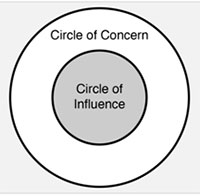
In terms of your life, it can be helpful to break things down into those that you can fully control, things you can have some control over, and things that you don’t have any control over (Irvine, 2009):
Things you can 100% control: how you eat, how much you exercise, friends you select
Things you have some control over: your work or school environment, how much effort you contribute, how you relate to family members, grades, promotions
Things you have no control over: the economy, how much things cost, the weather
Spend less time worrying about things you can’t control and more time being proactive about the things you can. It can be a great relief to have permission to look at reality and say “I will try my best, but there will always be variables beyond my control.”
Cup 5 is about accepting what life brings you. We have a natural tendency to avoid problems and their accompanying negative feelings. These feelings are a part of us. If we ignore them, they just grow stronger and more rambunctious. If we mindfully experience, open, and accept them, they pass through us like a cloud passing through a sky. They leave us wiser, more insightful, and more empathic. We owe it to ourselves to accept and integrate what life brings us. Helping ourselves can also lead to helping others that are going through similar struggles. Helping ourselves can also lead to helping others that are going through similar struggles.