Chapter 3: Distractions
As we’ve been discussing, personal and cultural denial keep us from facing our challenges head on. Distraction is one of the most powerful processes that supports this denial.
Our tendency to become distracted has been with us since the dawn of time. When those feelings that we do not like experiencing, because they cause us anxiety, discomfort or emotional pain, make their way to the surface, distraction provides us with an escape.
Ancient distractions like drugs, alcohol, sex, and gambling are still with us. In the past, as now, these distractions become problematic when the person relies on them too much or when they start negatively impacting their lives and the lives of those around them. These age-old distractions have always been able to ensnare the vulnerable. While the impact of these distractions can be devastating for the individual and their loved ones, their impact has actually been somewhat limited in that they do not have mass appeal.
Now, however, that is no longer the case. Things have changed.
Distraction Systems
We find ourselves in a new age. There are now distraction systems in place that are much more pervasive, effective, and addictive. In this chapter, we’ll talk about these newer weapons of mass distraction as well as older distraction systems that have been tweaked to be more effective.
Let’s start with food as it is something we can all identify with and it also happens to be a good metaphor to explain how these newer distraction systems have evolved.
Food
Look back at family pictures of your parents or grandparents. Notice how thin everyone looked? There were very few obese people back then. Today, over 30% of the people on this planet are obese. Something changed. You know what it was? Food became a drug; a drug that for many of us is very hard to resist.
We have always had a weakness for food. Take cheesecake for example. We all naturally really like cheesecake as it contains ingredients that were rare and deeply satisfying to our ancestors. As a result, we are hardwired to love it. We don’t decide to love cheesecake. We just do!
Food companies know this and now they have it down to a science. Know why you cannot eat just one chip? Because they have tested 37 different flavors of that one chip on thousands of people. In study after study they found that there was 1 of those 37 chips that was incredibly good at getting people to eat another chip. Let’s call that chip, chip #32. Guess what chip they mass produce? That’s right, chip #32 was the winning candidate. It now fills every bag for that brand. It is very much by design that you find yourself opening and then eating every single chip in a bag. You can learn more about this process here.
This food is not natural food. It is created in a lab. It is designed to hit certain taste buds and light up parts of your brain while, at the same time, leaving you with as little nourishment as possible.
Why?
Because that is how they make more money. They need to get you hooked on those chips, candies, or beverages because they need to make more and more money. The more you consume, the more money they make. The tragic thing is that these companies run out of “stomach share” so the only solution is to grow each stomach to consume more of their products.
Understanding how food companies have hacked our food provides a good framework for better understanding other distraction systems. Living in a meaningful manner is like eating a healthy diet. It is rich and satisfying. It involves facing problems directly. Distraction systems do not want you to live in this soulful way. If you do, then you become dramatically less interested in what they offer. Like the food companies, they need to keep you hooked on vacuous bites of information. They know what your mind craves and they give it to you in better and better packaging. These soulless bits of information are the equivalent of empty calories. These systems leave you wanting more and more because that is what they are designed to do.
Online Distractions
We are now living in a world that is incredibly distracting. Our brains were not designed to handle this kind of machinery. Think back to 10 to 15 years ago. The primary things to distract us were television, magazines, and video games. At the time, many of us thought that these things were pretty good and entertaining. Now they seem quaint. Remember when you had to watch a show at a certain time? Remember when everyone had to watch the same show? Now we have on-demand television with thousands of channels. You can watch any movie you want, at anytime, anywhere. Amazing!
Social Media
The Internet was really just starting to catch steam back then. Smart phones were not yet a thing. Social media sites like MySpace and Facebook lacked the levels of sophistication social networks now possess. Marry the deep data analysis that sites have with a smartphone that routinely sends you push notifications and you have the equivalent of cheesecake for the mind. It is nearly impossible to resist.
Thought Stop
I had an interesting experience the other night that really brought this home. I went out at around 10:30 to pick my mother up at the airport. My phone died on the way out. Her plane was delayed so I holed up in the bookstore for 30 minutes. They were closing so I left and went to the waiting area. There were about 150 people there. Every single one of them was staring at their phone. I thought to myself, if an alien were to visit us at that moment, what would they think? Probably something like, “Look at all of these entranced humans frantically rubbing these black glass boxes. What do these glass boxes do?”
Have you had this type of experience? If not, look for it the next time you are at the mall or in a public setting.
How do these online distraction systems work?
They start with an external trigger or notification. You may visit a Website or sign up for a service. They will then send you an email, follow you on the Internet with ads, or send you a push notification with very specific language that has been tested to get you to click on it. You click on the link and your attachment or connection to that distraction system gets a little bit stronger. You, unintentionally, provide that system with more information when you read an article, add a friend, or comment on a photo. Without realizing it, and behind the scenes, the machinery of distraction is starting to turn. On a scale of 1-10, with 10 being completely attached, you are a 2 at this point.
These companies know that you don’t really care about the company itself, but you do care about your friends, family, and co-workers. They leverage these relationships by showing your profile to these contacts. These people are then asked to add you as a contact, friend, or to comment on your photo. Guess what this does? It brings you back to the site and increases the attachment. Think about this just for a second. If a company wants me to come back to their site, then they have a much higher chance of getting me back if they tell me my nephew added me as a friend, or posted a new pic. I care about my nephew. I don’t care about the company. This happens a few times and the attachment goes from a 2 to a 5.
Soon, you have more and more connections on the site. Many of these sites have a magic number. Once you cross that threshold they know they really have you. Let’s say it is 10 connections. Once you have 10 connections they know with a level of statistical certainty that they can get you coming back to the site several times a week. Your attachment then goes from a 5 to a 7.
All this time they are still pinging you via email, ads or push notifications to get you back to the site. The prompts or triggers to get you back are all external. You may be experiencing uncomfortable emotions like anxiety, sadness, or boredom, but you are not yet feeling these as triggers to go to the site and escape these feelings. Instead, what happens gradually, is that the trigger moves from being external like an email prompt and moves internal. Soon, they do not have to remind you or leverage your relationships to go back to the site. You are now doing it on your own. You are checking it regularly on your own. Your attachment has moved from a 7 to an 8.
They’ve got you now, but they don’t completely have you. The tendrils are not yet deep into your brain and that is really where they want to go. They want to get as wrapped around your brain as possible, because the deeper they are - the more unconscious this behavior of checking the site - the more time you spend on the site and the more money they make. When you start living your life, not for what you are actually experiencing at the moment, but instead for how you imagine it will look to other people on these sites, then they really have you. When the experience itself is less meaningful than the image of you on the site and the number of likes it gets, then they are getting really deep. They have moved the center of your self from your actual life and transferred it to the perception of your life on their site. You now mostly live for reactions from other people on these company’s sites. By this time, you are likely refreshing the page, habitually looking at your phone, and wondering why your pic or video has not received more comments or likes. By this time you are fully hooked, as my good friend Nir Eyal would say, and your attachment has gone from an 8 to a full 10. They’ve got you hook, line, and sinker.
Scary stuff right? Let’s unpack it a little bit more.
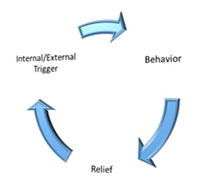
You experience a negative emotion, it is uncomfortable, you check a site/app to distract yourself, and then you temporarily feel better. Rinse and repeat.
This is what the process looks like. First, we have negative emotions (internal or external triggers), then we check the app/site (behavior), then we feel temporary reprieve from that negative feeling (relief).
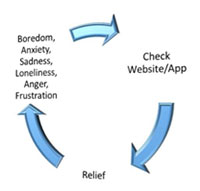

These companies employ geniuses to fine-tune this process to your particular brain. This is the reason you keep checking these sites hundreds of times a day. This is why teenagers are glued to their phones. None of this is an accident. It was designed this way. The same way that food companies have designed addicting foods and, earlier, cigarette companies designed cigarettes. They are not adding an external chemical via food or a smoke; instead, they are triggering a native chemical reaction - dopamine - in your brain to get a very similar effect.
Mind-blowing right? Nuts right?
You should be freaking out right now. You know what will likely happen though? You’ll cut back on these sites for a little while, maybe a day or two, and then you’ll be right back to using them at the same level you were prior to reading this chapter. They are extraordinarily addictive. They are very good at what they do.
Now, just to be a bit more nuanced about this, there are some sites that use this functionality for good. They might help you get in better shape, track your productivity, manage your finances, or take care of your emotional health (our 7 Cups app does the latter). The best way to assess if something is good or bad for you is to check how you feel at the end of using it. If you feel icky, bad, or empty, then it is likely not that great for you. If you feel good, lifted up, or better, then it is likely good for you. You know you, so just pay attention and make an informed judgement.
Celebrity News Sites
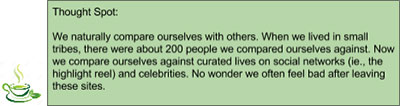
Beyond socal media, celebrity news sites are also incredibly good at this. Hundreds of millions of people click on People or similar sites to learn more about celebrities. My wife (Nicole, the co-author of this book) was pulled into this addiction. Without realizing it, she would be checking in on all of these people regularly. They are presented to you like they are your close contacts, like neighbors next door. You drop in and see that they are “just like us” as you look at images of them having coffee or going grocery shopping. In normal conversation, she’d update me on the latest news on how a celebrity power couple has adopted a new baby, or are in the middle of a divorce, or had an affair with the nanny. We started joking that they were her “friends.” There is some truth to this joke. Your brain cannot tell the difference what you imagine and reality, so these folks actually feel like friends and close contacts.
Like the food companies that add addictive chemicals to our food and like social media that hijacks the dopamine engine in our brains, celebrity news sites also take advantage of our natural vulnerabilities. We, as a species, are keenly aware of the leaders or royalty that surround us. There has been some pretty interesting research done on primates where the scientists will track the number of times a Gorilla or similar ape looks at the alpha or female leader of a group of apes. The normal apes will look to these apes hundreds of times a day. They do not choose to do this. They just do it. This same process happens with us. The celebrities or politicians are kind of like the most powerful apes.
Many people are less interested in celebrities in Hollywood, and more interested in sports or politics or “news.” The very same dynamics that I just outlined with celebrities happen in these mediums as well.
Video games can also be massively distracting. They are fun and engaging. My kids and I have spent hours playing Raymond Origins and had an absolute blast.
These games are addictive because they leverage a psychological process called self-efficacy. We all like to be good at something. When we are good at something we feel better about ourselves. This process gets stronger when the thing we are trying to master is slightly challenging. When it is too easy, we lose interest. If it is too hard, then we get frustrated and stop playing. Instead, what the game designers do is make it just hard enough to keep us interested.
Real life isn’t so clear cut. Many things are too easy or too challenging. If you struggle with “real life” then a video game can be a sort of haven from the challenges of the real world. Having a hard time getting a girlfriend? No problem, you are a great warrior on level 5 of the latest adventure game.
Video games that add a social component can be even more addictive. Think of Farmville or League of Legends. The video game itself is already addicting, but when your friends are asking you to do things for them, then it becomes that much more addicting.
The last online addiction to think about is pornography. Porn was once hard to get. You had to buy an actual, physical magazine. Porn is now ubiquitous and is often on the leading edge of technology. The use of porn has increased dramatically over the years and is predicted to keep its march moving forward. We are not interested in making a moral argument as to whether or not porn is a good thing. Rather, we just want to highlight that the addictive mechanisms are the exact same as the above distraction systems, except that they are much more powerful because they also involve a euphoric release in the form of ejaculation or orgasm. These biological processes release lots and lots of happy chemicals in the brain making porn a particularly potent form of distraction.
Offline Distractions
In addition to online distractions, there is another set of distractions that have been with humanity for thousands of years. The power, property and prestige systems have been in place since the agricultural revolution. However, our current era has seen these systems intensify to a distressing degree.
The common denominator that all of these offline distractions have is that they are external systems, with incentives, that are designed to keep you engaged and your self-worth dependent upon your performance in these systems. In the past, these systems were not as nuanced, effective and as culturally embedded as they are now.
School
Let’s start with school. What is school about? School is about grades. Get good grades, so you can get into a good college. Go to a good college, so you can get a good job. In the offline world, grades is where it all begins.
Academics and related activities now mean more to kids and their parents than they ever have before. We have four children and we allow them one extracurricular activity per season. Our kids have many friends that do something every night of the week. All of this is the consequence of the arms-race college admissions system. It is now no longer amazing to just get a 4.0. Now you need to get a 4.3, patent a software system and feed orphans in your spare time. And their identity is entirely tied to their performance. This is not hyperbole; kids in highschool and college are committing suicide at alarming rates because they are unable to meet these high expectations.
I didn’t grow up in the most academic environment. I had other things to worry about other than grades, so I wasn’t too caught up in this particular system. It may have ended up being one of the things that saved me.
One thing that is interesting about grades is that they are not a great predictor of success in life. We know, on average, that B students actually end up being more successful than A students. A students tend to be great rule followers. B students tend to take grades a bit less seriously. The thing about grades—much like our video game discussion earlier—is that they create an easy to follow path. You can read the syllabus or master the content and, if you work hard enough, increase your chances of getting a good grade. All of this can be good. I liked to get good grades (once I actually got my academic brain turned on) and I want my kids to get good grades as well, but, ultimately, grades should not be taken too seriously.
There is a famous W.B Yeats quote that says, “education is not the filling of a pail, but the lighting of a fire.” You want school to be about learning, about understanding and mapping the world, so you can move around it and work with others on it. You do not want it to be a compulsive process where you meet certain requirements to get a letter grade that has little to do with leading a successful life.
Employment
Once you get through the school system, you join the employment system. The token economy here is a little bit better than the school system. Instead of getting rewarded with letter grades, you now get rewarded with money. Real money you can spend to buy things.
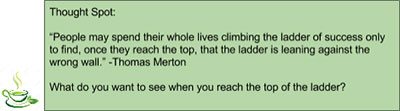
The goal here is normally to climb the ladder or get promoted. Typically, there is an external system that is creating the mileposts that tell you whether or not you are doing a good job. These markers are not tied into whether or not you are growing as a person. Instead, the incentives and benchmarks are there to increase the overall performance of the company.
Fortunately, there are many companies that are getting smarter about this. Google has led the way. They realize that intrinsic motivation comes down to work that allows you have a sense of purpose and impact. We also work hard to do this at 7 Cups. My goal is to align each person’s goals with the goals of the company.
By and large though, this is the exception rather than the rule. You can work very hard in your life, get promoted, make the company a lot of money and, in the end, not grow as a person or reach the goals you want to personally achieve. Like grades, getting promoted can be a good thing. It should be taken seriously, but not too seriously.
Wealth
Closely related to getting promoted is the distraction of making ever increasing amounts of money. I understand that for many folks just making enough money to survive or have a decent quality of life is a concern. For those of you in this situation, please ignore these next couple of paragraphs. For those of you that are making a decent amount of money or even a lot of money, try to be aware of how you think and feel about money. Money can be a terrible task master. You can find yourself stacking up piles and piles of money with no real benefit in your life. In fact, many times it just brings additional pain.
The research on this is pretty clear. We all have a happiness set point or place where we are likely to settle regardless of what happens in our life. Many think that if they win the lottery, get a better job, find a better spouse, or graduate that they’ll be MUCH happier. The truth is that you won’t be. You’ll pretty much settle right back to the same level of happiness you were at before you achieved that last thing you really wanted.
Think about this in your own life for a second. How long did the happiness from the new outfit, car, or promotion last? They call this the hedonic treadmill for a reason (Hedonic from hedonism; meaning living primarily for pleasure). You have to keep getting more and more to keep that happiness drip working, because once one thing is realized, the effect quickly fades. They even have this down to an annual salary. Happiness goes up significantly once you make $75,000 a year, then it plateaus and only slightly increases (Kahneman and Deaton, 2010). Unfortunately, by the time someone is making 75k annually, they’ve been playing the game for so long that it is very hard for them to stop playing the game. There is a fascinating piece in the NY Times that outlines this process for the very wealthy. You can read it here. Money may in fact be the greatest addiction and distraction system known to humankind.
Accomplishments
One last distraction: accomplishments. Some of you smarter folks reading this may have already realized the game of grades, corporate ladder climbing, and money. You may be an independent thinker that is focused on accomplishments. I applaud you. However, a warning, just like with the above distractions, be careful not to get addicted to accomplishments. You do not want to achieve things just for the sake of accomplishing them. It can be easy to think about getting that next notch on your belt, scaling that next mountain, or publishing that next book. You want to make sure that you are focusing on these things because they are meaningful and important. These are also powerful distractions that can keep you in denial.
This is not your fault.
Do not blame yourself for being distracted. These folks are paying very smart people lots of money to keep you distracted. They have your phone, family members, and friendships to leverage. They also have scientists pouring over reams of data to find more and more ways to keep you plugged in. Even the monks among us have trouble resisting this distraction cocktail. Still, despite it not being your fault that you have fallen into these distraction systems, the question now becomes:
Do You Want to Get Out?
Here are some questions you can answer to give yourself more insight. Please answer honestly and track yourself for a couple of days if you think you might be lying to yourself.
Online Distraction Questions
- 1. How much time do you spend on social media, celebrity sites, and news sites a day?
- 2. How much time do you want to spend on social networks, celebrity sites, and news sites a day?
- If the time you have put down on #2 is thirty minutes or more than what you put down on #1, then you are going to have to work extra hard.
- Offline Distraction Questions:
- 3. Is the work you are doing consistent with where you want to go in life? If you stay on the trajectory that you are now on will you be closer to where you want to go in 5-10 years?
- (scale of 1-10, with 10 being very close, where would you rate yourself?)
- 4. How hard are you currently working on a scale of 1-10 with 10 being very hard?
- If your answer to number to #3 is below a 5 and your answer to number 4 is above a 7, then it might be an indication that you are engaged in a distraction system. i.e., you might be in the grasp of a system that is benefiting from your efforts, whereas you yourself are not personally benefiting.
It is perfectly okay to work hard (i.e., have an answer of 7 or greater on number 4), if you are working consistently with your overall goals and direction in life.
What do all of these distractions have in common?
We engage in them in a mindless manner. We spend more time and invest more of our life in them, then we should. Many of them take more from us than they give. They operate a bit like a mental maze where you can get stuck and have a hard time getting out. Before we know it, we start liking the maze and we forget about our real lives, who we are, and our own unique sense of purpose.
Facing our problems and removing ourselves from these distraction systems can happen. We are not destined to live a zombie-like life for our remaining years. The first step is to begin to be honest about the problems you face. Let’s turn our attention there now.