Chapter 1: A Story
I want to open this book with the story of what happened on the planet Ancora. This story occurs at a time of crisis - a terrible virus was sweeping through the population. This virus attacked the brain, leaving the person in a trance-like state, while the body still functioned. Here on Earth, we would call them zombie like.
The truth is that the virus had always existed within the population of Ancora. It was hard to see it because it was so closely linked with its hosts. It took the Ancorans thousands of years to understand what they were fighting against. Scientists, through a series of fortunate accidents, were eventually able to discover and then pinpoint that the virus thrived when the mind was in a state of fear.
Wanting very much to be free from the virus, the wealthy people on Ancora immediately began using their resources to control their fear. They built thick walls around their homes and made their lives untouchable. Gradually, their culture changed and became built on proving that they could do everything themselves and needed no one. In time, they even agreed that social interactions should be limited because they were so unpredictable. When someone tried to speak from the heart, others withdrew from them.
Finally, a clever person figured out how to better manage fear through the use of pain-reducing devices. It didn’t take long before each wealthy Ancoran had a hand-held device that could release calming chemicals into the brain at the first sign of anxiety. Ancorans carried them everywhere, using them nonchalantly on the street, at work or at school, anytime they needed relief. It seemed like the perfect solution.
There was only one problem: it didn’t work.
The virus wasn’t being controlled - it was growing at an even faster rate. The devices only masked the problem. The more people tried to escape their pain and fear, the more sensitive they became to the smallest disruptions in their day and so the virus continued to spread.
What a conundrum. The scientists couldn’t make sense of all the evidence they had in front of them. Up to this point, they had been working tirelessly to bring relief to the wealthy parts of Ancora. When all of their theories seemed to fail, they began to broaden their scope and look at what was happening in the poorer, less-developed parts of Ancora. These people could not afford the pain-relieving devices or other luxuries. Shockingly, the scientists found that the virus showed no growth in these areas.
There was another group that the scientists also noticed. These were people who were living in the developed parts of the world, but didn’t quite fit in with the cultural norms. For some, they had endured so much pain or fear in their lives, that the devices could not numb their experience. If they had overcome the problems in their lives, they were admired and seen as spiritual leaders. If they were still suffering, they were dismissed as hurt or mentally ill and further isolated from society. What all of these Ancorans shared was that they had escaped the spread of the virus.
The real breakthrough for Ancora came from a scientist raised in the humblest of places, one of the poorest countries on the planet. He had risen through the global scientific ranks with his talent and fortitude and this scientist was able to see the puzzle from a unique perspective. He developed a simple theory that, while fear triggers the virus, the only cure was true human care and compassion. He was able to show that in places where human need persisted, among the poor and hurting, people had no choice but to care for one another and provide for each other’s needs. This, he suggested, was why the virus was not able to grow in those parts of the world. The scientist was able to show something truly astounding: in the most dire situations, where the virus was expected to thrive, the virus was nearly eradicated when neighbors reached out to each other with care.
This theory lined up with the experience of those who had endured and overcome great trials and losses in the developed world as well, who seemed so much more hearty and able to resist the virus. It also explained why the wealthy Ancorans, using their riches to become more distant from each other every day, were experiencing such an unprecedented outbreak of the disease. They had convinced themselves that they had no need; that they should not depend on others. It threatened everything about them, about what they believed, to realize that need was the pathway to healing.
Avoiding fear, it turned out, only created more fear and trying to fix the problem as individuals, each on their own, separated the people from the one true cure. Facing fear and pain with the help of others created resilience. The scientists tried to name the cure based on their research. Some saw it as existing between individuals, springing up between friends and neighbors in relationships, and they called it Trust. Some understood it as an ability to believe that the outcome would be good and that beyond fear was joy - these called it Hope. Some thought of it as the seed of something deeper, that could cure not only the virus but all of the other struggles on Ancora, even famine, war, and disease. It could grow them into what they were meant to be. These called it Love.
Explanation
We shared this story with you because sometimes it is easier to see things in “other” people or cultures. When we imagine uncomfortable things as far away or taking place somewhere else, they become less threatening to us. We can walk up to them, get close, and touch them.
The world we talked about in that story is really our world, just very thinly disguised. Many people in our advanced societies experience a similar type of zombie-like feeling. And, like the Marudians, when we try to escape from pain and fear, we really only make it worse. But it is hard to admit this and reach out for help. There are a lot of social pressures against asking for help.
People that are hurting or poor experience more pain and need than many people in our advanced societies. Other people feel excluded and less able to play the game. People in poor countries experience more sickness, violence and poverty. Things go wrong a lot more frequently for people in these groups. Unfortunately, they often compare themselves with people in the more advanced societies and feel ashamed that they need help.
Nobody likes asking for help, but it can be particularly challenging for many people in our advanced societies. Problems - even though they are a central and undeniable part of life - can feel embarrassing or shameful. The messaging is clear. People in the advanced groups are not supposed to have problems. Everything is always peachy keen. The unspoken rule is that problems should be hidden and kept out of sight.
Sadly, this approach keeps many people in a place of quiet suffering. They feel alone in their private pain. This unwillingness to let others in - whether it be from fear, shame, or pain - is what keeps folks in denial and in this zombie-like mindset.
The irony here is that many of the advanced people are actually the most ill. Billions are spent each year trying to convince the world that the most advanced among us are to be admired. Everyone should hunger for what they have. In a less than subtle way, the message to people that are poor and unusual is that they are wanting, that they are fundamentally not okay. What’s more tragic, is that often times these folks, without realizing it, accept this message. What they do not yet understand is that they may indeed be the healthier ones. They may be the people that are actually on the right track. Yes, life is harder for them. The need and the pain is real, but they are alive. They are struggling and seeking help. They are not numb. In fact, they may hold the cure that the advanced people need, but none of them can see it.
It is hidden.
The Secret
What is it that hurt and poor people have that advanced people do not have?
They have need.
Need forces you to face your problems and ask for help in solving them. Once you receive the help, you feel better and want to help others. This is the basic process that creates healing.
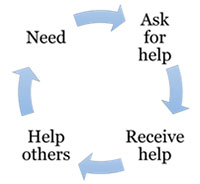
If you are ashamed of admitting that you have problems, then you cannot ask for help. If you cannot ask for help, then you cannot receive help. Without receiving real help, you may find it hard to genuinely help other people.
People that are poor are in a better position to receive help because they are less able to deny their pain and act like all is well. Their problems are very real and force them to seek out other people. This process of asking for, receiving, and giving help is what keep us well. It keeps us from becoming zombie-like.