Chapter 8: Cup 3: Practice: Practice Skills to Increase Calm
Practice skills to increase calm
So now we know how important and life changing it is to believe that love is all around us. Sometimes, no matter how hard we try, it can feel like love is out of reach or hard to notice. It can feel like we are stuck in a sea of negative emotions and can’t find our way out. We might stress more than we want. Sometimes we might feel overly anxious. Other times we might be more easily irritated.
We may also feel like we cannot stop worrying about the same thing over and over again. We want to stop, but our minds keep returning to it again and again. You can think of this as a mental loop. Mental loops can focus on unresolved issues from the past or worries about the future.

The problem is that worrying doesn’t work.
The reason it doesn’t work is because it doesn’t help us move past the issue or the negative feeling. Our mind is like a hamster on a wheel. We feel like we are making progress, but we are really just running in place.
Fortunately, the brain is very flexible. We can train it to help us navigate worry and day to day stressors. As discussed in the distraction chapter, however, this is not something that you can passively do. There are distraction systems in place that do not want you to feel calm, centered, and grounded.
The skills needed to increase calm are very simple. They will not take you long to learn at all. We created the 7 Cups app to help make practice even easier. If you download the app, then you’ll be prompted to do one of the below skills each day. When you complete one exercise your emotional teacup goes from half full to 75% full. If you do one more exercise, then your cup becomes completely full. If you miss a day, then the cup drops to 75%. If you miss another, then it drops to 50%. We are optimists, however, so your cup will always at least be half full. You don’t need the app to practice these exercises. It just helps. This is our way of keeping you one step ahead of the downward escalator.
These exercises work. I like to think of them as brain hacks. When you regularly practice these exercises, they change the way your brain functions. Take mindfulness for example. It is impossible to be both relaxed and anxious at the same time. When you listen to a mindfulness exercise, your body becomes deeply relaxed. When your body is relaxed it cannot also be anxious. You can actually use mindfulness to manually make yourself calm.
A final way of looking at these exercises is to view them like you would a medication. There is a certain dosage that is required to feel an effect. Your doctor would advise you to stick with a new medicine for at least a couple of weeks to see if it is working. You should do the same with these skills. The primary difference is that the skills are free, proven, and safe. The only side effects are increased calm and happiness.
Ready to get started?
Healthy Coping Skills
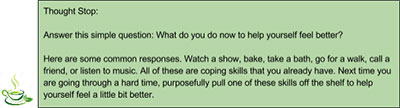
Many of us already have skills we practice that help us feel better when we are going through a hard time. We have not been taught to see them as skills, but they are skills nonetheless. What’s more is that they are already active and effective in your life, so you do not even have to learn them. You are already doing them. Once you are aware of them, you can just start doing them more deliberately to help yourself feel better.
Mindfulness
Mindfulness or meditation has been around for thousands of years. The mental health world recently discovered it and now we have a mindfulness treatment for just about every psychological issue. The core of what works in mindfulness is the same across all of these treatments. Mindfulness now also has robust research support for decreasing anxiety, depression, and stress. It also has positive benefits in that it increases compassion, empathy, memory, focus, and, believe it or not, our ability to fight off illness.
Not too bad for a simple 5-10 minute daily exercise, right?
Mindfulness or meditation can sound intimidating. It emerged from Buddhism and has been influenced by other eastern religions. People can read words like “dharma” or see someone sitting in a crossed leg lotus position and feel like mindfulness is too daunting. Let’s be honest, 99% of us don’t know what word “dharma” means and the vast majority of us would be incredibly uncomfortable in the lotus position. The good news is that you do do not have to read Sanskrit or shave your head to practice mindfulness.
Mindfulness is actually very simple. It starts with paying attention to your normal breathing. Special or fancy breathing is not necessary. Your regular in and out breathing is the pathway to calm.
The suggestion here is that your breath is your real center. We tend to locate our center in our minds. We feel like we exist behind our eyes, because we look out on things from this perspective. Mindfulness, on the other hand, suggests that our breath is our true center- like our breathing knows more about us than we give it credit for. You can imagine moving your center from your head to your diaphragm or belly. What happens? It feels different right? A little less forced and a little more relaxed?
One reason focusing on breathing seems so counterintuitive is because we use our minds to solve problems. We see a problem in the outside world, diagnose it, and then start trying to fix it by doing things. An example, your computer starts having challenges, so you turn it off, restart it and it works again. Similarly, when we experience pain in the external world, we often take steps to reduce that pain. If you are cold, then you can put a coat on. If it is raining, you can go inside. If you are in a cramped spot, you can get up and walk around. We can usually resolve problems in the outside world by identifying them and then implementing steps to solve them. (Hayes, Strosahl, & Wilson, 2008)
Internal problems like negative thoughts and feelings, however, are not solved in the same manner as external problems. Getting rid of pain in the outside world is usually a straightforward process. Getting rid of pain in the inside world is not straightforward. The same mechanisms don’t work.
You need a different strategy to work through internal pain.
Paradoxically, resolving internal pain is almost the opposite of resolving external pain. If you have a pebble in your shoe, you simply remove the pebble. If you have a pebble in your soul, you have to accept it in order to dissolve it. If you try to pluck it out or push it away, then it just grows in size and eats up more of your energy.
Acceptance and commitment therapists call this entanglement. The pushing away of the pain just strengthens its attachment to you. You can imagine pain like a giant beach ball that is following you. You have glue on your fingers and hands. When you try to push the beach ball away, it actually gets stuck to your fingers and hands. The harder you push, the stronger it gets stuck to you.
Another metaphor commonly used is quicksand. Freaking out is a great way to further sink into quicksand. Relaxing, leaning back, and gradually moving out through backstroke like motions is the best strategy but is likely the last thing that comes to mind. Freaking out is the natural response. Similarly, when we feel emotional pain, we can often feel frantic to get away from it. Unfortunately, the more we struggle, the more we magnify the emotional pain. (Hayes, Strosahl, & Wilson, 2008)
The main point is that the struggle to avoid pain is what makes you further entangled in the pain. Paradoxically, opening to the pain is what allows you to move past it. With the beach ball metaphor, if you open to the pain, then the beach ball will simply bounce off of you. It’ll likely come back and bump into you again, but it won’t stick to you if you do not try to avoid it or control it.
It is really hard to open to uncomfortable feelings. This is where mindfulness shines. It teaches you how to do this in a step by step manner.
Here are the steps:
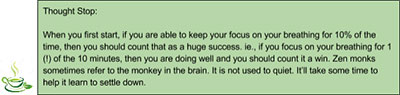
Plan to do this for 5 minutes. You can set a timer on your phone or look at a clock (that is okay). As you get better at it you can extend the time. Right now there is no rush.
Sit in a comfortable position and close your eyes. I often just sit in a recliner with my legs up.
Notice your breathing. Remember, you already know how to breathe well. Just notice the natural in and out of your breath.
Return your attention to your breathing when your mind wanders. And your mind will wander. No big deal. Whenever you figure out that your mind is thinking about something else, simply return your attention to your breathing.
Label uncomfortable thoughts or feelings when they come up. Just notice them like you would a cloud passing through the sky. If it is a worry, then just label the thought as worry. If you have an anxious feeling, then just label it as anxiety. One metaphor sometimes used here is the chessboard. Your thoughts and feelings are the chess pieces. You are the chessboard. You observe the thoughts and feelings. You are not the thoughts and feelings.
Keep paying attention to your natural in and out breathing.
When the time is up, pat yourself on the back, and give yourself some kudos. You did well!
We realize that this can be challenging. One way to make it much less difficult is to listen to a mindfulness reflection. This makes it easier to stay focused because you are listening to somebody continuously remind you to follow your breathing. These reflections also provide some variation, which can also help your brain stay interested. You can find over 300 mindfulness reflections from dozens of different categories for your use on the 7 Cups app.
Gratitude
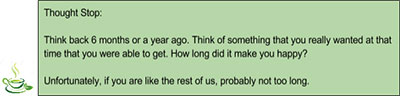
We talked a little bit about the hedonic treadmill in Chapter 3 - the idea that we always want more and that true satisfaction is hard to come by. We want more money, a better job, more vacation time, or increased recognition. The list is endless.

We can really torture ourselves with this idea of more. When I was a teenager I waited tables at a greyhound park. In order to get the dogs to run they’d put a rabbit like lure out in front of the dogs. It smelled like a rabbit and squeaked like a rabbit. The greyhounds could not resist it so they would run after it with all of their might. Of course it was always just out of reach.
Sounds familiar, right?
Many of the things we hunger after are always just out of reach. Of course, to make it worse, sometimes we are successful in getting what we want only to quickly lose interest in it and move onto the next thing. This is a part of our biology. We quickly adapt to the good things we have and reset at our earlier happiness levels. Frustrating indeed.
One antidote to this endless craving is gratitude. Like mindfulness, this too is simple, free, and proven to get results. Research has shown that gratitude is the single biggest variable in happiness.
Remember when I just asked you what you want more of and you made the list? Think for a second though on those items. How hard are they going to be to get? How much money will they cost?
Believe it or not, research has proven that gratitude will make you happier than those things. Let me repeat. Gratitude will make you happier than getting or achieving any of the things on that list.
The best part? It costs nothing! Zero dollars. A big fat goose egg.
The best things in life truly are free.
How much would you pay for a pill that you could take 1x a day that would dramatically increase your satisfaction levels? Most people would pay big money for that sort of pill.
Gratitude is that “pill” and it is free for the taking. You have an enormous bottle of gratitude pills that you carry with you everywhere you go. You just have to start taking them.
The research suggests that you should:
“Write down three things that went well each day and their causes every night for one week. In addition, provide a causal explanation for each good thing.” Seligman, M. P., Steen, T. A., Park, N., & Peterson, C., 2005
Practicing this simple exercise will bump your happiness level by 9% over a 6-month period. The longer you do it, the more effective it becomes. It is important to spell out why something went well in order to build out the connections in your brain. At first, the gratitude part of your brain will be like a one-horse town. Not a lot of roads or people. Then, as you do more and more of these exercises, it’ll turn into a bustling gratitude city, filled with people and roads.
There are other popular gratitude exercises you can do as well. One exercise involves writing a letter or email to someone to thank them for helping you. It doesn’t have to be long. You can just concisely and honestly let them know how they helped you.
Imagine getting a letter like that? It’d make you feel amazing right?
Send it!
Another way to short-circuit craving is by deliberately wanting what you have. Think about your relationships. Let your mind think about all that you love about them. Think about the possessions you already have. Again, let your mind marinate on them. We can shift our focus from what we do not have to what we do have in order to increase satisfaction.
The ancient Stoics took this a step further by practicing what William Irvine calls “negative visualization.” Call to mind those same relationships and possessions again. What would happen if you lost them? This is what happens when we face a catastrophe. Things come into perspective real quick. Instead of worrying about the new gadget we are hungering for, or the next vacation, we immediately start thinking about how to solve the crisis. Unexpected calamities have a way of showing us what is ultimately important.
Stoics sometimes even deliberately gave up things they owned in order to live with less. If they were rich, then they might live like a homeless person for a few days. They would do this regularly in order to keep that process of dissatisfaction from taking root. Here is an example from my life. I went hiking with my sister and a friend on the Appalachian trail for 7 days. No change of clothes, no hot shower, no bed. By the end of it, I was thankful for just a hot cup of coffee and a shave. As they say, “Absence makes the heart grow fonder.” This is true of people, possessions, and experiences.
A final exercise is to think about people that have less than you. If you are in the Western world, then you have a much better life than 99% of the people on the planet. You are living like a king or queen might have lived in our not too distant past. Humans are, by nature, comparison machines. Usually, we focus on comparing ourselves to those who have much more than we do, which makes us feel terrible about our lives. But, you can leverage this weakness by comparing yourselves with the many people that are struggling in our world. This can help put your many blessings into perspective.
In sum, Cup 3 focuses on practicing mindfulness and gratitude skills to increase calm in your life. You are hardwired to be anxious. In order to overcome worry and negative feelings, you have to deliberately practice skills on a daily basis to keep yourself moving in the right direction. The skills are simple, free, and proven to work. And on 7 Cups, you can find an app and a community to support you, so you can stay one step ahead of that downward escalator.