Chapter 6: Cup 1: Open: Share What is on Your Heart
Share what is on your heart with another caring person.
We can’t do this alone.
This cup is the first for a reason. It can be daunting to consider changing your life and facing problems in a new way. It can be confusing and it can be scary. We want you to connect to others, to a community that will support you and care about you. Having others in your corner can give you the courage you need to face the challenges in your life.
But sharing what is on our heart can make us feel very vulnerable.
Why?
Sharing means letting someone in. It means opening up and talking with them about something that is troubling you. You are giving the other person power. If the person isn’t trustworthy, then they can hurt you.
We don’t start off feeling vulnerable about sharing. The natural state of childhood is one of openness and wonder. But, just like on Ancora, our society doesn’t celebrate open sharing. Vulnerability can make you a target. So, gradually, we get a little bit tougher each year. We grow a thicker skin. We learn to monitor ourselves a tad more. As we described earlier in our discussion about how the shadow is created, we begin to hide more and more of our true selves.
Sometimes people can be hurtful without even knowing it. Parents, often unknowingly, can pull away from us when we are young. They may be overwhelmed with the busyness of life and message to us that our feelings are not as important. Kids at school can be rough too, just trying to look tough themselves. It can be a challenge to find safe and secure relationships. We can feel like we are out there all on our own.
For all of these reasons and more, we learn that sharing what is on our heart is a scary endeavor, and, maybe, not a good idea.
Often times, as adults we continue this trend in the friendships we are part of.
A lot of times, we do not use good judgement when it comes to choosing friends and inviting people into our lives. We do not put a lot of deliberate thought into the process, but allow proximity and our own unconscious patterns to rule. But this is something we should think about! Our lives are greatly influenced by the network of relationships we are a part of. Our family members, friends, and co-workers deeply affect the way we view ourselves and the world around us.
There are lots of ways of capturing this idea:
“No man is an island.”
“You are the average of the 4 people you surround yourself with.”
“Your friends go to jail, you go to jail. Your friends go to Yale, you go to Yale.”
We are social creatures and we understand ourselves through our closest relationships. So, let’s take a few minutes to examine those relationships.
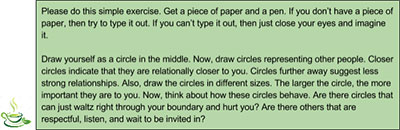
What you see on that piece of paper is a picture of your peer network. Interesting, right? Give yourself a moment to look at it and just jot down any other thoughts or insights that come to mind when you look at it.
Now, consider these questions. How many of those people did you deliberately invite to be in that network? How many have you arbitrarily picked up along the way because you lived near, worked with, or are related to them? Of those that are more arbitrary, if you didn’t live near them, would you still choose them for a friend?
Don’t get me wrong, you can find great friends based on random variables like geography or work. If you find a person that you really click with that happens to live next door, fantastic (!), that is great news. If not, then realize that there are plenty of people out there. You really don’t have to settle for the friends you have. There is no rule that says you have to spend a lot of time with a friend just because they want to spend a lot of time with you. And you do not need to spend time with people just because they are related to you.
Many of us think long and hard about the person we date or marry. There are entire industries built up around this mate selection process. It is a big deal. Yet, for friends, where these relationships often extend longer than our romantic relationships, we provide almost no forethought.
That stops now: you are hereby granted conscious permission to think clearly about and choose who you would like to have as friends.
This goes for all of the people in your life, including co-workers and, even, family members. As Harper Lee said, “You can pick your friends, but you sho can’t pick your family.” That is true, but you can choose how much time or how important the people in your family are to you (except, of course, your own young children). I’m not advocating cutting people out of your peer network. I’m just suggesting that you be deliberate about who gets to be a big circle.
We can sometimes be in denial about being in a bad relationship (see chapter 2). Much of this happens on an unconscious level. We find ourselves connected to a partner or friends that are not really that great for us. Still, even though we know this on one level, it can be hard to *see* it on another level.
Here are some questions to help you assess if a relationship is good for you or not.
- Do you feel drained after spending time with this person?
- Do you feel bad about yourself after spending time with this person?
- Does this person cause messes and drama around them and in your life?
- Do you feel like this person does not believe in you?
- Do you find it hard to say “no” to this person when you know you should?
- Do you feel like you cannot relax or be yourself around this person?
If a person meets any or all of these criteria, then feel free to shrink their there circle. Simply spend less and less time with them until they are no longer draining your life. Your life will get much better.
Many kind and giving people can find themselves being taken advantage of. It’s tricky to know where to draw the line when you are being a caring friend to someone who has a lot of needs. The trick is to listen to yourself, to balance the nurture and resources that you are giving, with the nurture and resources that you are receiving. If someone is very needy or particularly draining to you, spend just as much time as in comfortable for you. You can be a help and support for them without having to be the only help and support for them. And when you play just your part in their lives, you leave room for them to grow.
Again, nobody is advocating removing these folks from your peer group. The recommendation, instead, it to simply begin to decrease the size of their circles and to increase the distance between your circle and their circles. On the other hand, if someone in your social network leaves you feeling encouraged, challenged or supported, feel free to spend more time with them. Grow their circles and draw closer to them.
Give to and nurture the relationships that make you stronger and happier. Let these people know that they are important to you by loving them back!
Doing this on paper brings the learning to a new level. Please find your paper again. Mark these people by writing in their names over their circle. Write the word “before” on them. Now, draw new circles that represent them with smaller sizes and at a further distance, or bigger circles, closer to yours. This is where you want to go. As you meet new people, make a habit of checking in with yourself. How does this person make you feel? Do they belong in your social circle?
Though Spot:
People have their own weather systems. They bring their weather into your world. If your disposition is normally sunny and 70, yet every time Stacy comes around it becomes dark and rainy, then know the gray clouds have nothing to do with you. They are coming from Stacy. When you meet a new person, simply allow yourself to get a feel for their weather. If you like it, then let them into your network. If you don’t like it, then don’t let them in. Don’t increase the size of that person’s circle by spending more time with them.
Now, just to be clear, very few of us are always sunny and 70 and we cannot expect all of our friends to alway be sunny and 70 either. We all have cloudy days or can feel overcast. The key thing to diagnose is whether or not the weather is consistently harmful. If it is, then you can shrink the circle.
Being aware of the person’s weather is one way to find safe and good people for potential friends or a mate. Another way is to gradually get to know them. If dating, ask about past relationships and hear how the person talks about them. Are the problems always the other person’s fault? Just be deeply curious about their lives. Learn all that you can about them. Then, take a step back and look to see if there are negative patterns. The best predictor of future behavior is past behavior. The stronger the pattern, the more likely it’ll manifest and impact your relationship. If you are not interested in having that experience, then simply shrink the circle. No harm, no foul.
This is a process. You do not want to rush it. But you will be surprised how much more peaceful your life can be when you are careful about who is close to you. And when you are in charge of how much energy a person is allowed to take from you, you will have the energy you need to change your life and reach your goals.
Now that you are aware of your current social system, how do you start opening up to others who are safe and caring?
Unfortunately, not all of us have trustworthy people that live or work near us. Good, safe, and caring people can be hard to find. This is one reason that loneliness has tripled since 1984 (Cacioppo, 2013). Kind and caring people create more kind and caring people. If the population of these folks is decreasing, then, unfortunately, we’ll see and less and less of these sorts of relationships increasing.
We created 7 Cups to help solve this problem. We have just started, but already we’ve created a positive upward spiral that will help to reverse this trend. The critical first part was to create a reliable way to find safe, trustworthy and compassionate people. This, to me, is the definition of an active listener on 7 Cups. Many of these folks, just like mental health professionals, are wounded healers. They’ve faced their own challenges, come through the other side, and are now giving back.
A second, but perhaps just as important, part to increasing openness in our lives is reducing our fear of being judged. This is sometimes referred to as stigma. At any given time, 30-40% of us are struggling. Think of the last 10 people you met. 3 or 4 of them are going through a hard time right now. It would be really hard to tell which 3 or 4 needed help, because many of us do not feel safe being vulnerable. We keep up a front, because we are rightfully afraid of being judged. 7 Cups is an anonymous system for just this reason. It is a safe and completely private place to practice sharing openly with a caring person.
You will know that you’ve found a good listener because of how you feel when you talk to them. If you feel understood, validated, encouraged and strengthened by them, then you have just been loved. It can feel a little scary the first time. Leaning on others and asking for help is a skill just like any other skill. The more you do it, the easier it becomes. Before you know it, it’ll feel quite natural opening up to another person. And, you know what? You’ll feel a world better.
We can see this in kids, but we struggle to realize that it holds true for adults as well. There is a field of study in psychology called attachment theory. It focuses on how people bond with one another, particularly on how young children connect to their caregivers. Kids, especially when they are little, need to be held a lot. Once they get a bit older they can move away for a little while and start to play on their own. Then, after a short time, they circle back to be picked up again. This is because each child has an emotional gas tank. The tank gets low with too much distance or time away from the parent. When the child comes back, sits on a caregiver’s lap, reads a book, or sings a song, then the tank gets filled back up. At that point the child can go out and explore again.
Many parents make the mistake of trying to push their kids. They withhold love or care, because they mistakenly believe that pushing their kid forward is going to help them grow or master skills more readily. This is flat wrong. If you want your kid to grow and excel, then love them. Make sure that gas tank is filled up. When it is full, they have fuel to explore. If you push them away, or put too high of expectations on them, then you drain the tank and limit their ability to grow.
All of this applies to adults as well. Our tanks get low too. We don’t sit on the floor and cry to get someone to pick us up and pay attention to us. No, instead, we pick up the phone and share how we are going through a hard time. We lean on someone for support. What are we doing? We are connecting with someone we trust, and getting our tank filled back up. It is the equivalent of the 3 year old raising their hands and asking for a hug. Kids and adults need to be filled up. There is absolutely no shame in that. It is how we are wired.

There are lots of things that drain our tanks more quickly. Being sick drains the tank. Loud noises drain the tank. Stress drains the tank. There is a lot of work to do and we need to know that there are safe people in our lives who will support us and fill us up when we are down. With these people around us, we are able to take on any challenge life has to offer. And our victories become their victories.
In summary, Cup 1 is about sharing what is on your heart with a trusted person. It involves opening up, being vulnerable, and learning to lean on people for support. Understanding your peer network is important because it influences how you feel on a daily basis. You want to be mindful of who you let into your peer network and also be deliberate about shrinking the circles of those who are unhelpful.
We understand that finding safe people can be challenging. We built 7 Cups so kind people could find one another much more readily. We know that fear of judgment keeps us from getting support. Anonymity protects us and enables us to open up and share things we feel embarrassed about. We all have challenges. We all struggle. None of us is alone. Lastly, please know that we all need regular support. Each of us has a gas tank that gets low from the challenges we face. Cup 1 is all about learning to let someone fill up your tank. When your cup gets full you are in a much better position to help fill someone else up.