Chapter 2: Denial
Denial is a core process we all experience. Denial can be good. When you are in crisis, you want to be in denial about certain things because it helps you survive. For example, when my kids were born 10 weeks premature, I needed to be in denial about their real chances of survival because I needed to focus on the things I could change. Denial, however, can also problematic in that it can keep you from making changes in your life that will help you and those you love. The zombie-like process described in Chapter 1 is built on the bad kind of denial. This chapter explains how denial develops and is maintained.
The first part to understanding denial, is to understand that we operate on both conscious and unconscious levels.
You’ll recall the iceberg metaphor. The part above the surface represents the conscious mind. The much larger part below the surface represents the unconscious mind. We like to believe that we are fully aware, but much of what we think, feel, and do actually happens below the surface, outside of our awareness.

My wife and I have had the good fortune of parenting 4 beautiful children. We’ve seen them all grow up and change. It is always fascinating to see a child learn how to walk, eat, or climb stairs. None of this comes naturally. Kids have to learn how to do these behaviors. If you haven’t yet, try to watch a new baby learning to eat with a spoon. It is really tough for them. Eating requires a lot of conscious attention and hand-eye coordination to make sure the spoon reaches their mouth. When they are first learning, they often miss and get the food all over their cheeks and clothes.
When was the last time time that you missed your mouth with a spoon? Learning this behavior once required conscious thought, awareness, and concentration. Once mastered, however, it is moved to the unconscious mind so the conscious mind can focus on the next big important item to learn.
Let’s look at one more example. Many of you can remember learning to drive. Learning to drive also requires conscious thought. You have to pay attention to the signals, braking, and steering. If you drive a standard or a manual, then it requires even more conscious attention. You need to learn when to shift from gear to gear, which can be particularly challenging on a hill. Can you remember how nervous you were, how challenging it was when you first started? Then, within months, as you gained mastery, all of this became second nature. You don’t even have to think about it. Driving gets moved to the unconscious mind - or pushed outside of your awareness - because you have already figured it out. This frees up the conscious mind to tackle the next big project that requires deliberate thought.
Relating to others is also a process we learn consciously that eventually becomes unconscious.
You may not remember, but learning to relate to people initially required a lot of conscious thought. Once mastered, it too, was moved to the unconscious mind. Virginia Satir, one of our most famous family therapists, said, “Families are people factories.” She meant that we learn how to relate to others during our early experiences of our families. The patterns of interacting that we use today were set up early on in our lives and were reinforced over and over again until they became automatic and part of our unconscious. Our peers and others influence us as well, but the basics are learned very early on and inform much of how we think about ourselves and others later on in life.

There is one very important side effect of this early learning about how to interact with others...it’s called “the shadow”
One thing we learn from these early relationships is that there are some parts of ourselves that are “good” and some parts of ourselves that are “bad”. We are all born very unique people with different strengths, weaknesses, and oddities. We naturally express all of these different components of ourselves as babies and young children. Gradually, however, different people message to us that some of these attributes are less acceptable than others. Authority figures tend to like it when we are kind and compliant and like it less when we are opinionated and stubborn. What happens, gradually, is that many of the “good” components get validated, accepted, and integrated into who we are. These pieces become conscious and a part of our identity.
There are other parts of us that are not validated, not accepted, and these pieces become dis-integrated from our identity or sense of who we are. However, even though they are dis-owned, they do not go away. They stay kind of stuck in our unconscious minds, just below the surface, outside of our awareness. We may experience them when we let our minds wander, in our dreams, and they sometimes burst into our conscious life and cause us to behave or make decisions in ways that seem out of character.
In the language of Jung, these unacceptable parts become a part of “the shadow”; they are the pieces of our self that are not in the light, not in our conscious, hidden below the surface of the iceberg.
Robert Bly (1988) has captured this well:
Let’s talk about the personal shadow first. When we were one or two years old we had what we might visualize as a 360-degree personality. Energy radiated out from all parts of our body and all parts of our psyche. A child running is a living globe of energy. We had a ball of energy, all right; but one day we noticed that our parents didn’t like certain parts of that ball. They said things like: “Can’t you be still?” Or “It isn’t nice to try and kill your brother.” Behind us we have an invisible bag, and the part of us our parents don’t like, we, to keep our parents’ love, put in the bag. By the time we go to school our bag is quite large. Then our teachers have their say: “Good children don’t get angry over such little things.” So we take our anger and put it in the bag. By the time my brother and I were twelve in Madison, Minnesota we were known as “the nice Bly boys.” Our bags were already a mile long.
Then we do a lot of bag-stuffing in high school. This time it’s no longer the evil grownups that pressure us, but people our own age. So the student’s paranoia about grownups can be misplaced. I lied all through high school automatically to try to be more like the basketball players. Any part of myself that was a little slow went into the bag. My sons are going through the process now; I watched my daughters, who were older, experience it. I noticed with dismay how much they put into the bag, but there was nothing their mother or I could do about it. Often my daughters seemed to make their decision on the issue of fashion and collective ideas of beauty, and they suffered as much damage from other girls as they did from men.
So I maintain that out of a round globe of energy the twenty-year-old ends up with a slice.
Bly goes on to talk about how different cultures influence the repressing of different parts of ourselves. In the United States, females are supposed to deny the more masculine side. They are encouraged to be less directive and assertive. The “bossy” campaign illustrated this wonderfully. Males, on the other hand, shouldn’t be too feminine, emotional or tender. The more we ignore these unintegrated pieces of ourselves, the less developed they become. They stay stunted and immature.

Although these characteristics are very threatening inside of us, we can become very attracted to them when we see them portrayed in the outside world, in books or movies. At that safer distance, we can experience these parts of ourselves vicariously, getting a kind of release of the building pressure they create inside of us. This is why movies and books about sex, horror, and violence are so popular.
But even with these cultural releases, the split off parts of ourselves do not ever really leave us alone. They keep knocking on our door and asking to be let in. They keep popping up above the surface. They want to be integrated, to become part of who you are.
Why do we keep them away?
We keep them away because they are scary.
Why are they scary?
The split off parts of ourselves are scary because when we originally acted in and through them, back when we were small, they caused problems in our relationships with our parents or caregivers.
Here is a common example: many parents struggle when their kids are overly strong or angry. Parents, often times not meaning to, overcorrect this type of behavior. They may respond to anger, repeatedly, in a harsh manner or they may, unconsciously, withdraw from the child emotionally. Regardless, the child gets the message that anger threatens the relationship they have with their parents. This is anxiety provoking to a child because they need their parents in order to survive. They are dependent on them to live. What happens, gradually, is that the child learns that in order to maintain a close relationship with parents, they need to keep those angry feelings at bay. This happens repeatedly and the child eventually becomes walled off from their sense of anger. It is pushed down below the surface, into the unconscious.
Now, anger is a normal human emotion. It is the emotion of protection. It helps you stand up for yourself and other people you care about. When anger gets shut down, it is harder for you to keep good interpersonal boundaries or advocate for yourself at school or work.
The rejected parts of ourselves cause us anxiety.
In this childhood process, anger causes anxiety because the expression of anger is connected to the experience of parents behaving harshly or withdrawing. The child quickly learns this, so whenever anger rumbles to the surface, anxiety is right there next to it. They become linked together. Anxiety is an extraordinarily uncomfortable emotion. We want to get rid of anxiety as much as humanly possible. Do you know what works great for getting rid of anxiety and anger? You guessed it...denial.
There is an unconscious process called the triangle of conflict that keeps our systems balanced.
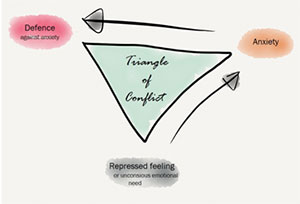
Image credit: http://www.coachwiththegreenhat.com/the-biggest-lie-i-have-no-time/malan-triangle-of-conflict-with-text/
In this example, it consists of anger, anxiety, and denial. You can think of this like an air conditioning system. Once a room gets too hot as measured by the thermostat, the air conditioner automatically turns on and starts blowing cold air into the room. Once the room is cooled off, the thermostat tells the air conditioner to turn off. This system keeps the room at an even temperature. We have our own internal thermostat that keeps these parts of ourselves and our anxiety down. It is denial.
If you grew up in a home where your anger or strength was not acceptable, then, as an adult, you’ll start to feel anxious whenever you feel angry. As a result, denial will kick in and you’ll push away the issue, as well as your internal anger. This denial will help you distance yourself from your anger and get you back to a place of balance or equanimity. Just like a thermostat triggers the air conditioning to cool down a room, anxiety triggers denial to decrease anger and get you back to a comfortable spot.

Remember, this happens on an unconscious level. There is no conscious choice made. The reaction was learned when you were very young and learning how to interact in relationships; now it just happens automatically.
As adults, we are attracted to people and experiences that support our unconscious relationship patterns.
These patterns, once setup, tend to be reinforced over and over again. They feel comfortable and well-worn, kind of like an old sweater or pair of shoes that we like. They are familiar and predictable. We know what to expect. When people treat us in ways that are consistent or reinforce these old patterns we feel secure.
One of the great challenges that humans face is that we will continue in relationships that are bad for us if they feel familiar and predictable. This is not a good thing. If I am raised by parents that value submissiveness and compliance and I establish this as a pattern of relating, then I’ll feel most comfortable in relationships with friends and romantic partners that are dominant or difficult to please. If someone is interested in helping me grow stronger, stand up for myself, or have better boundaries, then I’ll feel less comfortable with this person. This person may even be genuinely trying to help me and be a force for good in my life. However, because it is different, inconsistent with how I see myself, and, unconsciously, threatening, I’ll be less comfortable in this type of relationship. They inadvertently trigger my anxiety.
Amazing, right?
We’ll highlight one example to further flesh this out. Think of a friend who is dating or married to someone that is clearly bad for them. Everyone knows that the person is bad for them. They mistreat them, take advantage of them, make them feel bad. They might even be abusive. You don’t like this other person. Nobody does...except your friend.
Why does your friend stay with them?
Your friend stays with them because it feels comfortable. It feels familiar. It isn’t good, but it feels predictable. Humans will choose bad and consistent over healthy and different if they are unaware or unconscious.
Denial can be powerful.
We’ll talk more in the second half of the book on how to integrate these parts of ourselves that are in our shadow. Beginning to integrate and restore this energy to ourselves is a big part of feeling better, stronger, and having better relationships.
For now, however, we just wanted to outline how the process of developing denial works. Through this process we learn how to focus on things about ourselves and others that are consistent with what we accept and like. We learn to deny, or push out of awareness, the things about ourselves that threaten us and cause anxiety.
Cultural Denial
Denial also happens on a societal level. We call this Cultural Denial
This habit of denial that we all individually develop also impacts how we operate as a culture. We collude - we agree on an unconscious and unspoken level - to deny things about our society that we do not like or find threatening. For example, we tend to be in collective denial about the prevalence of sexual assault and abuse. Fortunately, we are now in an age (thanks to the Internet!) where our collective denial seems to be breaking down much more rapidly. It is going to be a process and it’ll take a while, but I have no doubt that the pace of denial breaking down will continually quicken. The trends are obvious for anyone to see. This is a very good thing.
One big factor that keeps our denial in place is our belief in heroes. We want to believe that there are really smart people that are on top of things, in control, and are going to help us. This, too, has its roots in childhood. Remember back when you thought your dad was extremely strong? This idealization of our parents helps us feel safe. It makes the world less scary. Belief in our parents’ goodness, omniscience, and strength helps us feel secure. Then, as we grow up, and hopefully earlier rather than later in life, we begin to understand that our parents are fallible. They are not superhuman. They make mistakes and poor decisions; they can be quirky, and stubborn. They become de-idealized. This process of beginning to see your parents as fellow humans is a great milestone in life. It helps you mature. It enables you to begin to assume more responsibility for your life.
For some of us, however, this need to believe in superhumans continues. We desperately want to believe that the president, other government leaders, the federal reserve, scientists, and others are superhuman. We want to believe that they are on top of things, fully aware, and can easily solve our problems. We want to believe that they have their hands on the controls and all will ultimately be well. Unfortunately, just like with our parents, we need to realize that these folks are all human too. They are just like you and me. They are working ridiculously hard to keep us on course, but, they too, have the same limitations that we all have.
In order to deal with what is happening in our world, we are going to need to assume responsibility on a societal level as well. We will need to work together to solve our challenges. There are very smart people that can help and lead us, but, ultimately, we all have a role to play. The problems we face as a society, as a world, are not going to be resolved by a few thousand smart people at the UN. They are going to be solved by all of us.
Facing the issues that we are personally and culturally in denial of is difficult. This process is made even more challenging because we are increasingly distracted. Distraction maintains and increases our denial. In the next chapter, we’ll talk about how distraction works so we can then get on with the good work of trying to make our lives, and this world, better.