Chapter 12: Cup 7: Commit: Live According to What is Important
Live According to What is Important
As we’ve been discussing, denial and distraction will work hard to keep you off track in life. They do not want you to live a life that is grounded, satisfying, and purposeful. If you want to live your life in this manner, then you have to decide and commit to it. You have to say to yourself, regularly, day in and day out, I choose to live for what I believe is important. As Yogi Berra said, “If you do not know where you are going, you’ll end up someplace else.” Cup 7, the final cup, is designed to help you get to where you want to go in life.
Let’s start with an exercise. I came across this exercise in an executive leadership book many, many years ago. I’ve looked for it online, but cannot find the reference. What follows is my adaption.
To start, please go to a quiet place and give yourself 45 minutes to an hour to think and reflect. When ready, start reading.
Exercise
Imagine you wake up one morning. You feel rested. The birds are singing. It is a beautiful fall day. The sun is shining and there a few clouds in the sky. You get dressed, grab a cup of coffee or tea, and decide to head out for a weekend drive. The trees are starting to turn. You can see the different shades of yellow and red.
You get to one beautiful tree lined street, like a canopy overhead, and you notice that many of your friends and family members are parked. They are dressed up and they are heading into a building with two white doors. You get curious so you pull over and park your car. You are dressed casually, but you decide to go in and see what is going on anyways. You climb the stairs and walk up the sidewalk. You call out to a few of your friends with a warm ‘hello’, but they do not respond. Strange. It seems like they are ignoring you.
You open the door and there is a long hallway. Nice thick carpet. The lights are dim. You walk down the hallway to a big room and follow all of your family and friends in. It is a very nice room. Kind of formal. People look sad. You attempt to make eye contact, but, again, nobody will look at you.
There is a big central aisle that divides the room. You decide to walk down it. As you are walking down it, you see that there is a lectern and three very special people seated at the front. You know these people. These are the people you are closest to. This is starting to get odd.
You also notice that there is a casket. You walk over to the casket and are taken aback. You were not expecting this. The person in the casket is...you. You are at your own funeral. It is the end of your life. You are much older than you are now.
No wonder nobody can see you. You are dead. You grab a chair, get comfortable, and begin to listen as each of the people seated at the front get up to say something about you.
Instructions:
Get a pen and a piece of paper or open up a doc. Write down what each of these people say about you. Just write what you want them to say. Don’t judge it or get lost in whether or not it is accurate or will be accurate. The important thing is to write it down.
If you are married, or envision yourself in a long-term relationship, then imagine one of these people as your spouse or long-term partner. What do you want this person to say at the end of your life?
If you have children, or envision yourself with children, then imagine the second person as your grown child. What do they say about you?
If you have a long-term friend, or envision yourself with a long-term friend, then imagine the third person as that long-term friend. This can be someone that you’d think of as a best friend. What do they tell others about you?
Finally, if you have a co-worker that you are close to, or someone you volunteer with, then imagine what this person says about you.
After you’ve written it down condense what each person has said into 3 simple sentences. If you have 3 people, then you should have 9 sentences. If 4 people speak at your funeral, then you should have 12 sentences.
Remember, this is the end of your life - whenever you imagine yourself dying. I think I’ll die when I’m like 85, so I imagine myself as 85 in this exercise.
Interpretation:
This exercise is designed to help you identify what you think is most important in life. These are your true values. If you were to live your life in a manner that reflected these values, then you would be a happy person and you would feel like your life was well lived. If, on the other hand, you live your life in a manner that is inconsistent with these values, then you will more than likely be an unhappy person and will feel like you did not live a meaningful life.
Whenever we take on a project, it is is very smart to do what Stephen Covey recommends and “begin with the end in mind.” If you identify what you want the end to look like, then you can arrange your steps to make sure you get there. Your life is no different. Right now you are at Point A in life. This funeral exercise shows you Point B. You have to live in a manner so that your path connects Point A to Point B.
Identifying where you want to go is the first part of committing. The second part focuses on practical steps to take to make sure you stay on the right path.
Time Management
Boring. Boorrrinnnnng. Yes, I realize this sounds boring. Time management shouldn’t be called time management. It should be called life management. Because time = life and life = time. It is often said that time is the only non-renewable resource. Minutes, hours, days, weeks, years. They all pass by and you cannot get them back.
I spent a lot of time talking to parents before finally being ready to have children. Without a doubt, the biggest piece of advice given to me from every single parent I talked with was some derivative of, “Enjoy them while you can, because it goes by quickly. Blink and they’ll be grown up.” I took this to heart and have made sure to spend lots and lots of time with my kids. When I die, I want my kids to say, “He was always there for me. He deeply understood me and helped me no matter what. My Dad loved me.”
In order to make sure that they say that at my funeral, I need to take deliberate steps each day and week to make sure that I am in line with that goal. It is okay for me to get off track or have busy times. That isn’t a problem. But, if I want to be known to them as a close and loving father, then I need to continuously course correct and get back on track. Here is an immediate example. I’ve been working quite a bit on this book. My son came down earlier and told me he missed me. I hadn’t planned on it, but now I’m going to take them for a walk to the playground and candy store. I’m listening and I want to make sure I stay on track.
One very helpful tool for life management comes from the classic book First Things First (Merill, Merill, & Covey, 1999). These authors came up with a very simple matrix that shows how life management can be understood by looking at it through 4 different quadrants based on importance and urgency.
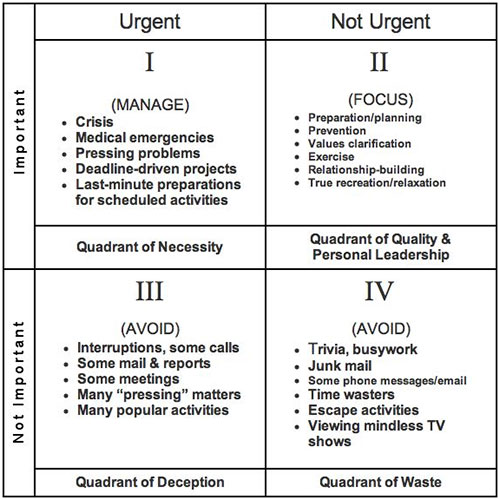
Let’s unpack each of these quadrants.
Quadrant 1 - Important and Urgent - These items are are time-sensitive and valuable. You have to do them. You don’t really have a choice. You want to make sure you leave time in your weekly schedule for these things to come up, because they will. If you have extra space, then you can focus on them without getting behind on other items.
Quadrant 1 example from my life - any kind of major, unexpected, problems that happen on 7 Cups. These require my full attention and cannot be ignored.
Quadrant 2 - Important, but not Urgent - This is where you want to spend most of your time in life. It keeps you on track to live a rewarding and meaningful life. For example, reading this book and working the 7 Cups program is a Quadrant II activity. It is very important that you do these items, but nobody is going to ask you to do them. They do not cry for attention, so it is very easy to continue to push them off and instead focus on more urgent, but less important items.
Quadrant 2 examples from my life - this book, family dinners, regular exercise, 1:1’s, mindfulness.
People that are very effective, have mastery of life, and are happy and productive, spend most of their time in Quadrant II. In keeping with our Marudian metaphor, Quadrant II time helps you become aware so that you do not stay stuck in a zombie-like trance. People that are ineffective spend very little time in Quadrant II.
Quadrant 3 - Not Important, but Urgent - These items are urgent because they are important to someone else, but not important to you. If you do not have a good handle on where you are going or what you are trying to accomplish, then it is very easy for people to slide items into your life that are urgent and important to them, but not at all in line with what you want in life. Emotion is contagious so if they act like it is urgent and important, then you can “catch” that feeling and make time for it. This Quadrant is sometimes called the Quadrant of Deception for this reason.
Quadrant 3 examples from my life - meetings that other people want to have with me, but they are not really important for what I want to accomplish and, often times, they seem important to the other person, but most times they are not.
Quadrant 4 - Not Important and Not Urgent - This is the Quadrant of Wasting Your Life. Sounds brutal, but it is true. This stuff adds nothing to you or the people you love. It just takes from you. You really want to work on minimizing the amount of time you spend in this Quadrant so you can spend more time in Quadrant II.
Quadrant 4 examples from my life - reading tech and political news. I tell myself that this is important and it’ll help me, but I’ve spent hundreds of hours reading this stuff and it hasn’t helped me 99% of the time.
Ideally, you want your time to look like the figure below. The vast majority of your time is in Quadrant II. You also spend a good deal of time in Quadrant I knocking out important items in crises. You spend as little time as possible on activities in Quadrant III, because they do not belong on your life track and, finally, you do not spend any time in Quadrant IV. The distraction systems we discussed in Chapter 2 live in Quadrants III and IV. You can kill them off by spending more time in Quadrant II.
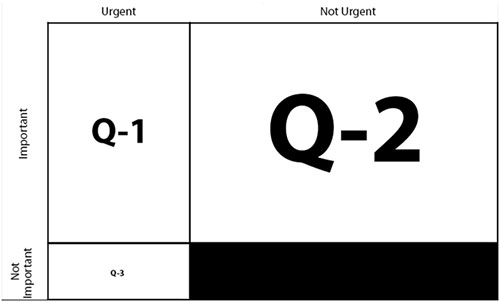
Image credit: http://personalexcellence.co/blog/put-first-things-first/
Big Rocks and Little Rocks
If you are like most people, then you are nodding and agreeing with what I have outlined above. All of that sounds great, but, really, how do you actually make it happen in real life? Fortunately, it is not as challenging as it seems. The Big Rocks and Little Rocks metaphor can help.
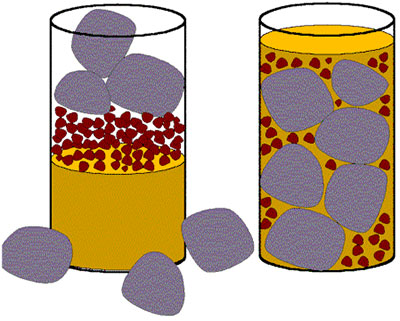
Look at the two jars above. Each jar was initially empty. There were two separate, equal, piles of sand, little rocks, and big rocks. The person that filled the jar on the left started with the sand. Then they put the little rocks in and then finally added the big rocks. The problem with this strategy was that there was not enough space to get all of the big rocks in. That is why you see them outside of the jar.
Now, look at the jar on the right. This person followed a different strategy. First, they put the big rocks in, then they put the little rocks in, and, finally, they poured the sand in. The little rocks and the sand fit around the big rocks. All of the sand, little rocks, and big rocks fit in the jar.
These jars are metaphors for different strategies you can take with your weekly schedule. The big rocks are your Quadrant II items. The really important things in your life like good relationships, planning, and exercise. The little rocks and the sand are the less important items in Quadrants III and IV.
If you look at your weekly schedule, it likely already feels way to full. However, if you take a step back and deliberately plan, you can see that if you start with the big rocks, and then put the little rocks around them, then you end up with enough time in your week to focus on the important things. This strategy, however, requires that you start with the big rocks first.
7 Cups Program
Much of what we have outlined in this book are Quadrant II activities. They are very important, but they are not urgent. Nobody is going to bust through your doors and require you to practice mindfulness. You are not going to get an alarming email that warns you to be thankful. Nobody is going to keep harassing you to get down to the soup kitchen. These are all big rocks. You’ve got to schedule them in if you want to live your life in a deliberate manner.
Now, let’s be real, a program in and of itself is essentially useless. There are thousands of self-help books out there. Many of them have good, proven research to back them up. Unfortunately, nobody bothers to implement what they recommend.
Why?
Because they do not provide rails to guide you and help you through the program. We all need rails to live the good life. We need tracks to keep us moving in the right direction. Like I said, life is like an escalator going down, if you are not taking 2 steps up at a time, then you’ll just find yourself sinking deeper and deeper into zombie -making distraction systems. You will not find yourself ending up where you imagined yourself in the above funeral exercise.
We created 7 Cups to give ourselves and other people rails. The community is comprised of kind, compassionate, and generous people that are working the 7 Cups program. They do this work via the 7 Cups website and apps (iPhone and Android).
Almost everyone starts by sharing what is on their heart (Cup 1). They receive care and and then begin to attune to love (Cup 2). As they notice love in their life, they realize that they can get more of it by deliberately practicing skills to increase calm (Cup 3). The next step involves manually taking care of the body by learning simple exercises to sleep, eat, and exercise well (Cup 4). A more advanced skill involves learning to accept what life brings you - the pain, the problems, and the negative emotions (Cup 5). This makes you stronger. It also increases your compassion and empathy which prepares you to deliberately and consistently care for others (Cup 6). Finally, you stay at it, you keep working the program, you look at your life on a week to week basis to make sure you are on track. You keep adding the big rocks in first. And, you learn to help others do the same (Cup 7).
We know that what we are asking you to do is not easy. We are asking you to continue to live according to your values even when it feels scary, painful or difficult. We believe that you can do it and we also know that you can’t do it alone. None of us can. We don’t want you to do it alone. Not one step. Come join us.
Closing Note
You made it! Thank you for going on this journey with us. I hope that you found this book helpful. We jam packed it with all the insights we’ve learned over the years. When we began, we told you that we believed in you, your life made sense, and that growth was not going to be easy.
We now believe in you even more than we initially did. You now have a map, a compass, and number of tools that will help you on your journey. You are much better prepared to help yourself and others.
Remember, growth is not easy. It is always challenging. It is never a clear, crisp, straight line. I see it as an upward spiral. We face a challenge, resolve it, and then come around to it again. It looks a little bit different, but it is often a very similar challenge.
When we resolve these challenges we are rewarded with a gold nugget - an answer, a new insight, or more courage. Problems help us grow. They make us stronger. We need to learn the discipline of welcoming them into our lives.
The 7 Cups program is designed to help you overcome these challenges and better care for others. We wrote it up so you could learn and apply the material on or off of 7 Cups. You can practice mindfulness and gratitude in your own life or via our apps. You can ask for help by leaning on trusted friends or you can lean on a listener on 7 Cups. You can love someone in your office or online in our community. Just stay focused and keep working the program.
We’ve said a lot in this book, but the most important lesson is that it is very important to care for vulnerable people. It helps them, it helps you, and it makes the world a better place. Authentic self-sacrificial love is especially potent. This is the good stuff, the magic stew. I’ve spent my life looking and I’ve not found anything to be stronger or more effective.
We’ve got to learn to tap into it collectively to solve the real challenges we face. We are doing that now on 7 Cups and it is working. I believe we can do it more effectively and at a much larger scale. If you’d like to join us, then we’d love to have you. We need your help and unique perspective.
Ready?
You can start right now.
Book Description:
This book is designed to transform your life by changing the way you view yourself and the world. It draws on proven research, healing traditions, and what we learned at 7 Cups, the world’s largest emotional support system.
This book will change your life by:
Exposing the truth about how the world actually works.
Helping you understand and break free from the traps that keep you stuck.
Teaching you how and why you, your behaviors, and relationships make sense.
Empowering you to move through worry and fear to the life your heart desires.
Showing you how caring for others connects you to a deeper, stronger, and more nourishing life.
7 Cups for the Searching Soul is a short, but powerful book. It is simple and jam packed with insights. It will take you out of your current life and open the door to a whole new beginning. Read it to now to change your life and the lives of those you love.