The Way of the River: Paddling Together

Hello Community!
We are all on the river of life. We all hit rocks, or challenges, that can be difficult to overcome. And we paddle through those hard times together.
For a long time I've been working on a simple way to describe how we get through hard water here at 7 Cups. Many of you helped shape it through your posts, feedback, and stories over the years.
How this thread works: This is our home base on the river. Read through once, then come back anytime, every week, every day, or whenever you hit a rock, and share the rock you're facing and the paddle stroke you're taking. Jump to the last page to see where everyone is now.
Welcome
You belong here, just as you are.
You don't have to have it figured out. You don't have to be the strong one. You're welcome here because you're hurting, not in spite of it. Everyone here has hit rocks, and that's what makes us a community.
You don't earn your place by doing anything. You already have it. The paddle strokes below aren't a test. They're simply what we do together.
Card
(You can take a screenshot of this or save the image for a reminder)
You belong here, just as you are.
You can't control the river.
You can choose how and when to paddle.
We are paddling alongside you.
Avoided rocks come back. Faced rocks change us.
Name. Say what the rock is.
Reach. Ask for help. Take the rope someone throws you.
Balance. Breathe, rest, let the feeling pass.
Face. Turn toward it. Ask what it might be teaching you.
Act. Take your next paddle stroke.
Let Go. Forgive, and release the outcome.
Give. Paddle alongside someone.
In rough water: Name, Reach, Balance.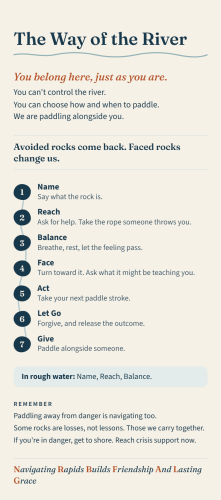
Remember
Paddling away from danger is navigating too.
Some rocks are losses, not lessons. We can carry those together.
If you're in danger, get to shore. Reach crisis support now.
An easy way to remember the strokes
Navigating Rapids Builds Friendship And Lasting Grace
Each first letter is a stroke: Name, Reach, Balance, Face, Act, Let Go, Give.
Anyone who has rafted with others knows it's true: getting through rough water together makes you friends and aware of grace.
The Way
Life brings rocks, and some rivers are rougher than others.
We avoid them. We deny, blame, numb, or thrash.
Avoided rocks come back. We keep hitting the same kinds of rocks until we face them.
Facing rocks, with others beside us, changes us.
Wisdom isn't fewer rocks. It's spending less time on them, and more people we can help.
The Seven Paddle Strokes
Each paddle stroke has something you do, and a way it connects you to others.
1. Name
You: Say what the rock is in plain words. Challenges become a little easier to hold once we can put words to them.
Together: When we name a rock to someone else, we don't have to be alone with it anymore.
2. Reach
You: Ask for help. Take the rope someone throws you. Let someone in. This is the stroke we can come back to again and again.
Together: We heal through relationships before we heal through techniques. Sometimes we need someone simply to listen. Sometimes we need someone to remind us that we're not alone. Choose people who help you feel safe enough to be yourself and face what you're going through.
3. Balance
You: Stay upright in rough water. Breathe. Rest. Give the feeling time to move through you. You're the sky, not the cloud: feelings pass through you, but they aren't all of you. Look after the basics too: sleep, food, movement, and time to recover.
Together: Sometimes we borrow someone else's calm before we can find our own. Sitting beside a calm person can make the river feel a little less rough.
4. Face
You: Notice the rocks you've been trying not to see. Avoiding something isn't a failure; sometimes avoidance is how we survived something difficult. When you feel safe enough, begin to turn toward it. You can ask: What happened? What am I feeling? What do I need now? And, when you're ready: What might this rock be teaching me?
For some people, faith, God, a Higher Power, or a sense that Life can be trusted can be part of this. For others, meaning comes from somewhere else. There is no single way to make sense of what happens to us.
Together: Whatever you believe, you don't have to face the rock alone. We're paddling alongside you.
5. Act
You: Take your next paddle stroke. It doesn't have to be a big one. Maybe you need to solve something practical. Maybe you need to say, "I'm sorry." Maybe you need to set a boundary. Maybe you need to leave a situation that isn't good for you. The paddle is yours.
Together: Others can help you think it through. They can listen, help you see things differently, and cheer you on.
6. Let Go
You: Challenges often stir up old hurts and remind us of difficult past relationships. Forgive the person from your past that this brings up, forgive yourself, and forgive the person in front of you now. Forgiveness doesn't mean removing a boundary or staying somewhere that hurts you. A boundary can come first.
Letting go also means accepting what is, even when it isn't what we wanted, and loosening our grip on how we thought things should turn out. We can't control every bend in the river, but we can trust that, whatever comes next, we can meet it. You'll know you've let go when the old hurt doesn't catch you the way it used to.
Together: Letting go is easier when someone is paddling beside you.
7. Give
You: When you have the strength, paddle alongside someone else. You don't have to fix their problems or tell them where to go. Just be there. Share what the river has taught you when it might help. Listen when they need to be heard.
Together: Paddle with them, not for them. You can help others while still needing help yourself. That's how belonging grows.
How Belonging Grows
You belong from the moment you arrive. But the feeling of belonging usually grows in stages:
Uncertain. "Will I be okay here?"
Safe. "Kindness here is reliable."
Known. "I know names, and people know mine."
At home. "I'm glad I'm here."
Paddling alongside. "I help others find their place here."
Share where you are on the river
This thread is our place to paddle together. Come back anytime.
Rock: What you're facing (one or two lines is plenty)
Paddle Stroke: Which paddle stroke you're taking (Name, Reach, Balance, Face, Act, Let Go, or Give)
Beams/Prayers? Ask if you'd like them
Then reply to at least one other paddler. When you reply, paddle with them, not for them.
Big rocks and small rocks are both welcome. A flat tire counts!
If a rock shifts, reply to your earlier comment and tell us how it went. Add "OK to share" if we can someday share your story anonymously to help others find their way down the river.
I'll go first below!
Navigating rapids builds friendship and lasting grace.
See you on the river!
Stroke: Let Go. 7 Cups has always been bigger than me. We've made it this far with a lot of grace and an amazing community full of smart, caring people who help us solve problems together.
Beams or prayers? Yes, please! I'll take all the beams and prayers!

@GlenM Always sending beams and hoping we keep paddling towards more flourishing
@SoulfullyAButterfly thank you for those beams!

You know what I want as a person sometimes? It's just to talk with someone.
Human, preferably.
♡
@PatienceImpatiens You are at the right place for that!
@PatienceImpatiens this is THE place for that :)

@GlenM rock so it is a big rock but i was recently offered a job with all the apparent positives but a whole lot of hardwork which i dont know where to start with
stroke i have started with baby steps but well, idk how well i am doing but lets see
beams or prayers, please go ahead, i need them
@hermione010 Good luck! We are here paddling with you and will support you as you figure it out
@hermione010 that is great news! what are some of the positives and what is a baby step you are taking? sending beams and prayers!
@GlenM Great post!
Rock: Figuring out a new health challenge
Paddle Stroke: Balance - doing what I can control, with patience
Beams/Prayers? Yes please! Positive energy for the win
@SoulfullyAButterfly i pray you will truly flap your beautiful wings and beat it🤗
@SoulfullyAButterfly i love that you highlighted patience. i think that is a really tough part of this process. we want things to resolve on our timeline and, at least for me, it seems like it almost never works that way. patience is very wise!

@GlenM
The way of the river is a really strong analogy. It captures the reality of life’s challenges in a way that actually makes the journey easier to understand. And what stands out even more is how it’s been simplified further here into something practical.
Breaking it down into clear, actionable paddle strokes makes it feel manageable, not overwhelming. It’s not just an idea, it’s something people can return to and apply in real moments.
What also matters is the emphasis on not doing this alone. A lot of people don’t have the support they need offline, so having a space where you can face things alongside others can make a real difference.
Really appreciate the thought that went into making something this complex feel this clear and usable. Looking forward to seeing how people engage with it and apply it in their own way.
@Hope thank you! yes, this is now version 30 I think! It was just way too complicated before. I very much hope this is the simplicity on the other side of complexity. that we have the distilled or concentrated version here that is simplified and helps. time will tell!