Community /
Site Updates Forum

Info
1,737 Friends
Filter by Topic
"Did You Know?" 7 Cups Facts
"The Way of the River" Series
Ambassador Team Updates
Archives
Book Recommendations - Admin Picks
Community Guidelines
Community Surveys
Events & Discussions
Feature Updates
Glen's Nook - Community
H's Hangout
Hope's Corner
Monthly Community Team Updates
Noni
Questions and Answers
Site Updates - 2019 and Earlier
Site updates and changes
SoulfullyAButterfly's Content Garden
Group chat
Ask questions, get support and make friends
Quick links
About Us
Get Started
Talk to an expert therapist
I am classically trained as a Dialectical Behavioral Therapy (DBT) and...
Talk to Danielle Now
Create a New Thread
Gif
Photo
Link

Filter by Topic
"Did You Know?" 7 Cups Facts "The Way of the River" Series Ambassador Team Updates Archives Book Recommendations - Admin Picks Community Guidelines Community Surveys Events & Discussions Feature Updates Glen's Nook - Community H's Hangout Hope's Corner Monthly Community Team Updates Noni Questions and Answers Site Updates - 2019 and Earlier Site updates and changes SoulfullyAButterfly's Content Garden
Forum Guideline Refresher: Listener Boundaries & Utilizing Member Accounts
by Heather225
Last post
Monday
Monday

...See more
Whether you are new to the community or a seasoned Listener, it’s always good to refresh ourselves on the guidelines that keep our platform safe. One topic that comes up often is Listener Boundaries (specifically Forum Guideline 7) and knowing when to use a Member account.
The Golden Rule: Maintain the Listener Role
When you are logged into your Listener account, your primary focus should be on giving support. If you are going through a tough time, need to vent, or are looking for emotional support for your own personal struggles, please switch over to your Member account.
This ensures that anyone reaching out to a Listener is connecting with someone who is currently in the right headspace to help.
-------------------------
Relating vs. Seeking Support
It is totally natural to want to connect, but there is a clear line between empathizing with someone and accidentally reversing roles:
* Okay (Relating): Briefly mentioning a past experience to validate a Member's feelings and show them they aren't alone. (e.g., "I hear you. When I dealt with anxiety, I felt really overwhelmed too.")
* Not Okay (Seeking Support): Sharing your current struggles in a way that shifts the focus to you, which puts the Member in the uncomfortable position of having to comfort you.
-------------------------
Keep Your Accounts Separate
To protect everyone's boundaries, 7 Cups requires your Listener and Member identities to remain completely separate.
* Please do not link your two accounts in your bio or username.
* Avoid announcing, "I'm going to switch to my Member account now." Just log out and log back in!
* Keeping these separate stops lines from blurring and prevents Members from feeling obligated to support a Listener they previously confided in.
Listener Boundaries are enforced in Forum rule #7: "Users are expected to maintain a listener role if on a listener account. This includes not seeking emotional or personal support and following the expectations of a listener outlined in active listening. Please switch to a member account if necessary." Please note that violations of this guideline result in post removal.
-------------------------
What About Listener Support?
If you had a heavy chat and need to decompress about your listening experience, that is what Listener-only spaces, such as the Listener Support Room [https://www.7cups.com/chat/?c=2_2b554a18cf379d85bN8W7-fzi03rI51eauafmg], Peer Supporters [https://docs.google.com/forms/d/e/1FAIpQLSc2yFIiL6az6UEOc5LNqOOERpM7D0g8F49x0qjbIq7QwhJOBQ/viewform], and Mentors [https://www.7cups.com/listener/training/mentors/]are for! However, if you need to talk about your own real-life problems, please log into your Member account to get the dedicated support you deserve.
Taking care of your own mental health is just as important as being there for others. By keeping these boundaries clear, we keep the community safe, organized, and supportive for everyone.
Follow us on social media!
by Hope
Last post
Sunday
Sunday
...See more
Hi everyone, I hope you all are well. Did you know you can follow 7 Cups on your favorite social media platforms?
Social media can be a mixed place, on one end we can find accounts/pages related to all of our favorite things but on the other hand, it can make us compare ourselves to others and sometimes interact with less than positive content. On our social media accounts, we share positive content focusing on inspirational quotes, the great things happening in our community, and what's up in the mental health world with a little fun in between. Our aim is to provide you with content that is good for your mental health.
Following 7Cups social media accounts not only makes a positive impact on your feed, but it also helps us reach more people. More people can know about our platform and can benefit from our mission. That's quite a win, win if you ask me!
To acknowledge and show our appreciation for the support you show you and us! Everyone who follows the following social media accounts will receive the ‘Super Supporter badge'
Instagram - @7Cups [https://www.instagram.com/7cups/]
Twitter - @7Cups [https://twitter.com/7cups] & @7CupsTeen [https://twitter.com/7CupsTeen]
Facebook - 7CupsOfTea [https://www.facebook.com/7CupsOfTea/]
Youtube - 7 Cups of Tea [https://www.youtube.com/channel/UCYsco2bYgzQzUsLnaO899Qg]
LinkedIn - 7-cups [https://www.linkedin.com/company/7-cups]
You can also follow 7 Cups Academy on LinkedIn! 7-cups-academy [https://www.linkedin.com/company/7-cups-academy/]
Step 1) Hit follow! (We understand that not everyone has accounts on all social media platforms so you can follow the ones that you have accounts on)
Step 2) Reply to this thread and let us know that you have followed us!
7 Cups for the searching soul book - Read and review to get a badge!
by Hope
Last post
September 2nd
September 2nd
...See more
Hi everyone, I hope you are doing well. Some of you may be aware that we have our very own book! It's called the 7 Cups for the searching soul. There is even a training /self-help guide based on the same book. The book focuses on helping you understand your behavior better, provide you with tips and tricks to grow as a person, and provides in-depth information about how our platforms can support you with your journey of growth.
We encourage everyone to read the book and reflect on its contents. The admin team and I have read the book and we have really enjoyed the overall experience.
You can download your copy of the book on Amazon for free here [https://www.amazon.com/7-Cups-Searching-Soul-7Cups-ebook/dp/B01BFWMCXY]
* Please note that the book is available in the following Amazon marketplaces: United States, United Kingdom, Canada, India, Mexico, Brazil, Germany, Japan, Spain, France, Italy, Australia, and the Netherlands.
Don't see your country listed? We've got you covered! Please find PDF and MOBI versions here [https://www.smashwords.com/books/view/611898].
To get the Soul Searcher badge please follow the following steps:
Download the e-book from Amazon (if your country provides it) or use the second link and read it.
Leave us a review on Amazon [https://www.amazon.com/7-Cups-Searching-Soul-7Cups-ebook/dp/B01BFWMCXY] or Good reads [https://www.goodreads.com/book/show/28930126-7-cups-for-the-searching-soul?from_search=true&from_srp=true&qid=465CcxbNjk&rank=1].
Respond to this thread, let us know you did step 1 & 2 and tell us what were your favourite bits!
We will appreciate your support in downloading and reviewing the book as more downloads/reviews help us reach and support more people.
Sexual Feelings and Sexx Chat
by GlenM
Last post
Sunday
Sunday
...See more
People come to 7 Cups looking for support for a variety of reasons. Sometimes, people need help with genuine sexual challenges (premature ejaculation, pain during intercourse, sexual addictions, fetishes, women
3 Key Things!
by GlenM
Last post
August 18th
August 18th
...See more
Please post here 3 key things you have done to help move 7 Cups forward. I will be doing this on a daily basis. Feel free to do it daily, weekly, or monthly. Right now we've got thousands of people doing a lot of work on the site, but we don't have a clear way of being able to support one another. The goal of this thread is to help all of us see all the good work that is going on. Please ask any questions or share thoughts!
Sustainability VI: Back 7 Cups
by GlenM
Last post
August 3rd
August 3rd
...See more
Dear Community,
I hope you all are well.
Soon you'll be able to back 7 Cups directly, through monthly or one-time contributions. You'll see a "Back Us" button in the top menu. You can also find it here: http://7cups.com/back-us/ [http://7cups.com/back-us/]. Guests, members, and listeners can all take part.
For a long time I wasn't very transparent about what it costs to run 7 Cups. More recently I've started to open up: it's expensive, and revenue is a real and ongoing challenge. When I've shared that, many of you responded the same way - how can we help? This is the answer.
We've built 7 Cups together, brick by brick. Everyone here has their own square on the sphere. It has never been my project that you volunteer for - it is a community we own in common, and it runs on something that can't be bought or sold: people showing up for each other because they choose to. That's exactly why we're asking you to back it rather than charge for it. Backing is the only model that fits what we actually are.
If 7 Cups has been a place where you found support, or found a self you didn't know you had, or found people who mattered to you, then this is a way to help keep your square, and everyone's, standing.
Cris worked hard on the icon: a beating heart, with colors that shift over time and it follow you around the site.
Please let me know what you think. I’m happy to hear thoughts, questions, and concerns. Thank you for considering it, and thank you for building 7 Cups with me.
Best,
GlenM
Time Management
by GlenM
Last post
August 3rd
August 3rd
...See more
Time Management
One helpful tool for life management comes from the book First Things First (Merill, Merill, & Covey, 1999). These authors came up with a very simple matrix that shows how life management can be understood by looking at it through 4 different quadrants based on importance and urgency. Let�s discuss each of these quadrants.
Quadrant 1 - Important and Urgent - These items are time-sensitive and valuable. You have to do them. You don�t really have a choice. You want to make sure you leave time in your weekly schedule for these things to come up, because they will. If you have extra space, then you can focus on them without getting behind on other items.
Quadrant 1 example from my life - any kind of major, unexpected, problems that happen on 7 Cups. These require my full attention and cannot be ignored.
Quadrant 2 - Important, but not Urgent - This is where you want to spend most of your time in life. It keeps you on track to live a rewarding and meaningful life. For example, reading and actually thinking about this guide is a Quadrant II activity. It is very important that you do these items, but nobody is going to ask you to do them. They do not cry for attention, so it is very easy to continue to push them off and instead focus on more urgent, but less important items.
Quadrant 2 examples from my life – prioritizing problems, mapping out a plan to solve them, regular exercise, 1:1�s, mindfulness.
People that are very effective at 7 Cups, have mastery of life, and are happy and productive, spend most of their time in Quadrant II. People that are ineffective spend very little time in Quadrant II.
Quadrant 3 - Not Important, but Urgent - These items are urgent because they are important to someone else, but not important to you or the problems you are trying to solve. If you do not have a good handle on where you are going or what you are trying to accomplish, then it is very easy for people to slide items into your life that are urgent and important to them, but not at all in line with what you want in life. Emotion is contagious so if they act like it is urgent and important, then you can �catch� that feeling and make time for it. This Quadrant is sometimes called the Quadrant of Deception for this reason.
Quadrant 3 examples from my life - outside meetings that other people want to have with me, but they are not really important for what I want to accomplish and, often times, they seem important to the other person, but most times they are not.
Quadrant 4 - Not Important and Not Urgent - This is the Quadrant of Wasting Your Life. Sounds brutal, but it is true. This stuff adds nothing to you or the people you love. It just takes from you. You really want to work on minimizing the amount of time you spend in this Quadrant so you can spend more time in Quadrant II.
Quadrant 4 examples from my life - reading tech and political news. I tell myself that this is important and it�ll help me, but I�ve spent hundreds of hours reading this stuff and it hasn�t helped me 99% of the time.
Ideally, you want your time to look like the figure below. The vast majority of your time is in Quadrant II. You also spend a good deal of time in Quadrant I knocking out important items in crises. You spend as little time as possible on activities in Quadrant III, because they do not belong on your life track and, finally, you do not spend any time in Quadrant IV. The distraction systems we discussed in Chapter 2 live in Quadrants III and IV. You can kill them off by spending more time in Quadrant II.
Big Rocks and Little Rocks
If you are like most people, then you are nodding and agreeing with what is outlined above. All of that sounds great, but, really, how do you actually make it happen in real life and in your work at 7 Cups? Fortunately, it is not as challenging as it seems. The Big Rocks and Little Rocks metaphor can help. were two separate, equal, piles of sand, little rocks, and big rocks. The person that filled the jar on the left started with the sand. Then they put the little rocks in and then finally added the big rocks. The problem with this strategy was that there was not enough space to get all of the big rocks in. That is why you see them outside of the jar.
Now, look at the jar on the right. This person followed a different strategy. First, they put the big rocks in, then they put the little rocks in, and, finally, they poured the sand in. The little rocks and the sand fit around the big rocks. All of the sand, little rocks, and big rocks fit in the jar.
These jars are metaphors for different strategies you can take with your weekly schedule. The big rocks are your Quadrant II items. The really important things in your life like good relationships, planning, problem-solving, and exercise. The little rocks and the sand are the less important items in Quadrants III and IV.
If you look at your weekly schedule, it likely already feels way too full. However, if you take a step back and deliberately plan, you can see that if you start with the big rocks, and then put the little rocks around them, then you end up with enough time in your week to focus on the important things. This strategy, however, requires that you start with the big rocks first.
Short Helpful Videos!
by GlenM
Last post
July 26th
July 26th
...See more
Dear Community,
I hope all is well!
I've been working with you all on the Way of the River [https://www.7cups.com/forum/wayoftheriver/] teaching and community. I was asked to do a retreat for crisis counselors. I took all of my 7 cups posts and the Way of the River series came out of that. This was about a year or more ago.
I finally was able to carve out time to work on a video for Part I: Navigating Your Own Kayak: How to Paddle through Calm and Rapid Waters. You can find the video here: https://www.youtube.com/watch?v=FClfVJD1gGk.
I've shared this video with some family members, friends, leaders, and folks on the team. At present, the feedback has been a little mixed. It was my first crack at it so I know I need to do a fair amount of iteration to get it to a good spot.
@annasilverberg gave me feedback on the forgiveness section. I'm going to update it with their feedback.
I think, overall, I may need to do a handful of videos instead of one long one that is 22 minutes. The long one still works for our community, but it should likely be complemented with smaller versions like 1, 3, 5 minutes long. You'll notice that the videos have chapters. Those are more or less the segments.
We want these shorter videos to help people on 7 Cups and off of 7 Cups. Imagine you are a person going through a hard time and you come across one of these videos. The goal is that you'll get a new insight or way of seeing the situation that is useful and helps you. The secondary goal is that you'll come to 7 Cups and get help by talking with a listener about whatever is on your mind.
The ask I'm making of you is to help me figure out which parts or segments are the most useful and helpful. If you were not on 7 Cups, which of these chapters or parts would be the most meaningful and helpful to you?
I'll then tally up the results and create videos - and also update them with any feedback like Anna above - so that we can hopefully help and reach more people. The parts that are the most helpful I'll make first.
Thank you for the help on all of this. I feel a little awkward about doing this, but also think it is necessary and will be helpful.
Part V: Sustainability Update
by GlenM
Last post
July 21st
July 21st
...See more
Dear Community,
I’ve got 4 kids. Part of my job as a father is to help raise my kids so that they can function autonomously in the real world. How do I do that? I care for them and let them “bake” until they are young adults. By bake I mean I want to create an environment where they can mature and develop their strengths as much as possible before launching in the real world.
What does this look like? I cover all costs and provide a rich and nourishing environment to prepare them for college. Then they go to college. I cover tuition for the first 3 years. They cover their last year. For room and board, I cover the first year, but starting sophomore year I cover about 70% of their costs; they have to cover 30% of their rent and food costs by working in the summer and part-time throughout the year.
I do this in a staged manner so that by the time they are in grad school or have graduated they are more or less living on their own and able to cover all of their living costs. I’m of course here to help and have signed on to pay for weddings for my 3 girls and do my best to pitch in during hard times.
In this context, I see 7 Cups as my 5th child. By far, my most expensive child! I have worked hard with the team and community leaders to create a high warmth and high expectations community for the child we are all raising.
And, man, has that kid matured and become smart and strong! When we first started, there were near constant fires. I was running all over the place. It was like having a very big and unwieldy newborn! Over time, 7 Cups went through early childhood, adolescence, and now, finally, it is in early adulthood and getting ready to launch (just like my twins).
We don’t talk about this much, but 7 Cups is big. It is a 99.99% site. That means it is larger than 99.99% of other sites on the Internet. If you lined up people from shortest to tallest. 7 Cups would be at the very tall end of the line and would be 6 feet 7 inches tall. Taller than Michael Jordan, but not quite as tall as Lebron James.
As you might imagine, it is very expensive to run 7 Cups. I won’t get into details, but I can share that it is far more expensive than anything else I have ever done in my life. You might be wondering - yes, that seems obvious - how does 7 Cups make money? At present, we make money in 3 main ways: we sell online therapy, premium accounts and branded versions of the platform to organizations.
Part of my job as the CEO is to make sure we have enough money. Just like I have to make sure my family has enough money. It wouldn’t be great if I said sorry kids we can’t go to the grocery store this week. Over the last 12 years, financing 7 Cups has been the thing that I have worked the hardest at doing. It is also the most challenging thing I’ve done in my life.
It is very difficult for a number of reasons. One, it is just very expensive. Two, we help a lot of people with less financial resources, so not a lot of people can afford therapy or premium accounts. Three, when you sell to an organization it is not uncommon for funding to stop or for other unforeseen challenges to arise. You can see it is like spinning 5 plates at once. I’ve been keeping all of those plates spinning for 12 years.
Like with my twins, it is now time for 7 Cups to start covering more of its own room and board costs. I need 7 Cups to start to generate more of its own revenue. In part, this is because I’m trying to be a good Dad. You don’t want your kids dependent on you forever. There might come a time when I’m not able to provide as much as I want, so it is good for all my kids - including 7 Cups - to be able to function on their own.
This leads me to advertising. I never did advertising on 7 Cups because I was afraid it would negatively impact its cognitive and emotional development. If we started advertising earlier, we would have become dependent on it for revenue. We would have been tempted to grow the population (even if that included folks that were harmful) because we would have wanted more page views to drive more revenue. I didn’t want us to be in that compromised position, especially when 7 Cups was still growing up.
Now, like with my twins, 7 Cups is growing up and becoming stronger and smarter. We are past the place of it being vulnerable. Adding advertising now will not hurt 7 Cups as a developing organism. It will, instead, strengthen 7 Cups because it will begin to function in a more autonomous and independent manner. This will allow for more dedicated progress.
How it has been with us historically is that I go and close a big account. This is great because it provides us with money to help cover costs. We work hard to align big client needs with the needs of the community so that whatever we build is a two for one deal. It helps the client that is paying us AND it helps the community. Sometimes, however, clients want things that don’t have any impact on the community. We have to build these things because they bring in much needed revenue, but they are also a distraction from our core mission of building a free, global, mental health system.
Continuous revenue from advertising will enable us the freedom to focus more on our mission and expand outreach so much farther than we could. The economy, funding challenges, etc. are extremely difficult to navigate. There is a lot of uncertainty and when you think you can count on something, well, sometimes you cannot and then it is very stressful to find new ways of covering our costs.
We are going to be thoughtful, careful, and smart about how we do this. Most of the advertising will be for guests (people with no account that are just visiting our expert articles or Q and A), but there will also be advertising for members and listeners too. We are going to be very mindful of ethics, privacy, and consent. Ads will be both programmatic and contextual. Programmatic works like most of the advertising on the Internet. You look for shoes and then shoe ads follow you around the Web. Contextual advertising isn't tied to you or your behavior. It instead looks at content on the screen to display ads. If you opt in, then you'll get programmatic ads. If you opt out, then you'll get contextual ads. We will be working on an extra build so that older users can write-in to support (help.7cups.com) to request ads being turned off. This has taken us quite a while to build. It was more complicated than we expected, so we are mostly focused now on getting these ads live. Please share any feedback below.
This is something that we are researching now and consulting with experts on. It will be a bit of a phased rollout. We’ll ask for feedback along the way.
In some ways, this is a big milestone for all of us. The child we’ve been collectively raising - 7 Cups - will start to function in a more independent manner. We’ll have more reliable finances and will be able to make more progress. It’ll be a huge relief for me too. I love 7 Cups, but being primarily responsible for funding it has been a very heavy burden for me to carry. I had more energy and broader shoulders when I was 36. I’ve been through the fire many times now parenting 7 Cups. I’m happy that it will soon not be resting on my own strength and, thankfully, good fortune.
Please let me know if you have any thoughts or questions and I’ll do my best to answer them below.
Best,
GlenM
PS - funding 7 Cups has been something we’ve been working on from the start. If you are interested in the history of 7 Cups and sustainability, then you can read check out the earlier posts linked below:
Part I: Sustainability Update
Part II: Sustainability Update Summer 2016 [https://www.7cups.com/forum/siteupdates/GlensNookCommunity_547/PartIISustainabilityUpdateSummer2016_46497/]
Part III: Transparency
Part IV: 7 Cups is Here to Stay! We are Now Sustainable! [https://www.7cups.com/forum/siteupdates/GlensNookCommunity_547/PartIV7CupsisHeretoStayWeareNowSustainable_57188/]
Does 7 Cups Make Us Wiser?
by GlenM
Last post
July 13th
July 13th
...See more
I deeply enjoyed our birthday celebrations. One thing I like to do during these events is zoom out and try to see the recurring themes that pop up. Kind of like - what is this group of people saying or repeating? How can I better understand what they are communicating?
There were a number of themes that surfaced during our celebrations. One that was surprising to me was the emphasis on 7 Cups helping to make us wise. I had never thought of that before.
Below is a definition of wisdom. If we, collectively, help one another become wise or practice wisdom, then I think that is a wonderful outcome.
Wisdom is the ability to make good judgments and sound decisions by applying accumulated knowledge, insight, and life experience. While knowledge is possessing information, wisdom is knowing when and how to use it for the greater good.
Key Characteristics of Wisdom
* Insight & Discernment: The capacity to see beneath the surface of complex situations and understand their deeper meaning or long-term consequences.
* Application of Experience: Using lessons learned from past mistakes or challenges to guide current actions.
* Prosocial Behavior: Actions directed not just at personal gain, but toward the common good and the benefit of others.
* Emotional Balance: The ability to manage uncertainty, maintain humility, and consider multiple perspective
If 7 Cups has helped you learn to be wise or to better practice wisdom, what parts of the wisdom definition feel the most accurate or resonate more with you?
You Aren’t Broken, You Have a Care Deficit: Introducing the Care Calculator
by GlenM
Last post
June 28th
June 28th
...See more
Hello Community!
A few weeks back I shared a post with you here called "Care is Electricity [https://www.7cups.com/forum/siteupdates/GlensNookCommunity_547/CareisElectricity_381633/]." The idea was simple. After all these years, I've come to believe the most powerful thing in healing isn't technique. It's care. One person actually giving a damn about another. The response from you and others surprised me. Many said something like: "I've always felt this was true, I just never had words for it."
That stuck with me and made me think more about next steps. Because having words for something still doesn't tell you what to do about it.
If you're going through a breakup, or you lost someone, or work is burying you, knowing that care matters doesn't tell you how much you need, whether you're getting enough, or where to go find more.
We've got tools for everything else. You want to know if you can afford a house, there's a mortgage calculator. If you are trying to track your health you can look at your blood pressure, or measure your BMI index. If you want to know how much stress you're under, there's the Holmes-Rahe stress inventory, which has been around since 1967. It adds up your big life events and tells you how much strain you're carrying.
But Holmes-Rahe always stops in a strange place. You take it, you add up your number, and it basically says "yes, you're under a lot, good luck." Nobody ever built the other half. You're carrying all this, so how much care do you actually need to get through it? What do you already have? Where are the holes?
We just built that part. We're calling it the Care Calculator.
It's three steps. First you mark what's going on in your life, the same kinds of events Holmes and Rahe named, plus a few they couldn't have seen coming in 1967. Then you map your care. You go through the people and places in your life, your partner, your family, a close friend, a faith community, a support group, a therapist, listeners/groups here on 7 Cups, and you get honest about how often each one really shows up. Not how much they love you in theory. How often care is actually reaching you right now. Then you see two bars next to each other. What you need, and what you have. And whatever space sits in between.
That space is the whole point.
When you can finally see it, something loosens. If you are carrying a huge weight and getting next to nothing back, of course you're wiped out. That's not a flaw in you. It's a gap. And gaps can get filled.
That shift, from "what is wrong with me" to "I don't have enough care right now," might be the most important thing this tool does.
Let me tell you a quick story about why I believe in this. This is just one story of a close friend. We have all seen similar stories happen here on 7 Cups.
Years ago a close friend of mine was deep in addiction. It had swallowed his life. He had people staying with him who were using him, and he'd lost his grip on what was real. His mom went in and pulled him out. I drove back and helped him move, partly on the old recovery wisdom that sometimes you have to get away from the places and people tied to using. It was a long road. There were stretches where I wasn't sure he'd make it.
But he came back, slowly. And when I look at what actually carried him, it was never one thing. There was a psychiatrist. There was therapy. There were NA meetings. There was his family, and a faith group that took him in and held on to him. Today he's working full-time, training to be a substance use counselor, and reaching back for other people stuck in the same hole. I'm about as proud of him as I can be. In my bones, proud!
No single care connection saved my friend. A whole bunch of them, carrying current at the same time, over years, did.
That is the heart of this thing. It counts every source of care as real.
There's a quiet ranking in mental health, where professional therapy sits at the top and everything else gets called "support." Nice to have, but not the real medicine. I don't buy that. I'm not knocking therapy. Good therapists do things a friend or a volunteer can't, and some situations need exactly that kind of help. Therapy belongs on the map. It just isn't the whole map. What decades of research keep showing is that the relationship itself is what heals. The feeling that somebody is in it with you. That's the care current, and it doesn't need a license. It can come from a sister who calls every Sunday, a small group in your faith community, or a stranger on 7 Cups who decided to spend their night listening to you. Nobody needs one perfect source of care. We just need enough of them.
Here is something to keep in mind. A mortgage calculator runs on real math. Care doesn't work like that. The stress side of this leans on decades of research, but the care side is our first honest guess. They're rough numbers meant to help you see your own situation, not some clinical readout. We're putting them out in the open on purpose, and we're asking researchers who study this to help us sharpen them. Treat it as a mirror or a reflection tool, not a verdict.
And if it shows you a big gap, don't panic. Instead, look honestly at where more care could come from. Sometimes it's already around you and people just don't know how hard things have become for you. A lot of folks want to show up, they only need to be let in. Sometimes it's a support group, or a faith community, or a listener who's walked your road. And sometimes the load is heavy enough that you need a professional, and that's okay too. If you're in real danger or thinking about hurting yourself, please reach out to a crisis line or emergency services right now [http://7cups.com/crisis]. A calculator isn't the place for that.
Here's what thirteen years with this community has taught me. Nobody should have to struggle or white-knuckle their way through the hardest parts of life alone. But people do it every single day, not because the care isn't out there, but because they can't see what they need or where to find it. They sit in the dark blaming themselves when the real problem is just that not enough care electricity is coming through.
This won't fix all of that on its own. It's an early version, and the numbers still need real research behind them. But if it helps even one person stop asking "what's wrong with me" and start asking "where can I find more care," that's enough for me.
I'd love for you to try it and tell me what feels right and what feels off. You all are the reason it exists, and your read on it matters to me. Not everything we try and do here works. We keep trying. This is another attempt. If it has value for you and helps, then please let us know. If you have recommendations on how to make it stronger, then please share those as well. And a big shout out to @AnnaSilverberg [https://www.7cups.com/@annasilverberg] and @InternalAcceptance [https://www.7cups.com/@InternalAcceptance] [https://www.7cups.com/@InternalAcceptance]for specific feedback and help on this post and calculator!
You can find it here: 7cups.com/care-calculator [http://7cups.com/care-calculator]
Measuring the Care Alliance
by GlenM
Last post
June 16th
June 16th
...See more
Hello Crew!
I shared a post called “Care is Electricity [https://www.7cups.com/forum/siteupdates/GlensNookCommunity_547/CareisElectricity_381633/]” a couple of weeks ago. The gist is that caring for another person is therapeutic - it brings healing to them.
In the clinical world, therapists use a tool called the Session Rating Scale [https://greenspacehealth.com/en-us/session-rating-scale-srs/] to measure this connection. It turns out, this tool is the single best predictor of what helps a person get better. A researcher actually did a study [https://pubmed.ncbi.nlm.nih.gov/26485198/] (worth reading) looking at listener therapeutic alliance levels right here on 7 Cups and found they were on par with professional therapist levels! I write more about this in the Care is Electricity [https://www.7cups.com/forum/siteupdates/GlensNookCommunity_547/CareisElectricity_381633/] post.
Starting tomorrow, we will begin using the Session Rating Scales in member and listener (1:1) conversations. You can read more about how the scale works here [https://greenspacehealth.com/en-us/session-rating-scale-srs/].
How it Works:
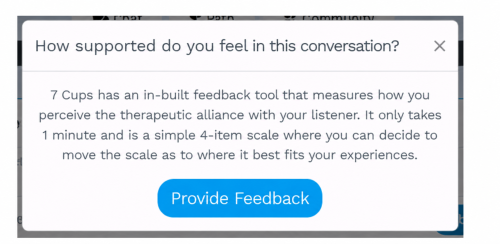
At 30 messages from the member, and then again at 100 message intervals (if it has been at least 7 days since the 30-message mark), members will see a modal that looks like this:
After the rating is submitted, both the member and the listener will see the results in their chat.
If you get a low score, remember: it is just data. It is not a grade, and it does not mean you failed as a listener in that conversation. It is simply a way for the member to let you know, in a less direct way, that they don’t feel quite understood yet. Mistakes are how we grow, so there is nothing to be ashamed of (check out my post: “We Are Not Our Mistakes [https://www.7cups.com/forum/siteupdates/GlensNookCommunity_547/WeAreNotOurMistakes_259257/]”). You also have to take these ratings with a grain of salt. External factors can influence a survey - sometimes a member is just having an incredibly overwhelming day, or they may not have the words to explain exactly what felt off. Not every member will be able to give clear, helpful feedback, and that is okay. The goal is to stay open to what you can learn without taking every score personally.
What do you do if you get a low score? (Adapted from here [https://www.supanote.ai/blog/session-rating-scale-srs-how-to-use-it-respond-to-feedback])
*
Step 1: Reflect and Thank.
"I notice the score on [item] is lower today. I appreciate you being honest. Can you tell me more about that?"
Stay curious. Stay grounded. Do not defend, over-explain, or debate the number.
*
Step 2: Get One Concrete Example.
Ask for a specific moment that didn't land. If they can't name it, offer gentle options: "Was it the pace? The focus? The depth?" Clarify whether the issue was the content of the chat or the way you were relating to each other.
If the member cannot explain it, you can still respond with care:
“Thank you for letting me know. I’m sorry it didn’t feel quite right today. I’ll keep this in mind and try to be more supportive moving forward.”
*
Step 3: Collaborate on Adjustments.
Offer two small, testable changes moving forward. More structure? Slower pacing? A different focus? Confirm what success would look like for them, and let them know you'll check in on how they're feeling about it later.
*
Step 4: Reflect with Support.
If a low score feels confusing, discouraging, or hard to understand, consider bringing it to a mentor on 7 Cups [https://www.7cups.com/listener/training/mentors/]. A mentor can help you reflect on the conversation, look for possible growth points, and decide what you might try differently next time. You do not have to process the feedback alone.
The therapeutic alliance - or what I’m calling the “Care Alliance” outside of a therapist relationship - happens with friends, family members, educators, and especially right here on 7 Cups!
Measuring this will help us better understand how the Care Alliance unfolds so we can - as individuals and a community - help people grow and heal.
Any and all questions are welcome! Please share below.
Update:
All, update! We just ran the first batch of SRS scores. Drumroll please!
Max score is a 40 (you add all the scores). 36-40 is considered therapeutic levels / therapist parity. Right now, our listeners are scoring a 34.76, which is remarkable! The results will get more solid as more results come in, but this initial sample is significant.
Job well done!!!
Score Averages
Category
Average Score
RELATIONSHIP
8.79
FOCUS
8.67
APPROACH
8.70
OVERALL
8.56
The Gift of Giving
by GlenM
Last post
May 27th
May 27th
...See more
Did you know at one time - a long, long, long, time ago - that listeners could charge on 7 Cups? When we went through YC [https://ycombinator.com], we thought that was going to be how 7 Cups was going to generate revenue to help cover the bills. What happened was that .01% of people charged and 99.9% of listeners did not charge.
Listeners very clearly communicated to us that 7 Cups was to be a 100% volunteer based service. People were going to give of their time out of the goodness of their hearts. They did not want to be compensated. Listeners were committed to freely giving the gift of compassion.
Since that time, listeners have given gifts of compassion - imagine them as little wrapped gift boxes 🎁🎁🎁 - to millions upon millions of people all around the world. We now have 20,000 conversations on 7 Cups a day. That is a lot of gift giving!
Giving a gift feels amazing. Some of you are excellent gift givers. You pay attention. You see what someone needs, and then you give them the gift and they are delighted to receive it because it fills a need they have. The old saying “giving is better than receiving” is true and anyone that has given a gift knows this to be accurate.
On 7 Cups, people come and they ask for help. That is what happens when a general or personal request is made. That request is an ask - it is an indication of a need to connect, a need to be heard, a need to be understood, a need to be seen, a need to be validated, a need to feel less alone. Our listeners pick up these chats, they answer those requests, and when they do, they give a gift to our members. A gift of listening.
Think about that space between a member and a listener. The request is sent out from our app on a phone on one side of the planet. The listener, on the other side of the world, sees the username and the issue and selects them. They connect - strangers that do not know one another - and they start talking. The member begins to open up and shares some of what is causing them pain. The listener paraphrases, tries to see the world through their eyes, and says this back to the member in their own words. In that space between, something remarkable happens, the listener gives the gift of compassion - out of the goodness of their own heart - and the person feels loved, understood, and cared for.
That is a beautiful, beautiful, beautiful, and remarkable thing.
Fast forward to February 2021. I finally - after years and years of trying to understand what we are doing on 7 Cups - see 7 Cups as an ecosystem [https://youtu.be/pRBZVZehiL0]. I share this idea with a friend, a medical anthropologist, and he says, “Glen, this is a system of reciprocity or what Marcel Mauss calls a gift economy [https://en.wikipedia.org/wiki/The_Gift_(essay)].” I have never heard of this before and immediately I’m excited to learn that 7 Cups can be understood through another lens that I cannot yet see through.
I do all this research on Mauss, gift economies/exchanges, and consult with my friend to better understand what we are doing. Long story short, with zero planning or deliberate building, we have accidentally recreated an ancient pattern called a gift economy where social bonds and connections are primary. Where this gift of compassion is shared from leaders to listeners and listeners to members and members to other members, listeners, and people in their life. On any given day, we have tens of thousands of compassion gifts circulating around the 7 Cups community. A good conversation, a WTG in a sharing circle, a shout out, a spotlight - all of these are gifts going round and round 7 Cups.
One interesting thing about the Kula tribe [https://en.wikipedia.org/wiki/Kula_ring] and their conception of a gift is that it becomes heavier or more valuable as it passes from one person to the next. Imagine our gift boxes of compassion circulating. Someone sends a gift to me about how awesome a listener or mentor is. I hear this and send it over to the community management team - hey I just received this message and think this person is great. They then send it over to the mentor and say hey great job! And so on. That gift of compassion becomes heavier with each person it touches. It becomes more meaningful.
7 Cups differ from the Kula tribe and ancient societies in a number of ways. We are based on the Internet, so we have unintentionally layered on a digital approach to gift economies. Also, if you watch that ecosystem video [https://www.youtube.com/watch?v=pRBZVZehiL0&ab_channel=7CupsofTea], then you’ll see that each party gets something and each party gives something naturally.
I wanted to share this gift economy model with you, because when I learned of it I was struck by its significance and how much more substantial it makes our work. Like someone in the desert sweeping off the top of a pyramid and then seeing the rest of it under the sand. We, collectively, have swept off an ancient - and beautiful - pattern of relating to one another.
We give gifts to one another on 7 Cups. It is a beautiful practice. Beautiful isn’t the right word. It is more than that.
Thank you listeners for being the first gift givers. Thank you for giving to me and many others millions of times. Thank you or helping us rediscover things we have forgotten.
A couple of questions to consider:
When you read the above (or watch the videos or read the links), what stands out to you about 7 Cups and gift giving?
How can we strengthen our gift economy even more? (I’ll share more on this in another post and weave in comments from this thread).
With gratitude,
Glen
Care is Electricity
by GlenM
Last post
May 19th
May 19th
...See more
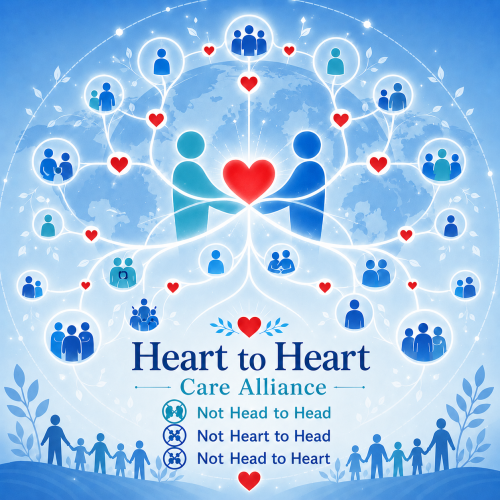
When I care for someone, I imagine a heart-to-heart connection with them. It’s like a live wire or cord connects my heart to theirs. Care is electricity. When we are loved and connected, we are getting charged up by others. I send them care, compassion, and love through this current.
This looks like me checking up on them, being interested in their life, and following how things are unfolding. Sometimes it includes giving more direct feedback. But most of the time, it simply consists of providing a high-warmth environment for them and truly listening.
When I was a child, I could see how simple care transforms lives.
My mother did in-home daycare throughout my childhood and adolescence. She cared for six kids alongside my sister and me. For most of that time, she cared for kids and families with fewer financial resources - parents who were actively struggling with addiction, loss, and deep pain. When these parents stopped by to pick up their kids in the afternoon, they’d sometimes stay for 30 minutes or even an hour. My mother was attentive. She simply cared for them. Sitting in that basement room, I watched people eventually begin to heal and recover. They were plugging in and getting their batteries recharged.
I’ve been involved in human service roles my entire life. I’ve cared for people struggling with addiction, people facing homelessness, and people starting over after hospitalization. I’ve worked in cities where kids were swept up in gangs and given up on. I taught some of these kids how to skateboard and played basketball with them. I enjoyed their company and loved being competitive with them.
Sometimes, "hanging out" is the most therapeutic thing you can do. You are generating a shared charge. I made sure they knew I saw them, and I never gave up on them. A lot of those kids healed, got on the right track, and have updated me over the years to let me know they are okay. I am proud of them.
I’ve seen it in my own family, too. When relatives have been in tough jams, the connection from my heart to theirs was flooded with a high-voltage current of hope, compassion, and prayers. Other family members connected their wires to them as well, sending a collective surge of support. Eventually, they made it to the other side. They healed.
Over time, I started realizing something important: people often heal through relationships before they heal through techniques. Being deeply seen, consistently cared for, and not abandoned during hard moments changes people. Sometimes the most transformative thing isn’t advice or intervention. It’s the experience of another human being sincerely staying connected to you.
The Science of the Heart-to-Heart Connection
In clinical psychology, the most important driver of successful therapy is something called the “therapeutic alliance.” The gist of it is simple: the client feels like the therapist likes them, understands them, and is genuinely on their team.
Carl Rogers, one of the founders of humanistic psychology, captured this perfectly:
“In my early professional years, I was asking the question, How can I treat, or cure, or change this person? Now I would phrase the question in this way: How can I provide a relationship which this person may use for his own personal growth?”
For all of you in our community, you’ll be familiar with this idea as it is core to active listening and the emotional support relationships we all form on 7 Cups. In fact, way back in 2015, a study [https://pubmed.ncbi.nlm.nih.gov/26485198/] was done looking at how 7 Cups listeners established a therapeutic alliance with members. A summary of the results follows:
Results: Overall, the ratings of the sessions were high. Most participants who indicated that they received psychotherapy indicated that the service provided by the free emotional support program is equal or better than psychotherapy. Relating to psychotherapy and online emotional support advantages, different advantages were found. The findings suggest that receiving support from volunteers makes users feel that the support is more genuine, citing more personal and sincere caring because listeners aren't just doing a job.
Authenticity Matters
We have also measured therapeutic alliance levels with our AI, Noni. People rate her high, but they still prefer to talk to another human being.
Why is that?
I think it is because we need to know that we matter to someone else. We want to feel that care flowing from a person who is actively choosing to give us their time. Carl Rogers knew that genuineness matters. You know when a person truly likes you, and you know when they are just acting the part.
I was talking with Cris about this today, and he mentioned a study involving phone calls. The researchers found that the person on the other end of the line just knew when the speaker was genuinely smiling, even without seeing their face. True care is felt and experienced differently. It carries a real electric charge you can't fake.
The 7 Cups Electric Field
This breaks care entirely out of the mental health infrastructure box. Humans are fundamentally electric. You can get that electricity from anyone - friends, family, or even the shared collective energy of a group.
Forced solation, being "in the hole," or deep loneliness is the removal of that charge. It is another way of saying, I am not getting a charge from another person. My battery is draining out.
7 Cups is an electric field where people come to get charged up. A person comes to the site looking for support. They raise their hand and say, "I am in pain. My battery is low." A listener picks up the chat. They connect a live wire, or cord, from their heart to the member’s heart. They send a current of care. The new member begins to heal. Sometimes, that member joins a group or connects with multiple listeners, receiving currents of care from all over the world. Eventually, their own battery charges up. They cross a threshold, and then they start to pass that current to new people who are raising their hands.
I sometimes imagine this as us all sitting around a warm fire. The new person arrives. We greet them and give them a bowl of hot soup. They are thinking - Wait, is this real? Can I trust and relax here and get help? Time goes by. The next new person arrives. The person that was just unsure welcomes them, invites them to sit by the fire, and gives them a bowl of soup. This happens thousands of times each day.
Tools Run on Power
Care is something we all naturally do for one another. I have a strong hunch that this simple, horizontal care may end up being the most powerful therapeutic ingredient in the world.
The ideal clinical therapist knows how to create a strong alliance and use technical interventions. Think of therapists as having highly specialized power tools to help you. But those tools run on electricity. If there is no electricity - if they don't genuinely like and care for you - then the tools simply will not turn on.
The therapeutic alliance, or the "Care Alliance," as I want to call it when we talk about regular people supporting one another, is the power source. Sometimes, you need technical skills to fix a specific problem. But often, the raw electricity of care is entirely sufficient on its own.
The traditional therapeutic alliance describes the trust and emotional bond between a therapist and client. But I think there’s a broader human version of this that exists outside clinical settings entirely.
A Care Alliance forms anytime someone genuinely feels:
“This person sees me. This person cares about me. This person is with me.”
It can happen between friends, listeners, parents, peers, mentors, spouses, group members, or even strangers during difficult moments. It is not built on credentials or technique first. It is built on authentic emotional presence.
Therapy is one place where this alliance can happen. But human healing relationships are everywhere.
We are going to start measuring this Care Alliance in a more deliberate way on 7 Cups. When a person cares for you, and you know it, there is an extra texture, a raw energy that travels through that bond. True care hits differently.
I think this care is very healing and powerful.
We launched 7 Cups in 2013. We’ve been at it for 13 years. We’ve optimized most of the site and apps to make it easier to use. We’ve added dozens of mindfulness activities, ways to find listeners, groups, self-help guides, etc. You name it, we’ve done it. This has all been done with the goal of helping people heal and recover.
For years, we’ve focused on improving tools, features, activities, and accessibility on 7 Cups. Those things matter. But more and more, I think the next chapter of healing may not be technological optimization. It may be helping people form deeper, more authentic bonds of care with one another.
Here is an image that I think captures how this "heart-to-heart" connection actually works.
I wanted to share these ideas with you all and ask you to help me better understand this care alliance. How does it happen on 7 Cups and in real life? What do you think of the way I’m describing it? What am I missing?
Feel free to share examples, video clips, stories, or ideas. Any and all help is very welcome. Thank you!
Mr. 8 or Life Obstacle Bets (LOB)
by GlenM
Last post
April 21st
April 21st
...See more
Like many of you, I’ve had to overcome a lot of challenges in life. I used to get frustrated with unexpected problems. Normally, they crop up exactly when I don’t want them to. I have 7 challenges to solve and here comes Mr. 8 jumping the line and requiring that I deal with him now. I say to Mr. 8. “Please go back to your place in line and I’ll get to you next week.” He says, “Nope. I’m here now and I’m not going to let you focus on problems 1 and 2 until you solve me.”
As you all know, we believe the problem is the path [https://www.7cups.com/about/culture.php]. That it is good to have a plan, but ultimately life is too complicated so a better idea is to simply solve the next biggest problem in front of you. Then, as you solve the problem, the path before you unfolds.
That means that solving Mr. 8 is likely the best thing to do even if it feels like a detour from my original plan. Over the years, I’ve stubbornly kept focusing on problems 1 and 2 even when Mr. 8 was bugging me. I have a lot of personal data on this. It yields an okay outcome. I also have data on just listening and solving Mr. 8 that is jumping the line. That data yields a much better outcome.
Ultimately, for me, this comes down to trusting the process of life - the river [https://www.7cups.com/forum/siteupdates/GlensNookCommunity_547/TheRiver_296728/] - rather than trusting myself or my own judgment. I can stubbornly hold to my own stance on things and try to force or control things OR I can trust that there is a reason for me to solve Mr. 8.
What this means for me is I have to have a belief that solving Mr. 8 is going to better help me and those I care for (my family, this community etc.). This is what I’ve come to:
Mr. 8 jumping the line has a personalized, tailored, custom lesson for me that I need to learn for optimal growth for myself and those I love. If I solve that problem (Mr. 8), then it’ll be better for me and those around me.
If I stick to my own perspective, and try to control things, then it’ll be less positive for me and those around me.
The concept of "the problem is the path" suggests embracing these challenges as part of the journey (adaptability).
I have come to think of Mr. 8 as a Life Obstacle Bet (LOB). I’m making the bet that solving Mr. 8 will yield better results than solving problems 1 and 2. If I am right, then fantastic. I better help others and myself. I also get to tell myself I’m making optimal progress. If I am wrong, then I’m not sure it matters all that much as I’m still solving a significant challenge that is calling me to focus on it.
The alternative belief is for me to be frustrated with the sometimes seemingly endless stream of Mr. 8 challenges that keep cutting the line. This results in me feeling irritated and frustrated. I feel like I’m not making the progress I want or need to make and I am in a constant place of playing catch up.
What is the Life Obstacle Bets (LOB) Approach?
The LOB approach reframes unexpected problems (Mr. 8) as opportunities for growth (reframing). You bet that solving Mr. 8 will yield better results than rigidly following the plan you originally had (prioritization and decision making). Even if solving Mr. 8 isn't the "optimal" solution, you're still addressing a significant issue (task management).
The LOB position invites the questions, “Hey, why not just believe that this frustrating problem is actually a disguised opportunity? What if this is a tailored challenge to help me and others grow?” If I am right, then life is easier, and I feel better about my progress. If I am wrong, then it doesn’t really matter in the long-run, and I still get to believe that I am taking the optimal path.
Benefits of the LOB Approach:
*
Reduces frustration from seemingly endless disruptions (improved decision making).
*
Encourages viewing challenges as disguised opportunities (positive reframing).
*
Fosters a sense of progress, even when tackling unexpected hurdles (improved task management).
In conclusion, the "Life Obstacle Bet" (LOB) tackles the frustration of unexpected challenges by reframing them as opportunities for growth. By prioritizing the most pressing issues (urgency and importance), and adapting your plan when necessary, the LOB approach fosters a sense of progress and reduces decision fatigue. This flexible and optimistic mindset allows you to effectively manage tasks, prioritize effectively, and ultimately achieve the best outcomes for yourself and those around you.
Discussion Questions:
*
Have you ever had a time when an unexpected problem turned out to be a positive experience? Remember, we can often only see this when we connect the dots looking backwards - like “oh that frustrating challenge was actually a key part of me now having this positive experience”. It only makes sense when we reflect. Similarly, when going through an unexpected frustrating time now, we can say “okay this will likely make more sense in the future just like those other times” now when I look back.
*
What's your biggest challenge with staying organized and managing your tasks?
*
How do you usually deal with feeling frustrated when things don't go according to plan?
Welcome to 7 Cups HQ. This is where all news and updates will be posted by staff and ambassadors, subscribe to stay in the loop!
Community Leaders
Community Mentor Leader

Community Resources
Self Help Guides https://www.7cups.com/supportGuides/selfHelpGuides.php
Feeling stressed? Visit our mindfulness resource center https://www.7cups.com/forum/MindfulnessSupportCommunity_106/ResourceLibrary_1062/
How about joining a discussion about what you find most challenging? Schedule is here: https://www.7cups.com/home/communityCalendar.php
Group Support Chatrooms https://www.7cups.com/connect/groupChatrooms.php
Forums with info on many areas you may be looking for https://www.7cups.com/forum/
Looking for an online therapist? 7cups offers this now, see here: https://www.7cups.com/online-therapy/?ob=1